

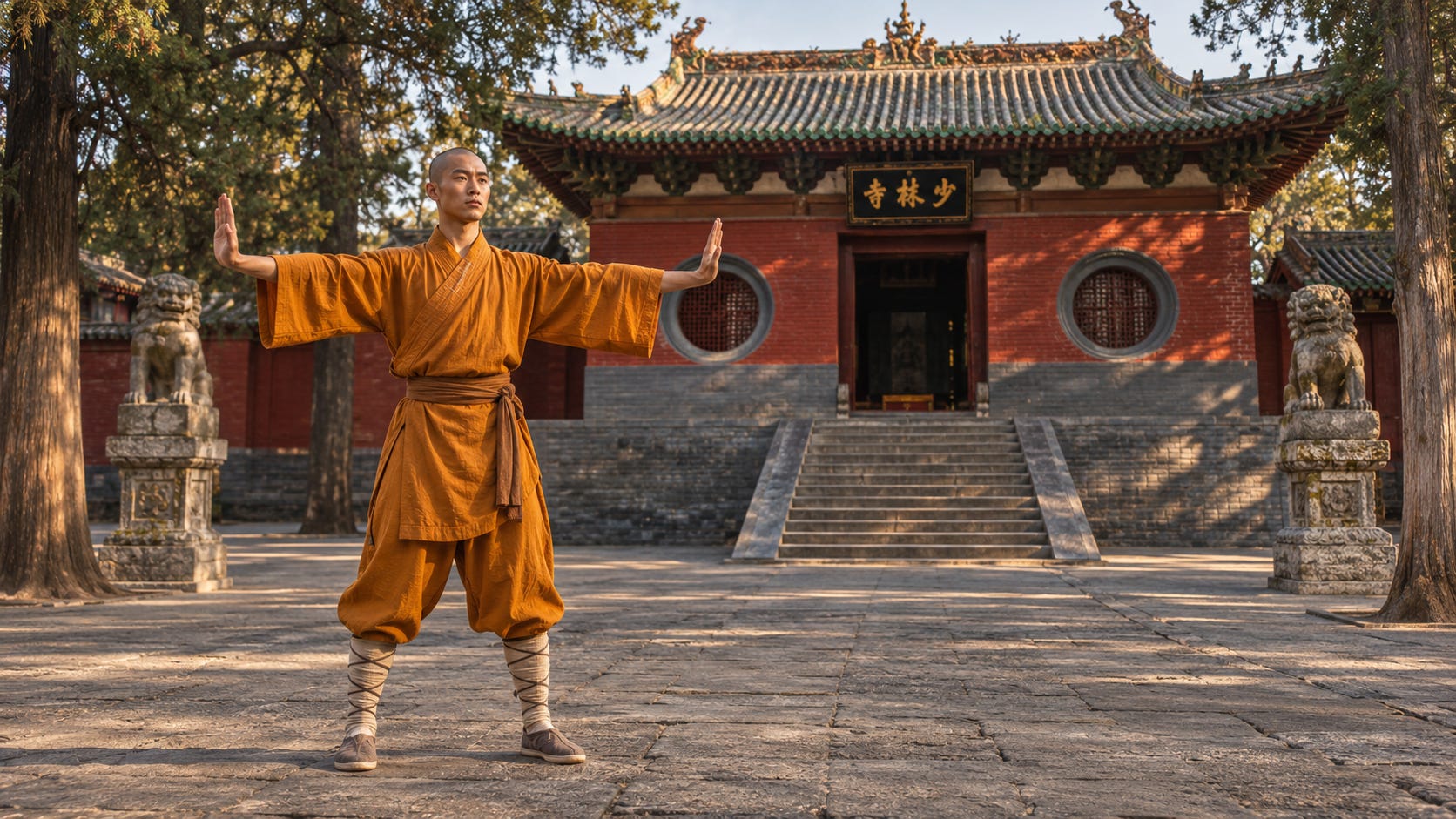
In Yi Jin Jing, lowering a stance or holding the arms in position can turn a familiar exercise into demanding work. The movement may remain slow, and the body may appear almost still, while maintaining the position requires considerable muscular effort. For practitioners, this raises a useful question: how does that effort train the tendons?
In earlier articles on Yi Jin Jing and the science of holding a stance, I explored the relationship between traditional training and connective-tissue adaptation. Here, I want to develop the practical side of that discussion through research on sustained holds, slow resistance exercise, and tendon adaptation.
The research helps explain why a held posture can be useful, how its demands differ from moving against resistance, and why progress depends on more than extending the time on a stopwatch.
What a tendon does under load
Tendons connect muscles to bones and transmit the force that muscles produce. When the calf muscles contract during a heel raise, they pull through the Achilles tendon to lift the heel. When the quadriceps work to maintain a bent-knee position, force passes through the quadriceps tendon and patellar tendon.
These tissues deform under tension. Some tendons also store and return elastic energy during movement. Their mechanical behavior influences how muscular force reaches the skeleton, making tendon properties relevant to both strength and movement.
Researchers often measure tendon stiffness: how much additional force is needed to produce additional elongation. In this context, stiffness describes a mechanical property. It is different from the feeling of being stiff when getting out of a chair. A tendon that becomes mechanically stiffer stretches less under the same force.
That distinction is useful in Qigong teaching. Relaxing the shoulders or reducing unnecessary muscular effort does not require connective tissues to become mechanically softer. Comfortable movement and a tendon’s ability to resist elongation describe different aspects of function.
Enough load to produce a change
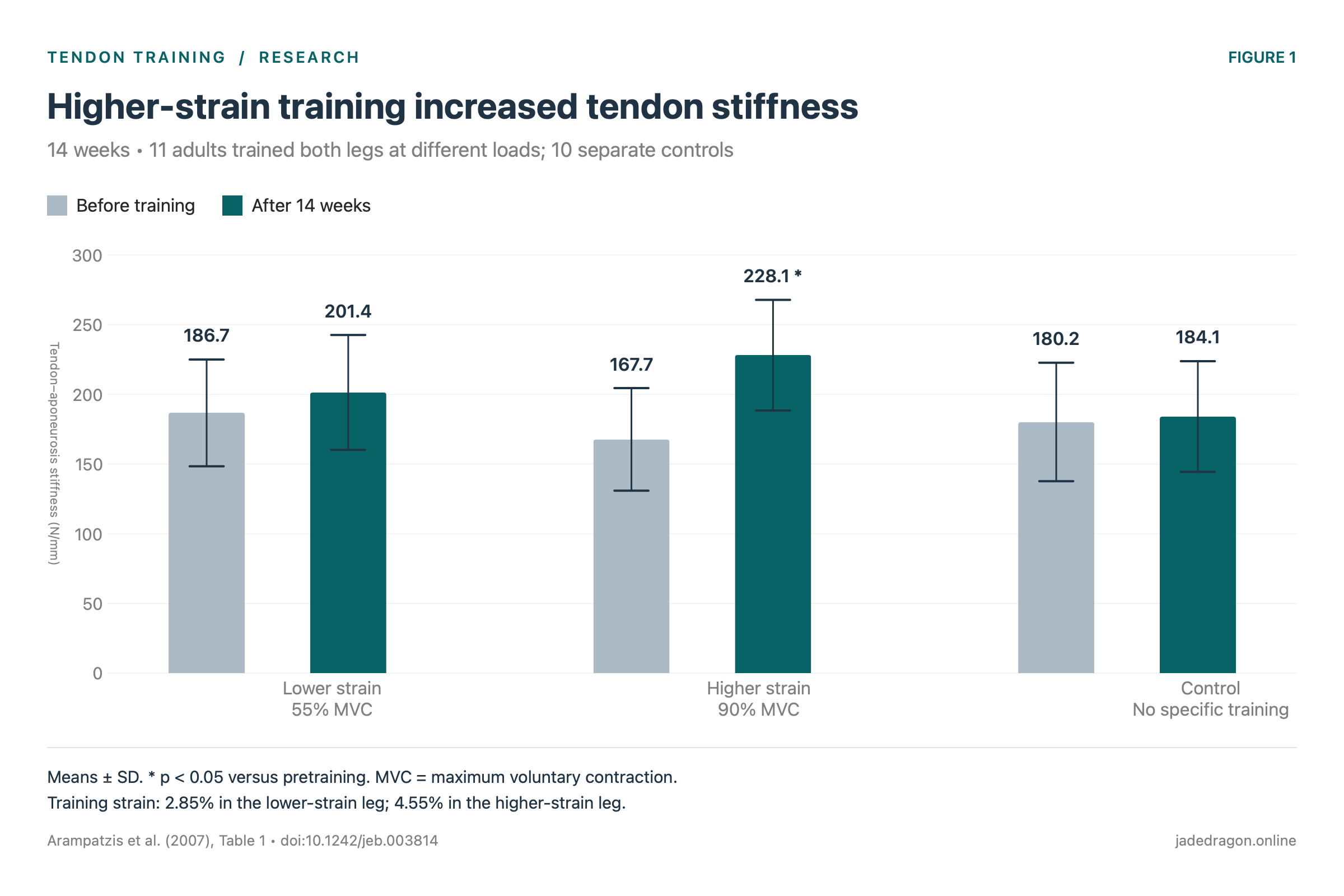
A revealing study by Arampatzis and colleagues compared two loading conditions within the same people. Eleven participants trained one leg with lower Achilles tendon strain and the other with higher strain, using similar training frequency and volume. Ten additional participants served as controls.
Strain means the amount a tendon lengthens relative to its starting length. The average training strains were approximately 2.9 percent and 4.6 percent. After 14 weeks, increased tendon-aponeurosis stiffness, improved material stiffness, and regional tendon enlargement appeared only in the higher-strain leg.
The practical lesson concerns the amount of loading. Repeating an exercise consistently is valuable, but the exercise must also provide enough stimulus for the adaptation being sought.
For Yi Jin Jing teachers, this suggests examining what a posture actually asks the student to do. A shallow stance and a deeper stance place different demands on the legs. Supporting some body weight with the hands changes those demands again. These are practical ways to adjust effort, although laboratory-measured strain percentages cannot be estimated from appearance or sensation alone.
Holding a position and pushing against resistance
An isometric exercise involves producing muscular force while keeping a joint position substantially unchanged. There are two useful ways to approach it. You can resist a load that would otherwise move you, as when maintaining a squat, or push against an object that does not move.
These are often called holding (or yielding) isometrics and pushing (or overcoming) isometrics. A held stance resembles the first. Pressing against an immovable support resembles the second.
A 2026 trial by Lum and colleagues compared these methods in ten adults, assigning one leg to each condition. Participants completed six weeks of knee-extension training at 70 percent of maximum voluntary force, using 20-second contractions.
Both conditions improved isometric strength. The holding condition produced greater increases in some muscle-thickness measures, and only that condition showed a statistically significant increase in patellar tendon thickness. The tendon effect was small, and thickness is a different measurement from stiffness or load capacity.
For traditional practice, the study gives a reason to examine how a posture is performed. Holding against gravity and deliberately pressing against resistance involve different tasks, even when both look still.
What the lighter-load research found
A 2024 study by Gilmore and colleagues, including exercise physiologist Keith Baar, examined lighter-load isometric training using records from rock climbers who logged their training in the Crimpd app.
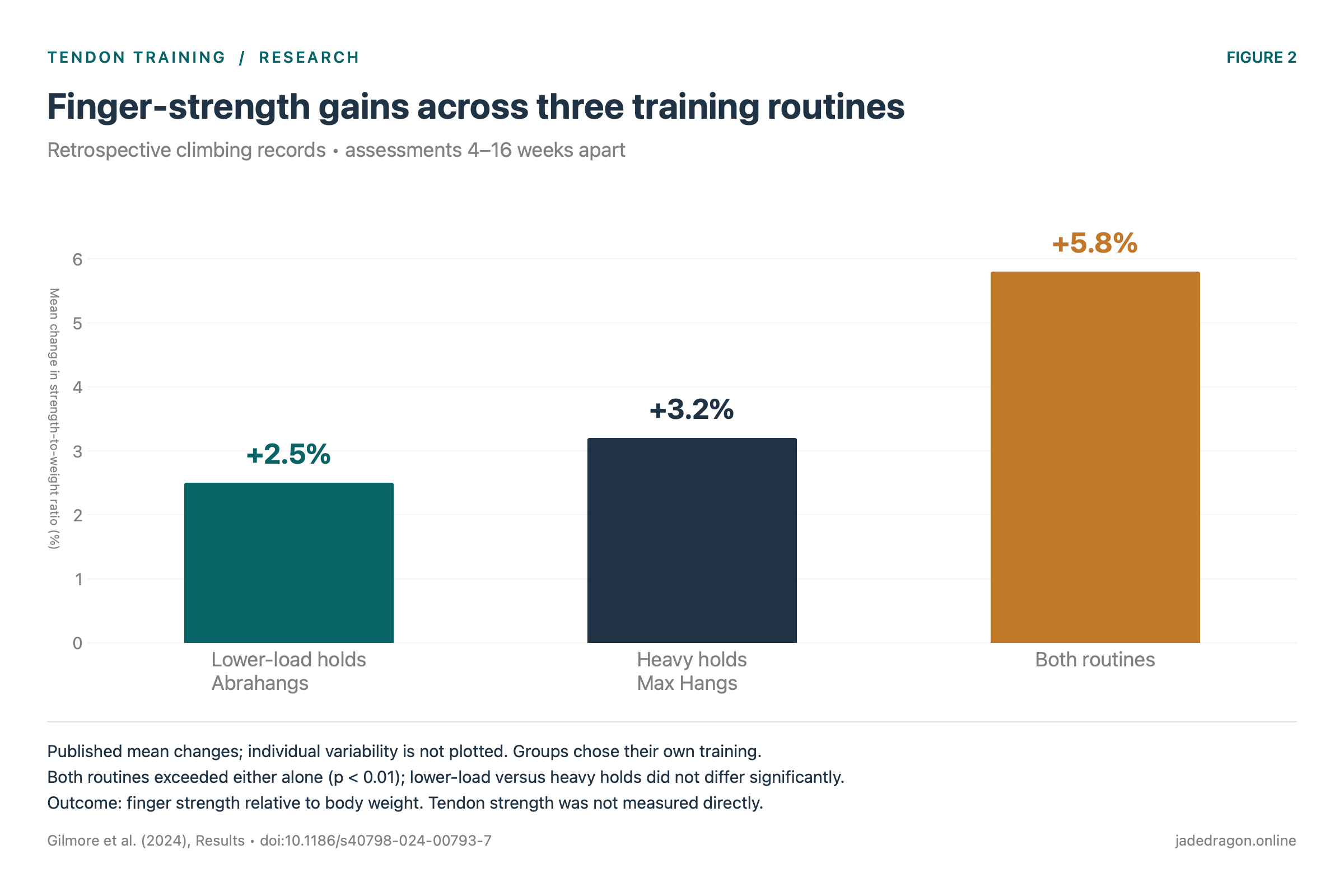
The researchers compared changes in finger strength among climbers who recorded low-intensity hangboard training, high-intensity hangs, both methods, or climbing alone. The lower-intensity routine kept the feet on the ground while the fingers supported part of the load.
Over assessment intervals of four to sixteen weeks, the lower-intensity and heavier training groups showed comparable improvements in finger strength. Those combining both approaches showed larger gains.
These were existing training records, so participants chose their own routines. The outcome was finger strength, which reflects the combined performance of muscles, connective tissues, and nervous-system control. Tendon stiffness and tendon strength were not measured directly.
The finding is encouraging for people who need an accessible starting point. It also explains why lighter-load strength results can coexist with studies favoring higher strain for tendon adaptation: the studies measured different outcomes.
Slow movement provides another useful stimulus
A held posture is one way to load a tendon. Slow resistance exercise provides another, with muscular force maintained as the joint moves through a range.
In an eccentric contraction, the muscle lengthens while resisting a load, as the calf does when lowering the heel. Heavy slow resistance training includes both the lifting and lowering phases.
A randomized trial by Beyer and colleagues assigned 58 people with chronic midportion Achilles tendinopathy to twelve weeks of eccentric exercise or heavy slow resistance training. Both groups improved in pain and function, and those improvements remained at the one-year follow-up. Neither approach produced superior clinical outcomes.
This gives teachers a useful reason to consider movement and holding together. A sequence can develop control as you move into a position, maintain it, and leave it. The therapeutic trial used specific resistance programs; its relevance to Yi Jin Jing is the broader loading principle.
Faster movements introduce further demands. Research comparing plyometric and isometric training found different adaptations in muscle and tendon mechanics. Someone preparing for running or jumping therefore needs practice tolerating those faster forces as well as sustained loading.
Give adaptation enough time
Holding a posture may become easier as coordination improves and the muscles become more accustomed to the task. Changes in tendon mechanics follow their own time course.
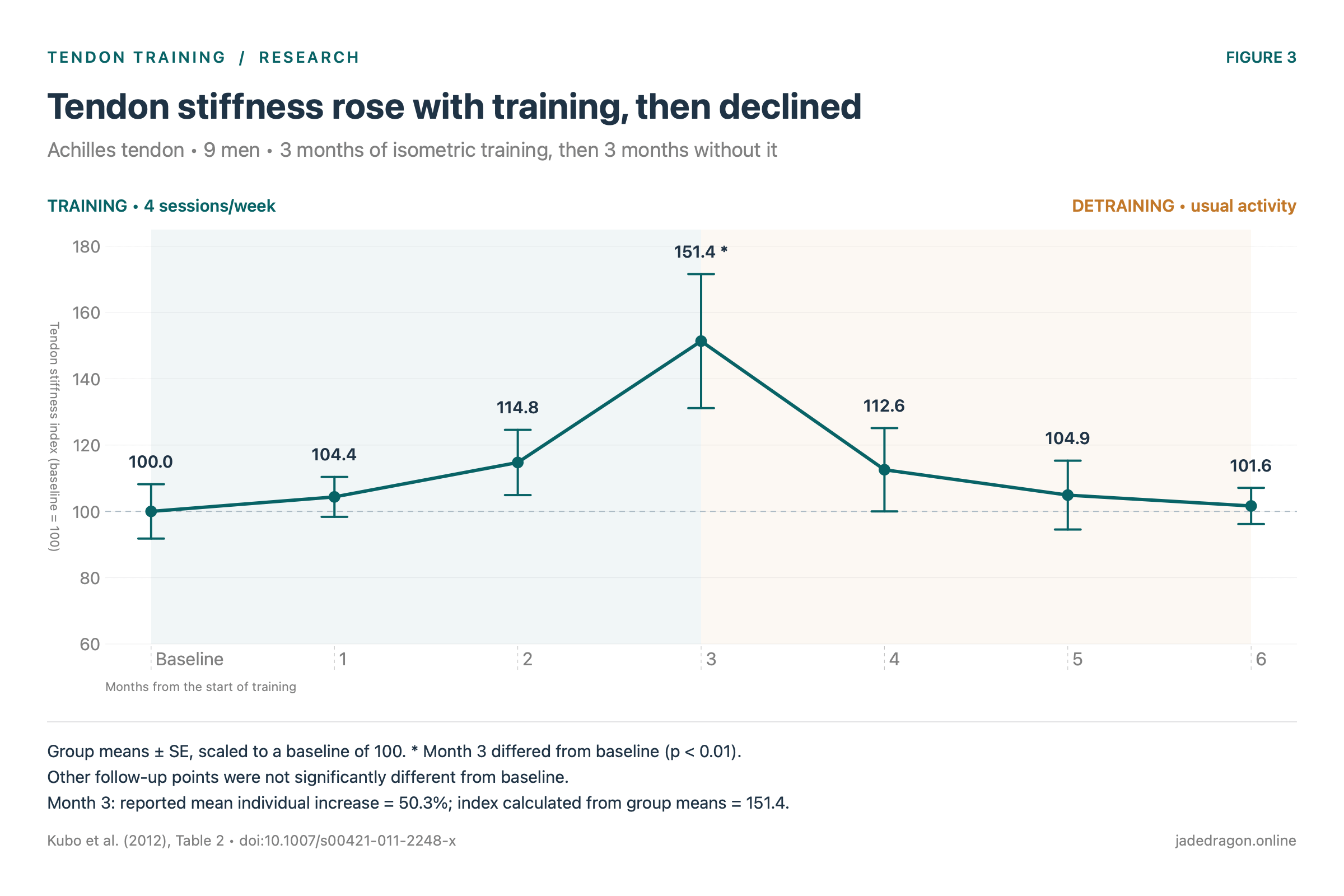
In a study by Kubo and colleagues, nine young men completed three months of isometric calf training. Achilles tendon stiffness increased by approximately 50 percent by the end of training, reaching statistical significance at the three-month measurement. After one month without the training, stiffness had returned to its pretraining level.
That was a small study using a particular protocol, but it illustrates both the time required for measurable adaptation and the importance of continued loading.
For a practitioner, a training record can be more informative than the intensity of a single session. Record the position, assistance used, hold duration, and response afterward. Over several months, those details show whether the task is becoming easier and whether the training demand has progressed.
Twelve weeks is a useful planning horizon for a sustained training block. The point is to give the tissues repeated opportunities to adapt while adjusting the exercise to the person.
Bringing the research into practice
For someone beginning sustained holds, a supported squat, a comfortable split stance, or an elevated push-up hold offers an adjustable starting point. Support and joint position allow the difficulty to be scaled, and the hold can be kept brief enough to maintain steady breathing and alignment.
Within a familiar Yi Jin Jing sequence, a teacher might choose one position that the student can maintain comfortably, introduce a brief pause, and observe whether breathing and alignment remain steady. This applies loading principles rather than a research-tested Yi Jin Jing protocol.
Once the position is manageable, change one feature at a time. Extend the hold slightly, reduce assistance, or increase the muscular demand through a suitable change in position. Progress should be repeatable across sessions. Worsening localized tendon pain or increasing next-day stiffness calls for reducing the demand and, if persistent, obtaining an assessment.
The burning sensation in a working muscle does not measure tendon adaptation. Nor does temporary pain relief establish that a tendon is ready for greater force. Trials of isometric exercise for patellar tendon pain have found variable short-term responses, so comfort during a hold should be considered alongside the response afterward.
For Qigong teachers, this creates a practical way to explain tendon conditioning: identify the tissues being loaded, choose an appropriate demand, and progress it over time. The traditional attention to posture and sustained effort becomes more useful when students understand what they are practicing. A shorter, well-controlled hold at an appropriate difficulty gives them a clear task they can repeat, assess, and gradually develop.
Like what you read? Keep exploring …

If this post resonated with you, you may enjoy my new book:
The Science of Medical Qigong: How Breath, Movement, and Attention Transform the Body
This book examines the growing body of scientific research exploring how Qigong practice influences human physiology. Drawing from clinical trials and experimental studies, it explains how coordinated breathing, posture, movement, and focused attention interact with the body’s regulatory systems.
The book explores research on:
• autonomic nervous system regulation
• cardiovascular function and blood pressure
• respiratory mechanics and lung capacity
• sleep quality and recovery
• inflammatory and immune signaling
• brain function and neural plasticity
• cognitive performance and mental health
Rather than presenting Qigong through mystical language, The Science of Medical Qigong approaches the subject through physiology, neuroscience, and clinical research, offering a clear explanation of how regular practice can influence the coordination and harmony of the body’s systems.
Available now in print and Kindle formats.