
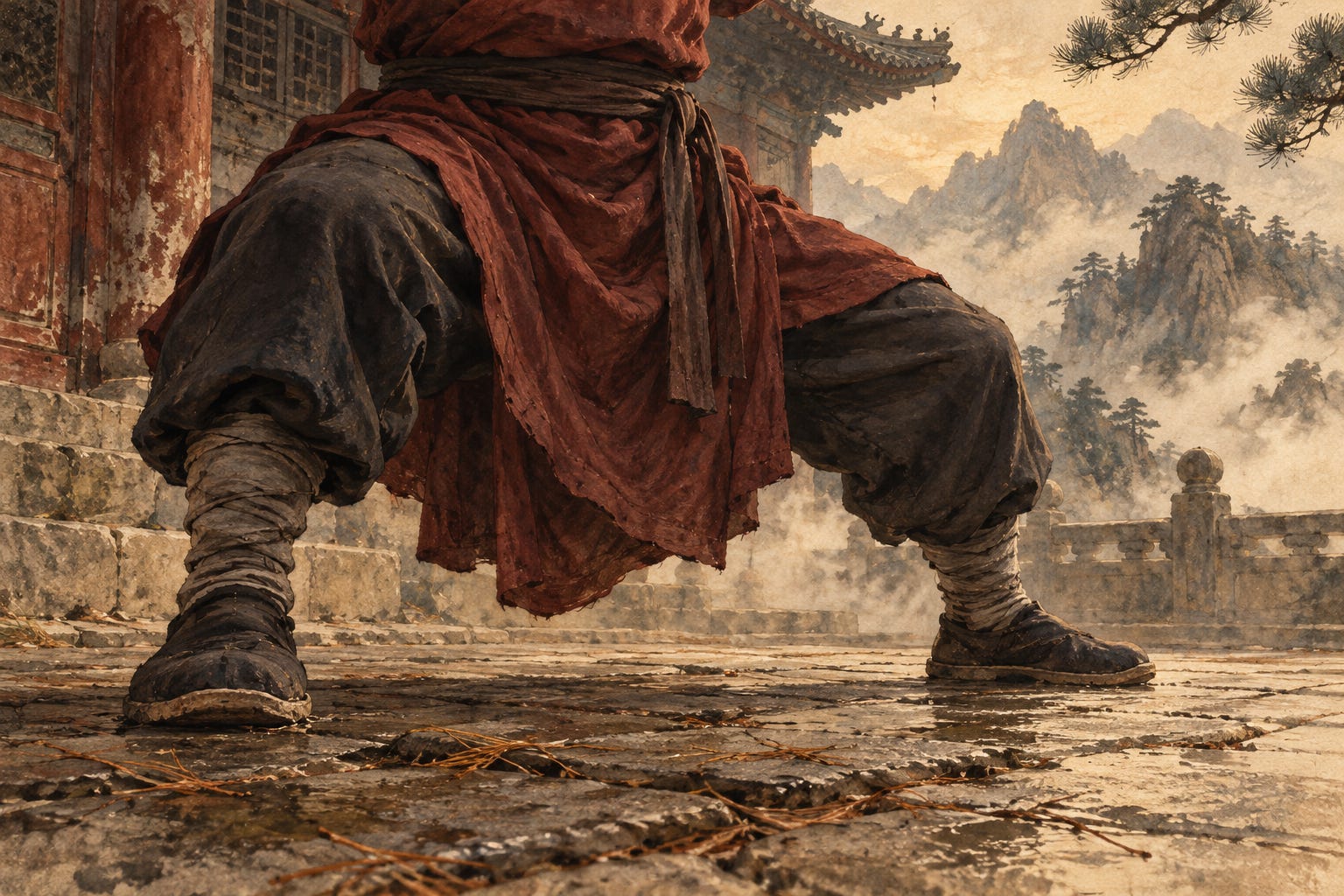
Stand in a horse stance for a few breaths and it may seem simple enough. The feet are planted, the knees are bent, and the body is upright. Stay there longer and the work becomes unmistakable. The thighs begin to burn. Small adjustments appear at the ankles and hips. Rising a few inches would be easy, but remaining at the chosen height requires continuous effort.
Muscles must produce force to keep the joints from folding under body weight. Tendons and broad sheets of connective tissue transmit that force, while the nervous system adjusts muscular activity to maintain the position. A stance can look still from across the room while demanding a great deal from the person holding it.
Horse stance, or ma bu (馬步), has long served as a foundation in many Kung Fu systems. Schools differ in its width, depth, and duration. Its purpose extends beyond leg conditioning: a stance gives the practitioner a stable position from which to move, strike, or receive force. Exercise science can tell us more about the work of holding that position against gravity.
Holding Against Gravity
Exercise researchers distinguish between two ways of performing an isometric contraction. In a pushing isometric, a person exerts force against something that will not move, such as an immovable bar. In a holding or yielding isometric, the person maintains a position while an external load tries to change it. Holding a weight steady with a bent elbow is one example. In a horse stance, gravity continually draws the body downward, and the legs keep the hips and knees at their chosen angles.
One task asks the person to produce a target force. The other asks the person to preserve a position under load. In a 2017 elbow experiment, Laura Schaefer and Frank Bittmann found that participants could maintain the pushing task longer than the holding task at the same high relative effort. The two forms of apparent stillness placed different demands on them.
A study published in 2026 made the comparison more relevant to the legs. Danny Lum and colleagues assigned one leg of each of ten adults to pushing isometric training and the other to holding isometric training. For six weeks, participants performed knee extensions at about seventy percent of maximum effort, holding each contraction for twenty seconds. Both conditions improved isometric strength. Only the holding leg showed a small increase in measured patellar tendon thickness; concentric and eccentric strength increased only after pushing.
Thickness tells us about tendon size, not its mechanical performance or injury risk. The researchers did not measure a change in tendon stiffness. Their experiment gives us a reason to study holding and pushing separately: the way a load is resisted may influence which adaptations appear, even when the joint remains nearly motionless.
A traditional stance is more complicated than a knee extension in a machine. Body weight acts through several joints, and balance requires adjustments from the ankles through the trunk. It resembles a holding task because the practitioner preserves a position against gravity.
What a Sustained Hold Asks of Your Tendon
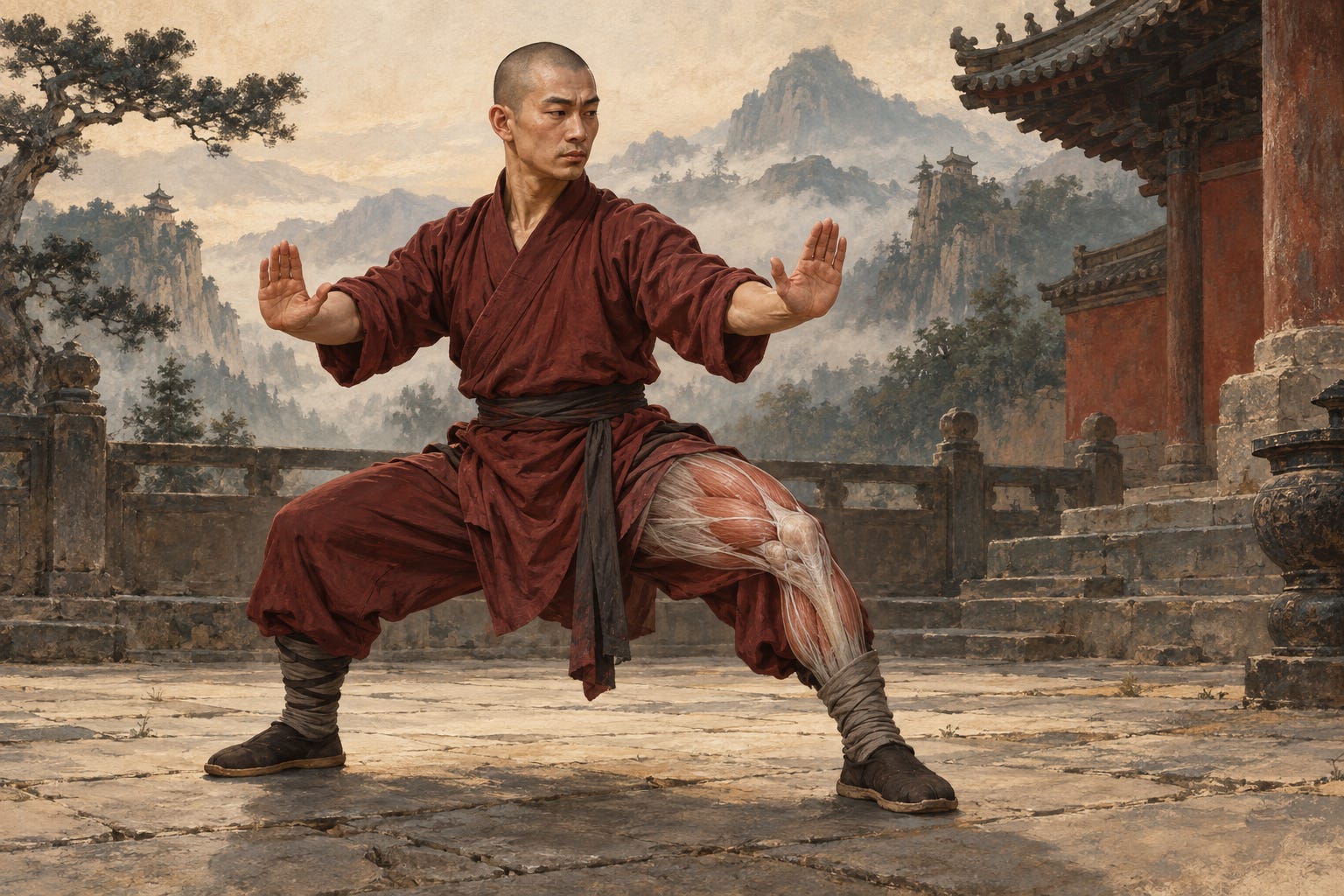
Tendons attach muscle to bone. An aponeurosis is a broad, sheet-like tendon within or alongside a muscle. These tissues help carry muscular force to the skeleton. When the quadriceps work to keep the knees from bending farther, their force passes through tendinous structures around the thigh and knee.
Keitaro Kubo and colleagues tested whether the length of a contraction changes how these tissues adapt. Eight men trained one leg with brief, repeated one-second knee extensions and the other with twenty-second contractions. Both protocols used about seventy percent of maximum effort, and the total work per session was matched. After twelve weeks, strength and muscle size had increased with both methods. Tendon and aponeurosis stiffness increased significantly only after the longer contractions.
Stiffness has a precise meaning here: how much a tissue resists stretching when force is applied. It is one part of how efficiently force passes from muscle to bone. The Kubo study suggests that spending time under tension can change the mechanical response of connective tissue even when the accumulated work is similar. It does not mean that every long hold produces the same result; the contractions in that study were demanding and repeated over months.
Another experiment moved closer to the shape of stance work. Eight people completed twelve weeks of isometric squat training, holding fifteen-second efforts at about seventy percent of their maximum, ten times per training day. Kubo’s team found that the tendon–aponeurosis complex associated with the vastus lateralis, one of the quadriceps muscles, became stiffer. The patellar tendon, measured separately, did not show the same change. The quadriceps also became stronger, and performance improved in a jump starting from a squat.
A single posture loads several tissues, and those tissues need not respond in the same way. The adaptation measured within the thigh cannot simply be assigned to every tendon crossing the knee, hip, or ankle.
In a larger 2018 study, Garry Massey and colleagues compared twelve weeks of brief explosive knee extensions with sustained contractions. Both programs increased patellar tendon stiffness. The sustained contractions also increased the stiffness of the knee extensor tendon–aponeurosis complex, while the explosive contractions did not. Different ways of producing force can reach different parts of the same muscle–tendon system.
Where Fascia Fits
Fascia is the connective tissue that surrounds and separates muscles and helps transmit force between neighboring structures. The fascia lata wraps the thigh. It is related to tendons and aponeuroses as part of the body’s connective-tissue system, but those names refer to different structures. Calling all of them “fascia” makes the anatomy harder to understand.
In 2019, Shun Otsuka and colleagues used ultrasound imaging to observe the fascia lata while fourteen men performed isometric knee extensions at increasing effort. As quadriceps contraction rose, the fascia lata became mechanically stiffer during the task. The change happened while the muscles were working. It shows that deep fascia participates in the mechanical demands of an isometric contraction; it does not show that one session permanently changed the tissue.
Longer-term research on fascia is beginning to take shape. A 2024 study of progressive resistance training found increases in measured fascia thickness over six weeks. It used resistance exercises rather than stances. Taken together, these studies show fascia responding mechanically to contraction and changing in measured thickness after some training programs. The long-term fascial effects of stance holds have yet to be measured.
Making Sense of the Load
Duration is only one part of stance training. The height of the stance, the position of the feet, the distribution of body weight, the effort needed to maintain the joints, and the number of sessions all affect the demand. Two people may hold a horse stance for the same length of time while placing very different loads on their tissues.
A review by Sebastian Bohm, Falk Mersmann, and Adamantios Arampatzis brought together twenty-seven human tendon studies. Tendons adapted to repeated mechanical loading through changes in stiffness, material properties, and, to a smaller extent, size. Loading magnitude was a stronger predictor of stiffness adaptation than whether the exercise was isometric, eccentric, or a combination of shortening and lengthening contractions. In the studies they examined, relatively high effort produced larger changes than lower effort.
That finding helps explain both the promise and the limit of a stance hold. A demanding, repeated hold can provide sustained force through the legs. The number of minutes on a clock cannot tell us how much force a particular tendon receives. A shallow stance held comfortably and a lower stance that takes real effort are different exercises, even if both are called ma bu.
The practitioner can choose a position that allows organized joints, steady breathing, and enough control to rise or move out of it. Time can increase as the position becomes familiar; depth and effort can change as strength develops. This makes the loading repeatable.
The traditional language of rooting describes a whole-body skill: balance, alignment, force production, and the ability to respond without losing position. Tendon and fascia research explains a physical part of that experience. It does not replace the skill being trained. A stance must eventually support movement and contact, not just a longer time on the clock.
Kung Fu practitioners have used sustained stances for generations because holding a position reveals demands that a quick movement can pass through. Research now shows that sustained isometric work can change the mechanical properties of tendons and aponeuroses when the loading is sufficient, while the fascia of the thigh responds as surrounding muscles contract. The emerging comparison between holding and pushing isometrics gives stance training a particularly interesting place in that conversation.
A well-trained stance looks quiet. Under the surface, the body is producing force, transmitting it through connective tissue, and making the small adjustments needed to stay ready to move.
Further Reading
Schaefer, L. V., and Bittmann, F. N. “Are There Two Forms of Isometric Muscle Action? Results of the Experimental Study Support a Distinction Between a Holding and a Pushing Isometric Muscle Function.” BMC Sports Science, Medicine and Rehabilitation (2017).
Lum, D., Oranchuk, D. J., Chen, S. E., and Kong, P. W. “Comparing the Effects of Push and Hold Isometric Training on Strength and Musculotendinous Adaptations: A Within-Subject Randomized Controlled Trial.” Journal of Strength and Conditioning Research (2026).
Kubo, K., Kanehisa, H., and Fukunaga, T. “Effects of Different Duration Isometric Contractions on Tendon Elasticity in Human Quadriceps Muscles.” The Journal of Physiology (2001).
Kubo, K., Yata, H., Kanehisa, H., and Fukunaga, T. “Effects of Isometric Squat Training on the Tendon Stiffness and Jump Performance.” European Journal of Applied Physiology (2006).
Massey, G. J., Balshaw, T. G., Maden-Wilkinson, T. M., Tillin, N. A., and Folland, J. P. “Tendinous Tissue Adaptation to Explosive- vs. Sustained-Contraction Strength Training.” Frontiers in Physiology (2018).
Otsuka, S., Shan, X., and Kawakami, Y. “Dependence of Muscle and Deep Fascia Stiffness on the Contraction Levels of the Quadriceps.” Journal of Electromyography and Kinesiology (2019).
Longrak, R., Sonchan, W., and Jaidee, W. “Regional Morphological Adaptations of Vastus Lateralis Muscle in Response to Different Progressive Resistance Training Programs.” South African Journal of Sports Medicine(2024).
Bohm, S., Mersmann, F., and Arampatzis, A. “Human Tendon Adaptation in Response to Mechanical Loading: A Systematic Review and Meta-Analysis of Exercise Intervention Studies on Healthy Adults.” Sports Medicine - Open (2015).

If this post resonated with you, you may enjoy my new book:
The Science of Medical Qigong: How Breath, Movement, and Attention Transform the Body
This book examines the growing body of scientific research exploring how Qigong practice influences human physiology. Drawing from clinical trials and experimental studies, it explains how coordinated breathing, posture, movement, and focused attention interact with the body’s regulatory systems.
The book explores research on:
• autonomic nervous system regulation
• cardiovascular function and blood pressure
• respiratory mechanics and lung capacity
• sleep quality and recovery
• inflammatory and immune signaling
• brain function and neural plasticity
• cognitive performance and mental healthRather than presenting Qigong through mystical language, The Science of Medical Qigong approaches the subject through physiology, neuroscience, and clinical research, offering a clear explanation of how regular practice can influence the coordination and harmony of the body’s systems.
Available now in print and Kindle formats.
Click here to get your copy