


Meditation 101: A Practical Guide to Training Attention
Meditation is a practice of learning to work deliberately with attention. You choose something to observe, recognize when your mind has wandered, and direct your attention back to the practice. Over time, you become more familiar with the thoughts and reactions that usually pass unnoticed.
The image of a monk sitting cross-legged in a mountain temple captures only one setting for meditation. You can begin in an ordinary chair, in a room at home, with a few minutes set aside to practice. Specialized postures, hand positions, and recitations have purposes within particular traditions, but a beginner can start with something as familiar as breathing.
What You Are Practicing
Meditation includes several approaches. Some methods develop concentration on a chosen object, such as the breath. Others involve observing thoughts and sensations more broadly or deliberately developing qualities such as compassion. The instructions below use breath awareness and counting to train attention.
Your task is to feel the breath, notice distraction, and resume observing. Thoughts will continue to arise. When you recognize that you have been planning dinner or replaying a conversation, you have noticed something important about your attention. You can then redirect it.
Brain-imaging research has examined this sequence directly. In a study of experienced meditators, researchers identified different patterns of brain activity during mind wandering, recognizing distraction, shifting attention, and maintaining focus. These findings help explain why noticing that you have become distracted is an active part of the practice. Hasenkamp et al., 2012
There is no need to criticize yourself each time this happens. Recognize what occupied your attention, then feel the next breath.

Becoming Familiar with Your Mental Habits
Much of daily life depends on habit. Familiar actions become easier through repetition, and this saves us effort. We can also become accustomed to replaying disagreements, anticipating difficulties, or treating an uncomfortable thought as though it demands an immediate response.
Meditation gives you time to observe these patterns. You might notice how quickly a memory brings tension into your shoulders or how a worry draws your attention away from what you are doing. Recognizing the pattern gives you an opportunity to respond more deliberately.
For example, while sitting quietly, you may remember a difficult conversation. Within seconds, you are rehearsing what you should have said. In practice, you recognize that you are replaying the conversation, notice any associated tension, and redirect attention to breathing. The conversation may still need your attention later. For these few minutes, you are practicing choosing where your attention goes.
Research suggests that this training can affect everyday stress. A 2025 randomized trial involving 138 university employees found that participants assigned to an eight-week meditation app program reported improvements in stress, repetitive stressful thinking, and perceived coping compared with a waitlist group. Participants were asked to practice for ten minutes daily. Because the comparison group did not receive an alternative intervention, the study cannot separate the effects of meditation from all the benefits of taking a regular break or expecting improvement. It nevertheless provides evidence that a brief, structured program can help new practitioners. Zawadzki et al., 2025

What Research Shows About Attention
Mindfulness training can improve some aspects of cognitive performance. A meta-analysis of 111 randomized controlled trials, involving 9,538 participants, found small-to-moderate improvements in several measures, including sustained attention and working-memory accuracy. Working memory allows us to hold information in mind while using it, such as remembering instructions as we complete a task. Benefits were also present in comparisons with active interventions, although they varied across abilities and programs. Zainal and Newman, 2024
These findings support practicing attention as a skill. They do not establish that every meditation method produces the same results or that a few minutes of breath counting will improve every aspect of thinking.
Claims about meditation physically enlarging particular brain regions also require more precision. Two combined randomized controlled trials found no detectable differences in structural brain changes between an eight-week mindfulness-based stress reduction program and its comparison groups. Improvements in how people feel or perform can occur without measurable changes in brain volume or cortical thickness over that period. Kral et al., 2022
In your own practice, look for changes you can observe: recognizing distraction sooner, following a task more consistently, or noticing irritation before speaking.
Finding a Comfortable Posture
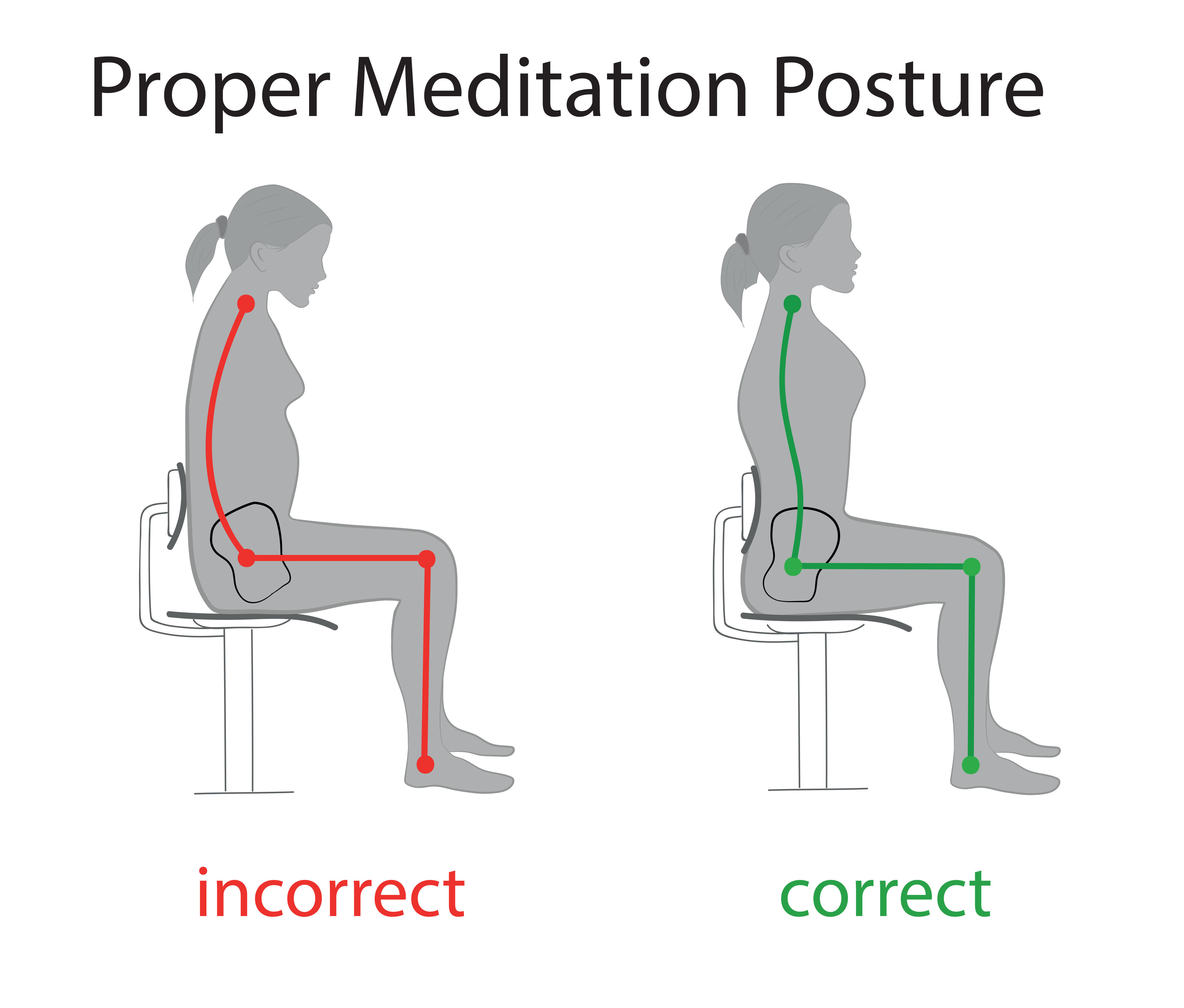
A chair is a practical place to begin. Place your feet flat on the floor and rest your hands on your thighs or in your lap. Choose a seat height that lets your legs rest comfortably. Use back support if you need it.
Sit upright with your head balanced over your torso. Preserve the natural curves of your spine and relax your shoulders. You should be able to breathe comfortably without holding your chest rigid or lifting your chin.
You can also sit on a cushion, kneel with appropriate support, or practice standing. Choose a position suited to your mobility and comfort. Adjust it if you develop pain, numbness, or unnecessary strain.
For more detail, see The Three Essential Postures for Practicing Meditation: Seated, Chair, and Standing.
Letting the Breath Remain Comfortable
Begin by observing your ordinary breathing. Feel the movement of your abdomen or lower ribs, or notice the passage of air at your nostrils. Choose whichever sensation is easiest to follow.
As you inhale, the diaphragm contracts and moves downward, increasing the space within the chest so the lungs can expand. The abdomen may move outward as this happens. Air enters the lungs; it does not travel into the abdomen. During quiet exhalation, the breathing muscles relax and the lungs recoil. National Heart, Lung, and Blood Institute
For this exercise, there is no need to fill your lungs to capacity, flare your nostrils, or push downward after inhaling. Let inhalation and exhalation follow one another comfortably. If a brief pause occurs naturally, observe it without deliberately prolonging it.
Breath awareness and controlled breathing are different practices. Here, you are training attention by observing breathing. Keep the breath comfortable enough that you can follow it without strain. If you become lightheaded or feel short of breath, stop adjusting your breathing and let your usual rhythm resume.
A Four-Stage Breath-Awareness Practice
Begin with five minutes in total. You can spend the whole session on the first stage while becoming familiar with it, then introduce the remaining stages as practice becomes easier. Later, if you are comfortable, you can gradually work toward five minutes per stage.
1. Count after each exhalation
Feel an ordinary inhalation and exhalation. At the end of the exhalation, silently count “one.” After the next complete breath, count “two.” Continue to ten, then begin again at one.
If you lose your place, start again at one. Keep part of your attention on the physical sensation of breathing so the counting remains connected to the breath.
2. Count before each inhalation
Now place the number just before the next inhalation. Silently count “one,” then feel the inhalation and exhalation. Count “two” before the following inhalation, continuing to ten.
This changes the timing of your attention, not the way you breathe. Avoid holding your breath while waiting to count.
3. Observe without counting
Set the numbers aside and follow the sensations of breathing. You might feel the abdomen move outward and inward or the ribs expand and settle.
When a thought draws you away, recognize that attention has shifted and resume observing the breath. If you repeatedly lose track, use counting again for a while.
4. Attend to a smaller area
If breathing through your nose is comfortable, narrow your attention to the sensation of air around the nostrils or just inside the nose. Observe whatever you can clearly feel without trying to create a stronger sensation.
If this area is difficult to sense, continue observing the abdomen or ribs. The purpose is to develop steadier attention, and a clear, comfortable sensation gives you something workable to observe.
Breath counting has also been studied as a training method. In a randomized study reported in 2014, four weeks of breath-counting practice improved a behavioral measure of mindfulness and reduced mind wandering compared with working-memory training and no training. That study supports the use of counting, although it did not test the exact four-stage sequence presented here. Levinson et al., 2014
Making Practice Part of Your Day
Choose a time you can repeat, perhaps after waking or before an evening meal. Put your phone aside and begin with a duration that fits your day. Extend the session when you can do so comfortably.
Some sessions will feel settled. Others will reveal how busy your mind is. In either case, you can practice recognizing distraction and directing attention deliberately. Feeling calm can be welcome, but it is not the only sign that you have practiced successfully.
If focusing on breathing makes you anxious, open your eyes and attend to the contact of your feet with the floor or to sounds in the room. Shorten or stop the session if distress continues.
Meditation has deep roots in religious and contemplative traditions, and it can also be practiced in a secular setting. You can begin by learning the method and observing your experience.
If you would like guided instruction, my free beginner meditation course at the Jade Dragon Qigong School offers a place to start.
References
Hasenkamp, W., Wilson-Mendenhall, C. D., Duncan, E., & Barsalou, L. W. (2012). Mind wandering and attention during focused meditation: A fine-grained temporal analysis of fluctuating cognitive states. NeuroImage, 59(1), 750–760. doi:10.1016/j.neuroimage.2011.07.008
Zawadzki, M. J., Torok, Z. A., Peña, M., & Gavrilova, L. (2025). App-based mindfulness meditation reduces stress in novice meditators: A randomized controlled trial of Headspace using ecological momentary assessment. Annals of Behavioral Medicine, 59(1), kaaf025. doi:10.1093/abm/kaaf025
Zainal, N. H., & Newman, M. G. (2024). Mindfulness enhances cognitive functioning: A meta-analysis of 111 randomized controlled trials. Health Psychology Review, 18(2), 369–395. doi:10.1080/17437199.2023.2248222
Kral, T. R. A., et al. (2022). Absence of structural brain changes from mindfulness-based stress reduction: Two combined randomized controlled trials. Science Advances, 8(20), eabk3316. doi:10.1126/sciadv.abk3316
National Heart, Lung, and Blood Institute. (2022). How the lungs work: What breathing does for the body. National Institutes of Health. Read the physiological overview.
Levinson, D. B., et al. (2014). A mind you can count on: Validating breath counting as a behavioral measure of mindfulness. Frontiers in Psychology, 5, 1202. doi:10.3389/fpsyg.2014.01202
If you would like to explore meditation in more depth, you may enjoy my new book:
A Moment’s Notice: How Meditation Trains Attention and Changes the Brain
You sit down to follow your breathing, then discover that you are planning tomorrow or replaying a conversation. Recognizing that distraction and redirecting your attention are central to meditation practice.
In A Moment’s Notice, I explain what happens in the mind and brain as these skills develop. Drawing on neuroscience and clinical experience, I explore why attention wanders, how an urge can override an intention, and how practice helps you recognize familiar reactions before you act.
The book explores:
How meditation trains attention.
Why thoughts and emotional reactions become habitual.
How to work with persistent thoughts, strong emotions, and discomfort.
Why a difficult meditation session can still represent progress.
How to apply these skills in relationships, work, and everyday decisions.
The final chapter brings the ideas into a guided fifteen-minute practice, with practical instruction on posture, breathing, and working with distraction.
Whether you are beginning meditation or developing an established practice, the book helps you understand what you are training and how to practice with greater confidence.