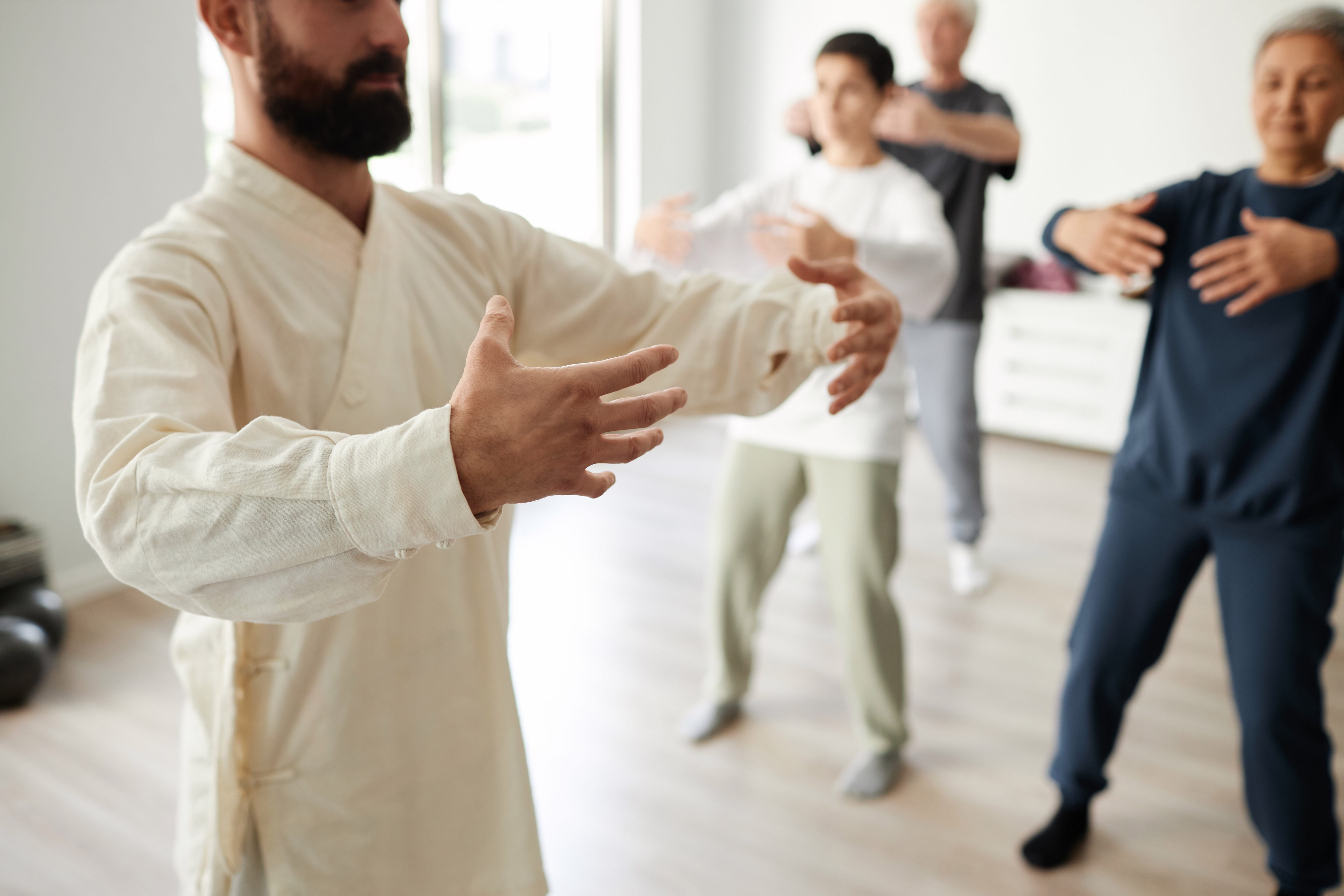
Zhan Zhuang: Standing Still Between Tradition and Neuroscience
Zhan Zhuang (站樁), often translated as standing meditation, is not a modern invention. It is an old training method, preserved within Chinese martial arts, Daoist cultivation, and medical traditions because it consistently produced results. Long before brain imaging or autonomic nervous system theory, practitioners noticed something unmistakable: when people stood in a certain way—relaxed, aligned, attentive, and still—the body reorganised itself and the mind settled without being forced.
This matters today, because many people encounter Zhan Zhuang through a modern lens. They ask: What is it doing to the nervous system? Why does it calm the mind? Why does it help balance, posture, and even neurological conditions? These are reasonable questions. But answering them does not require stripping the practice of its history or rebranding it as a recent discovery. Neuroscience does not replace Zhan Zhuang’s tradition—it simply offers a contemporary language for changes that have been observed for centuries.
A Training Method Preserved by Experience
In traditional contexts, Zhan Zhuang was never framed as philosophy alone. It was training. Practitioners stood not to imagine something, but to feel something: weight sinking, tension revealing itself, breath becoming quieter, awareness spreading through the body. Over time, teachers noticed reliable effects—greater stability, clearer attention, stronger structure, calmer emotions. Methods that did not produce these effects were abandoned. Methods that did were kept.
This is an important point. Zhan Zhuang survived not because of belief, but because it worked across bodies, generations, and circumstances. It was used by martial artists to develop balance and internal strength, by physicians to support health, and by cultivators to quiet the spirit. The language used to describe its effects—rooting, stillness, quieting the mind, sinking the qi—was experiential, not theoretical. It described what was felt, not how it was measured.
What Standing Still Does to the Brain and Nervous System
From a modern neuroscience perspective, Zhan Zhuang is unusual because it combines three things rarely trained together: postural load, stillness, and relaxed attention.
When you stand upright, the nervous system receives continuous information from muscles, joints, and balance organs. This information—called proprioceptive and vestibular input—tells the brain where the body is in space. In everyday life, this input is often drowned out by movement, screens, or constant mental activity. In Zhan Zhuang, it becomes the dominant signal.
At the same time, the posture is held without strain. This matters. Excess muscular tension signals threat and effort; excessive collapse signals fatigue. Zhan Zhuang sits between these extremes. The body is working, but not struggling. From the nervous system’s perspective, this combination sends a powerful message: the body is stable, supported, and safe.
When this signal is sustained, the brain begins to re-organise attention. Instead of scanning outward for stimulation, it turns inward, monitoring subtle changes in balance, breath, and tone. The mind quiets not because it is commanded to be quiet, but because it is no longer overloaded.
Why Standing Is Different From Sitting Meditation
Many people assume that stillness is the same whether one is sitting or standing. Neurologically, it is not.
Standing automatically engages balance systems that sitting largely bypasses. Small postural adjustments occur constantly, even when the body appears motionless. These adjustments feed the brain a steady stream of sensory information. This makes it easier for attention to stabilise without becoming dull or sleepy.
This may explain why standing practices have been found particularly suitable for people who struggle with seated meditation—those with fatigue, pain, anxiety, or neurological conditions. In a 2019 review article by Tao Jiang and colleagues, published in the International Journal of Martial Arts, Zhan Zhuang (referred to as Chan-Chuang) was described as unifying movement and rest, allowing participants to calm down gradually while maintaining alertness and balance.
Clinical Research: Modern Echoes of an Old Practice
In recent years, Zhan Zhuang has begun appearing in clinical research, not as a curiosity, but as a practical intervention.
Several studies have focused on Parkinson’s disease, a condition where posture, balance, tremor, and nervous system regulation are central challenges. In a study protocol published in BMJ Open in 2022, Linlin Zhang and colleagues outlined a randomised controlled trial examining the effects of Zhan Zhuang Qigong on tremor and aerobic capacity in people with mild to moderate Parkinson’s disease. The authors described Zhan Zhuang as a low-intensity, body–mind training method that stabilises posture while engaging attention, making it especially suitable for this population.
A follow-up protocol published in BMJ Open in 2024 by the same research group explored the use of Zhan Zhuang for Pisa syndrome, a postural disorder associated with Parkinson’s disease. The researchers highlighted Zhan Zhuang’s emphasis on spinal alignment and trunk stability, noting that it actively engages both large and small postural muscles rather than relying on isolated strengthening exercises.
What is striking here is not novelty, but alignment. The reasons modern clinicians find Zhan Zhuang useful—simplicity, safety, postural feedback, nervous system regulation—are the same reasons it was preserved historically.
Beyond Neurology: Stress, Sleep, and Regulation
Zhan Zhuang has also been studied in contexts far removed from martial arts or meditation culture. In a 2023 randomised controlled trial published in Frontiers in Public Health, Hansen Li and colleagues examined the effects of Chan-Chuang training in male methamphetamine users undergoing rehabilitation. Over eight weeks, participants practicing Chan-Chuang showed reductions in heart rate and blood pressure, along with improvements in sleep quality, balance, and overall well-being compared to controls.
From a neuroscience perspective, these findings point toward autonomic regulation. Reduced heart rate and blood pressure suggest a shift away from chronic sympathetic activation—the “always on edge” state common in addiction, trauma, and chronic stress. Again, this mirrors traditional descriptions of Zhan Zhuang as settling agitation and restoring internal balance.
Immune Support and the Quiet Body
One of the more striking applications of Chan-Chuang appears in supportive cancer care. In a paper by Mei-Ling Yeh and colleagues, published in Cancer Nursing in 2006, breast cancer patients undergoing chemotherapy practiced Chan-Chuang Qigong for 21 days. The study found significantly better preservation of white blood cell counts, platelets, and haemoglobin compared to controls.
The authors framed these effects in both traditional and physiological terms, suggesting that relaxation and nervous system regulation may influence immune and hematological function. Importantly, the practice was chosen precisely because it was gentle, easy to learn, and did not exhaust already weakened patients—qualities long emphasised in traditional settings.
Tradition and Science Are Pointing in the Same Direction
It is tempting to say that neuroscience is “finally validating” Zhan Zhuang. That framing misses the point. Zhan Zhuang was never waiting for validation. It was refined through careful attention to the body and preserved because it reliably changed how people felt, moved, and thought.
Modern neuroscience does not replace this knowledge. It simply gives us additional language. Where classical teachers spoke of rooting, neuroscience speaks of postural stability and sensory integration. Where tradition spoke of quieting the spirit, neuroscience speaks of reduced cortical noise and autonomic balance. These are not competing explanations. They are different descriptions of the same lived shift.
Standing Still as Training, Not Escape
Zhan Zhuang is not about withdrawing from life. It is about training the conditions that allow clarity and steadiness to arise naturally. In a world saturated with stimulation, it offers something rare: a way to train the nervous system through stillness, without force, and without distraction.
Its continued use—across centuries, cultures, and now clinical settings—suggests that the body recognises something true in this method. Standing still, when done correctly, is not passive. It is deeply instructive. And whether one speaks in the language of Daoist cultivation or modern neuroscience, the message is remarkably consistent: when the body settles, the mind follows.
References (APA Style)
Jiang, T., Lia, H., Dong, X., & Zhang, G. (2021). Effects of Chan-Chuang on physical and mental health: A literature review. International Journal of Martial Arts, 7, 48–64.
Li, H., Wang, C., Huang, X., Xu, L., Cao, Y., Luo, J., & Zhang, G. (2023). Chan-Chuang and resistance exercise for drug rehabilitation: A randomized controlled trial among Chinese male methamphetamine users. Frontiers in Public Health, 11, Article 1180503. https://doi.org/10.3389/fpubh.2023.1180503
Li, Z., Zhuang, J., Jiang, Y., Xiao, G., Jie, K., Wang, T., Yin, W., Zhang, Y., & Wang, Z. (2019). Study protocol for a single-blind randomised controlled trial to evaluate the clinical effects of an integrated Qigong exercise intervention on freezing of gait in Parkinson’s disease. BMJ Open, 9(9), e028869. https://doi.org/10.1136/bmjopen-2018-028869
Yeh, M.-L., Lee, T.-I., Chen, H.-H., & Chao, T.-Y. (2006). The influences of Chan-Chuang Qi-Gong therapy on complete blood cell counts in breast cancer patients treated with chemotherapy. Cancer Nursing, 29(2), 149–155.
Zhang, L., Liu, X., Xi, X., Chen, Y., Wang, Q., Qu, X., Cao, H., Wang, L., Sun, W., Chen, G., Liu, H., Jiang, X., Su, H., Jiang, J., & Bi, H. (2022). Effect of Zhan Zhuang Qigong on upper limb static tremor and aerobic exercise capacity in patients with mild-to-moderate Parkinson’s disease: Study protocol for a randomised controlled trial. BMJ Open, 12(7), e059625. https://doi.org/10.1136/bmjopen-2021-059625
Zhang, L., Chen, Y., Zhang, Y., Xi, X., Bi, H., Chen, P., Chen, F., Wang, C., & Huang, B. (2024). Efficacy and long-term effects of the intervention of Zhan Zhuang Qigong on Pisa syndrome in Parkinson’s disease: The study protocol for a randomised control trial. BMJ Open, 14(11), e084418. https://doi.org/10.1136/bmjopen-2024-084418
Like what you read? Keep exploring…
If this post resonated with you, you’ll love my book:
An Uncarved Life: A Daoist Guide to Struggle, Harmony, and Potential
This book blends timeless Daoist wisdom with real-world insight into how we can navigate struggle, cultivate inner peace, and live in alignment with our deeper potential. Drawing from classical texts like the Dao De Jing and integrating modern psychology and neuroscience, An Uncarved Life offers a grounded, poetic, and deeply personal guide to living well in a chaotic world.
Whether you’re seeking clarity, calm, or a more meaningful path forward, this book is a companion for anyone who wants to walk the Way with sincerity and strength.
Available now in print, Kindle, and audiobook formats.
Click here to get your copy on Amazon


Thank you for a very 'moving' explanation of this practice based in 'standing still' :)
A masterful presentation, conveying in language the experiential wisdom surely carried within the tradition... and a welcome message! (gassho hands _/\_)