Your Breathing May Be Undermining Your Spinal Stability
What Modern Research and Classical Qigong Both Reveal
Your Breathing May Be Undermining Your Spinal Stability: What Modern Research and Classical Qigong Both Reveal
Most people think of breathing as something that happens in the chest. Sit at a desk long enough, deal with stress, or simply lose the habit, and the breath becomes shallow and upper-chest dominant. The ribs lift. The abdomen stays relatively flat. The diaphragm barely descends.
This pattern does more than limit oxygen. It quietly undermines the stability of your spine with every breath you take.
A 2025 systematic review by Mirtaleb and colleagues examined diaphragm and deep core muscle function in people with low back pain. They found consistent evidence of reduced diaphragm thickness and excursion during breathing, along with altered recruitment of the transversus abdominis and internal obliques. The result is lower intra-abdominal pressure and reduced spinal stiffness precisely when the body needs it most.
Rehabilitation scientists often describe spinal stability using a simple box model. The diaphragm forms the roof, the pelvic floor the base, the transversus abdominis the front wall, and the lumbar multifidus the back wall. When the diaphragm descends properly during inhalation, it increases pressure inside the abdominal cavity. This pressure stiffens the entire cylinder and transfers load away from the passive structures of the spine.
Without that pressure, the walls of the box have to work harder to compensate. They often cannot fully make up the difference.
Two recent randomized trials make the practical implication clear. Masroor and colleagues found that adding diaphragmatic breathing exercises to standard core stabilization training produced greater improvements in pain, disability, muscle activity, and even sleep quality than core training alone. Li and colleagues reported similar findings in 2025. Participants who combined core work with intentional breathing exercises showed superior reductions in pain and greater gains in function and strength.
In short, strong abdominal walls are far more effective when the roof of the box is working.
The Qigong Perspective
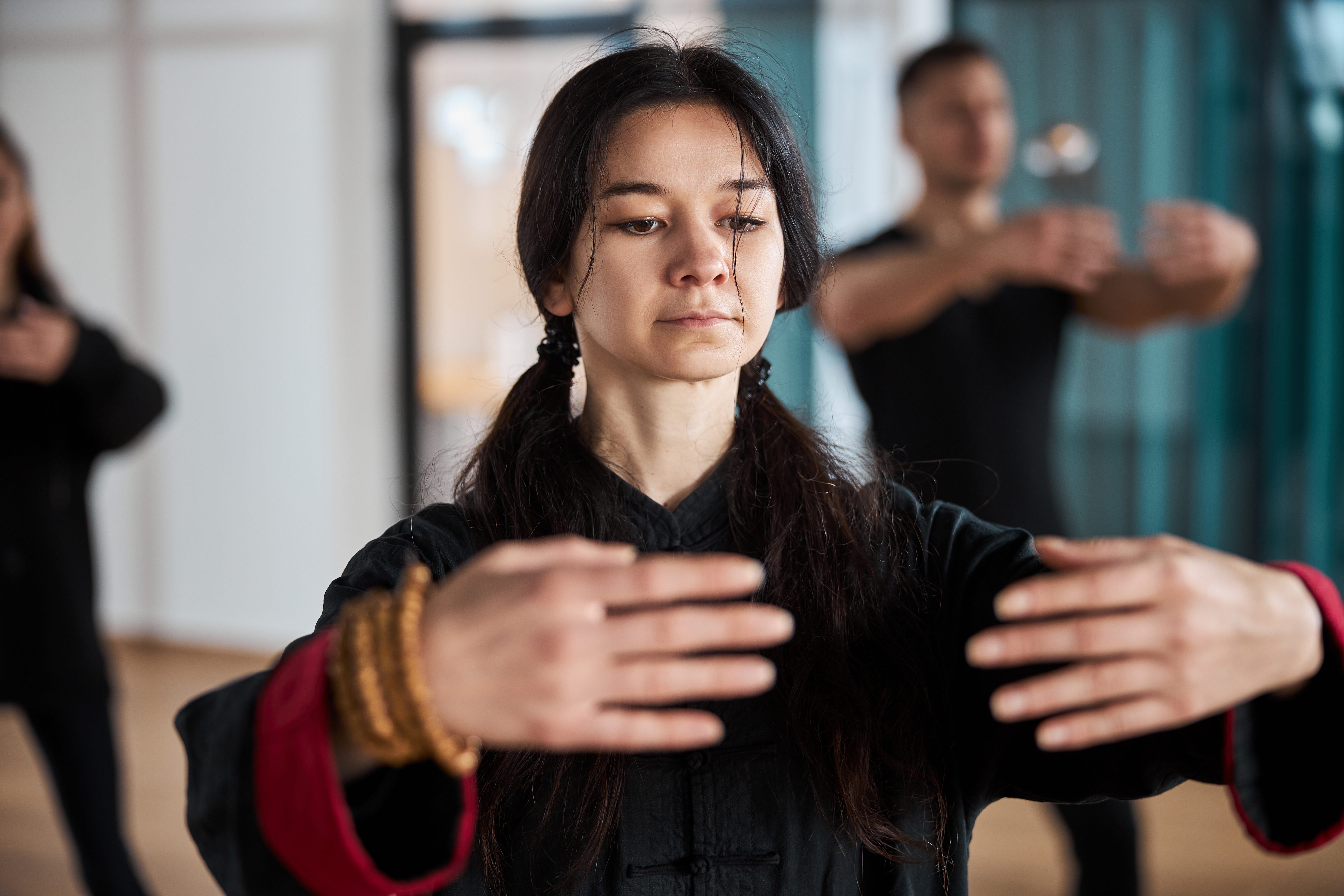
Classical qigong practice has long emphasized exactly this relationship between breath, posture, and internal pressure, though it uses different language. In standing qigong, often called Zhan Zhuang or post standing, practitioners learn to stand in a relaxed yet aligned posture while breathing deeply into the lower dantian. This is the area a few inches below the navel.
The instruction is consistent across lineages. Allow the breath to expand 360 degrees, front, sides, and back, while the chest remains relatively still. The abdomen, lower back, and sides gently expand on the inhale and soften on the exhale.
This is not mystical breathing. It is a practical method for loading the same stability cylinder described in modern rehabilitation literature. When the diaphragm descends and the abdominal wall expands in all directions, intra-abdominal pressure rises in a coordinated way. The spine receives continuous, subtle support with every breath. Over time the nervous system learns to maintain this support automatically during movement and static postures.
A 2025 meta-analysis by Yu and colleagues examined randomized controlled trials of qigong for chronic non-specific low back pain. They found that qigong significantly improved disability scores on the Oswestry Disability Index, with particularly strong effects in shorter interventions. Other reviews have documented reductions in pain intensity and improvements in functional status.
While these studies measure clinical outcomes rather than intra-abdominal pressure directly, the mechanistic overlap is clear. Qigong trains the very breathing and postural patterns that modern research now identifies as foundational for spinal stability.
What qigong adds beyond isolated core training is integration. Standing practice develops whole-body awareness, relaxed strength, and nervous system regulation alongside the mechanical benefits of diaphragmatic breathing. The result is not just a stiffer spine during a plank, but better postural control and resilience in daily life.
How to Check and Retrain Your Own Breathing
You can assess your current pattern in under a minute. Sit or lie comfortably and place one hand on your upper chest and the other on your abdomen. Breathe normally. If the chest hand moves first or more noticeably while the abdominal hand stays relatively still, you are likely defaulting to chest-dominant breathing.
To retrain diaphragmatic breathing, lie on your back with knees bent or sit in a supported position. Keep the chest relatively quiet. Allow the breath to expand the lower abdomen, sides, and lower back in a 360-degree pattern. Inhale through the nose so the abdomen rises gently. Exhale through the nose or mouth so it softens.
Start with five to ten slow breaths, focusing on the quality of expansion rather than forcing volume. Once this feels natural in a supported position, practice the same breathing while standing in a simple Zhan Zhuang posture. Feet shoulder-width, knees softly bent, spine elongated but not rigid, arms relaxed at the sides or held in a gentle circle as if hugging a tree. Maintain the 360-degree breath awareness while staying relaxed in the upper body.
Even two to five minutes daily can begin to rebuild the automatic connection between breath and postural support.
Many of the breathing practices I teach in the Inner Resonance app, including Resonance Breathing and Cyclic Sighing variations, are designed to strengthen this same diaphragmatic foundation while adding nervous system regulation benefits.
Bringing It Together
The research is consistent. If diaphragmatic function is impaired, core strengthening alone has a limited ceiling. Retraining the breath restores the missing pressure system that allows the deep core to do its job effectively. Classical qigong offers a time-tested method for developing this capacity within a whole-body, whole-person framework.
You do not need to choose between modern science and traditional practice. The best results often come from understanding both. When you breathe in a way that properly pressurizes and stabilizes your center, every breath becomes an opportunity to support your spine rather than a subtle source of instability.
If you are dealing with persistent low back pain despite consistent core work, or if you simply want to improve your postural resilience and movement quality, start with the breath. The research and centuries of practice both point in the same direction.
Like what you read? Keep exploring…
If this post resonated with you, you may enjoy my new book:
The Science of Medical Qigong: How Breath, Movement, and Attention Transform the Body
This book examines the growing body of scientific research exploring how Qigong practice influences human physiology. Drawing from clinical trials and experimental studies, it explains how coordinated breathing, posture, movement, and focused attention interact with the body’s regulatory systems.
The book explores research on:
• autonomic nervous system regulation
• cardiovascular function and blood pressure
• respiratory mechanics and lung capacity
• sleep quality and recovery
• inflammatory and immune signaling
• brain function and neural plasticity
• cognitive performance and mental health
Rather than presenting Qigong through mystical language, The Science of Medical Qigong approaches the subject through physiology, neuroscience, and clinical research, offering a clear explanation of how regular practice can influence the coordination and harmony of the body’s systems.
Available now in print, Kindle, and audiobook formats.
Click here to get your copy on Amazon
References
Mirtaleb A, et al. The breath-back connection: A systematic review. Journal of Bodywork and Movement Therapies. 2025;44:63-72.
Shi J, et al. Effects of breathing exercises on low back pain in clinical practice: A systematic review and meta-analysis. Complementary Therapies in Clinical Practice. 2023;79:102993.
Masroor S, et al. Effect of adding diaphragmatic breathing exercises to core stabilization exercises on pain, muscle activity, disability, and sleep quality in patients with chronic low back pain: A randomized controlled trial. Journal of Chiropractic Medicine. 2023. doi:10.1016/j.jcm.2023.07.001
Li Y, et al. The impact of core training combined with breathing exercises on individuals with chronic non-specific low back pain. Frontiers in Public Health. 2025;13:1518612.
Yu D, et al. Effect of qigong on pain and disability in patients with chronic non-specific low back pain: a systematic review and meta-analysis of randomized controlled trials. Journal of Orthopaedic Surgery and Research. 2025;20:194.


