


You might begin a Qigong session with your shoulders tight and your attention scattered across the unfinished business of the day. As you settle into the movements, your breathing becomes more comfortable. By the time you finish, you may feel more at ease. The next thing on your list seems a little easier to approach.
There is a biological side to that experience. Researchers studying Qigong have measured changes in chemical messengers involved in stress, mood, and the body’s response to discomfort. In some studies, those changes have occurred alongside improvements in how participants feel.
Emotional Chemicals
“Emotional chemicals” is a practical everyday expression for this topic. It includes neurotransmitters, which help nerve cells communicate, and hormones, which carry signals through the bloodstream. Dopamine, serotonin, endorphins, and cortisol each participate in processes that influence our emotional lives. Their effects depend on where they act, when they are released, and what else is happening in the body. Research on physical activity helps explain how movement can influence several of these systems. Basso and Suzuki, 2017.
Cortisol and the Stress Response
Cortisol is a good place to begin. Produced by the adrenal glands, it helps make energy available to meet the demands of the day and participates in our response to stress. Cortisol also follows a daily rhythm, normally reaching its highest levels around the transition from sleep to waking and falling toward the evening. Its timing helps coordinate activity, metabolism, and rest. Healthy function depends on that responsiveness and rhythm. Oster and colleagues, 2017.
For a student learning to care for patients, the demands can be considerable. A randomized study followed 34 first-year nursing and midwifery students over ten weeks. Eighteen practiced Qigong twice a week, while the others served as a comparison group. Within the Qigong group, depression, anxiety, and stress scores improved, and salivary cortisol concentrations decreased. The students’ reported experience and the hormone measurements both changed over the course of practice. Chan and colleagues, 2013.
A later trial explored that connection more closely. Thirty older adults with chronic physical illness were randomly assigned to Qigong or cognitive training focused on memory and executive function. The Qigong group experienced greater reductions in depressive symptoms, together with larger decreases in salivary cortisol. The researchers’ statistical analysis identified cortisol change as a possible pathway through which Qigong influenced mood. Lu and colleagues, 2020.
That finding gives us a practical way to think about the relationship between stress and emotional well-being. Changes in the body’s stress response may contribute to changes in how a person feels. In this trial, researchers could examine that relationship within the same participants.
Serotonin and the Biology of Mood
The same study also brings serotonin into the picture. Serotonin participates in mood regulation, and researchers have investigated its contribution to the emotional effects of exercise. The older adults who practiced Qigong showed a greater increase in blood serotonin than those receiving cognitive training. Here, the measurement describes serotonin in the circulation; serotonin activity within the brain is a separate part of the biological picture. Basso and Suzuki, 2017; Lu and colleagues, 2020.
The researchers also recorded an increase in blood levels of brain-derived neurotrophic factor, usually shortened to BDNF. This protein supports the survival and adaptability of nerve cells. Its presence in the findings adds another connection between Qigong research and the wider study of how physical activity affects the nervous system. Lu and colleagues, 2020; Basso and Suzuki, 2017.
Endorphins and Physical Comfort
Endorphins are relevant to the physical comfort we associate with feeling better. They belong to the body’s own opioid system, which participates in pain modulation, reward, and responses to stress. Basso and Suzuki, 2017.
In a study of ChunDoSunBup Qigong, researchers collected blood before, during, and after a training session. Beta-endorphin rose significantly during practice. ACTH, a hormone that helps signal the adrenal glands to produce cortisol, decreased during and after the session, while cortisol itself remained stable. The study captured several distinct hormonal responses as the practice unfolded. Ryu and colleagues, 1996.
Dopamine, Motivation, and Reward
Dopamine contributes another part of the story through its involvement in motivation and reward. Researchers have studied its role in the rewarding effects of physical activity, making it a natural subject of interest when exploring why movement can feel satisfying. Basso and Suzuki, 2017.
An early Qigong study measured chemical messengers in the blood of 68 people before and after practice. The researchers reported an increase in circulating dopamine. They also found a decrease in blood serotonin, a different pattern from the later trial in older adults. The studies recorded different chemical responses in different groups and practice settings. Liu, Jiao, and Li, 1990.
Related meditation research offers a closer view of dopamine activity inside the brain. In a study of meditation, researchers used PET imaging to examine dopamine release during meditation. They found increased release in the ventral striatum, a brain region involved in motivation and reward. Participants reported heightened sensory imagery and a reduced desire to act. This provides an example from meditation research of dopamine signaling changing alongside a change in conscious experience. Kjaer and colleagues, 2002.
Carrying the Feeling into Daily Life
Qigong gives movement and meditative attention a shared place in daily life. As you practice, you follow the position of your arms or the transfer of weight through your feet. You notice your breathing and adjust your effort. These are simple, repeatable actions that give you a way to engage with your physical and emotional state.
The chemical findings offer possible contributors to the changes people experience through practice. Cortisol connects the discussion with stress regulation. Serotonin and dopamine bring in processes involved in mood and motivation, while endorphins connect with pain and reward. Each adds detail to our understanding of why a session can leave us feeling different.
For your next practice, choose a familiar sequence and move through a comfortable range. Keep your breathing easy. When your attention wanders, bring it back to the movement you are doing. Give yourself a moment at the end before reaching for your phone or moving on to the next task. Notice how you feel and how that feeling carries into the rest of your day.
Like what you read? Keep exploring…
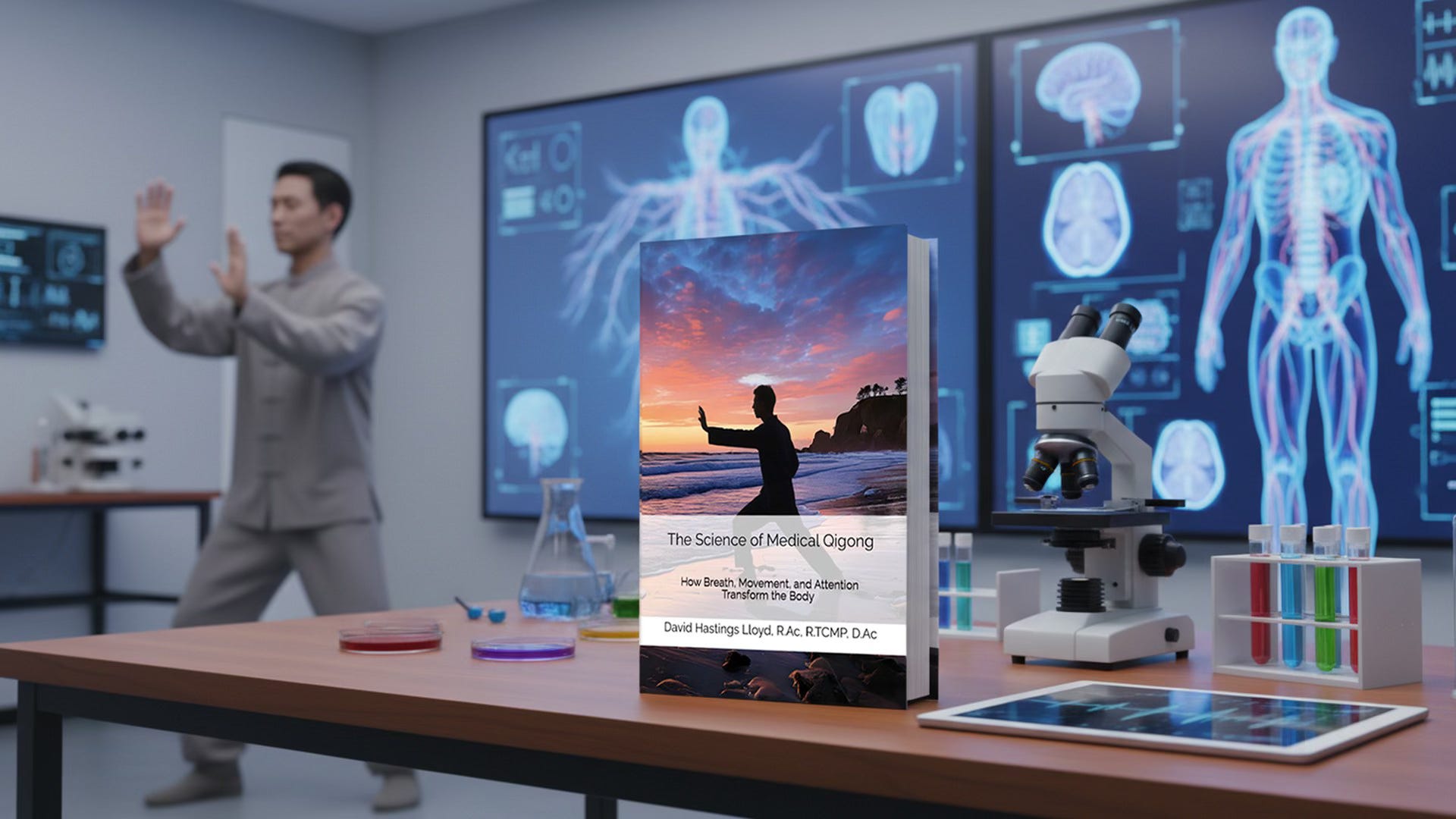
If this post resonated with you, you may enjoy my new book:
The Science of Medical Qigong: How Breath, Movement, and Attention Transform the Body
This book examines the growing body of scientific research exploring how Qigong practice influences human physiology. Drawing from clinical trials and experimental studies, it explains how coordinated breathing, posture, movement, and focused attention interact with the body’s regulatory systems.
The book explores research on:
• autonomic nervous system regulation
• cardiovascular function and blood pressure
• respiratory mechanics and lung capacity
• sleep quality and recovery
• inflammatory and immune signaling
• brain function and neural plasticity
• cognitive performance and mental health
Rather than presenting Qigong through mystical language, The Science of Medical Qigong approaches the subject through physiology, neuroscience, and clinical research, offering a clear explanation of how regular practice can influence the coordination and harmony of the body’s systems.
Available now in print and Kindle formats.
Click here to get your copy on Amazon
References
Basso, J. C., & Suzuki, W. A. (2017). The effects of acute exercise on mood, cognition, neurophysiology, and neurochemical pathways: A review. Brain Plasticity, 2(2), 127–152.
Oster, H., et al. (2017). The functional and clinical significance of the 24-hour rhythm of circulating glucocorticoids. Endocrine Reviews, 38(1), 3–45.
Chan, E. S., et al. (2013). Biochemical and psychometric evaluation of Self-Healing Qigong as a stress reduction tool among first year nursing and midwifery students. Complementary Therapies in Clinical Practice, 19(4), 179–183.
Lu, E. Y., et al. (2020). Qigong for the treatment of depressive symptoms: Preliminary evidence of neurobiological mechanisms. International Journal of Geriatric Psychiatry, 35(11), 1393–1401.
Ryu, H., et al. (1996). Acute effect of qigong training on stress hormonal levels in man. The American Journal of Chinese Medicine, 24(2), 193–198.
Liu, B., Jiao, J., & Li, Y. (1990). Effect of qigong exercise on the blood level of monoamine neuro-transmitters in patients with chronic diseases. Zhong Xi Yi Jie He Za Zhi, 10(4), 203–205, 195. Chinese-language article with an English abstract.
Kjaer, T. W., et al. (2002). Increased dopamine tone during meditation-induced change of consciousness. Cognitive Brain Research, 13(2), 255–259.