


In a 2014 study published in Evidence-Based Complementary and Alternative Medicine, Li and colleagues examined whether practicing Baduanjin Qigong could improve physical fitness and health markers in adults. The researchers conducted a randomized controlled trial to evaluate how a structured Baduanjin training program influences body composition, flexibility, and physiological measures over time.
Baduanjin is one of the most widely practiced forms of Qigong in China. The practice consists of a sequence of slow, coordinated movements performed with regulated breathing and attentive awareness. Unlike many forms of exercise that emphasize intensity or muscular effort, Baduanjin emphasizes controlled movement, postural coordination, and calm concentration.
What is Ba Duan Jin?
Baduanjin has been practiced in China for more than a thousand years and is commonly recommended as a health-promoting exercise in community programs. Despite its widespread use, relatively few controlled trials have evaluated its physiological effects in healthy adults.
Many previous studies of traditional Chinese exercises have focused on clinical populations, such as individuals with metabolic disorders or chronic illness. Research specifically examining healthy adults has been limited. This study was designed to explore whether a structured Baduanjin training program could produce measurable changes in physical fitness and health indicators in otherwise healthy individuals.
The researchers approached this question using a holistic framework. Instead of examining a single physiological marker, they evaluated several aspects of health including body composition, cardiovascular measures, respiratory function, and physical fitness.
What the Researchers Did
The researchers conducted a randomized controlled trial involving healthy adults between the ages of 20 and 59. Participants were recruited from the community around Wuhan Sports University and screened to ensure that they had no major chronic illnesses and did not already engage in regular moderate exercise.
A total of 110 participants were enrolled in the study and randomly assigned to one of two groups: a Baduanjin training group or a control group that maintained their usual lifestyle.
Numbers Behind the Study
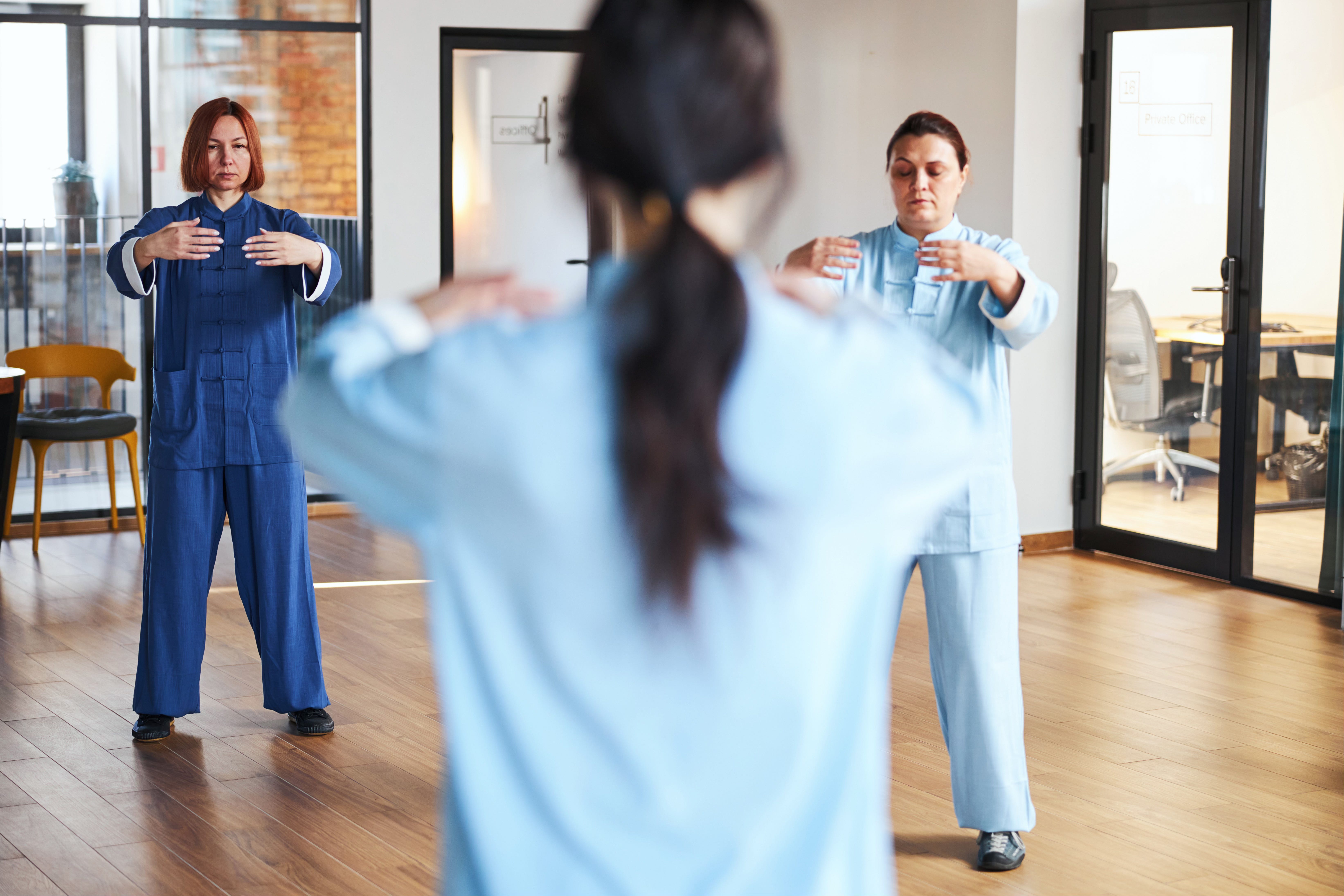
Participants in the intervention group practiced Baduanjin Qigong for 16 weeks, performing the exercise at least three times per week for 30 to 60 minutes per session. The training program included the traditional sequence of movements such as raising the arms to regulate the internal organs, drawing the bow posture, and lifting the heels to stimulate circulation. Researchers evaluated a wide range of physiological measures before and after the intervention, including blood lipids, blood pressure, heart rate variability, lung function, body composition, flexibility, balance, and aerobic capacity. Skinfold measurements at the scapula, triceps, and abdomen were used to estimate changes in body fat distribution, while flexibility was assessed using the sit-and-reach test.
What Changed
After sixteen weeks of training, several measurable changes appeared in the Baduanjin group.
One of the clearest findings involved body composition. Participants practicing Baduanjin showed reductions in subcutaneous fat at several anatomical locations. Skinfold thickness at the lower corner of the scapula, triceps brachii, and abdomen decreased significantly compared with the control group.
Flexibility also improved. The sit-and-reach test, which measures the ability to bend forward and stretch the hamstrings and lower back, showed a statistically significant improvement in the Baduanjin group. This suggests that the training enhanced joint mobility and muscular flexibility.
Other physiological markers showed smaller changes. Body weight and body mass index declined slightly in the intervention group but did not reach statistical significance. Measures such as blood glucose, blood lipids, heart rate variability, and lung function did not show major differences between groups during the study period.
Mechanism / Interpretation
Baduanjin combines moderate physical activity with controlled breathing and attentive movement. This combination creates a form of exercise that simultaneously engages muscular, respiratory, and neurological systems.
The movements of Baduanjin emphasize coordinated stretching of the spine, shoulders, hips, and lower limbs. Repeated practice of these patterns likely explains the improvement observed in flexibility testing. Increased joint mobility and improved muscle elasticity can enhance overall physical coordination and reduce the risk of injury.
The reduction in subcutaneous fat may reflect the cumulative effect of moderate aerobic activity performed consistently over several months. Even relatively gentle exercise can influence body composition when practiced regularly.
Another characteristic of Baduanjin is the requirement for coordination between movement, breathing, and attention. This integration may influence autonomic regulation and psychological state, although this particular study did not find large changes in measures such as heart rate variability or depression scores.
System-Level Framing
Health is influenced by the interaction of multiple physiological systems rather than a single biological marker. Exercise interventions often produce subtle improvements across several domains rather than dramatic changes in one variable.
This study illustrates that pattern. While blood lipids and cardiovascular measures remained relatively stable, the training produced improvements in flexibility and body fat distribution. These changes reflect the type of adaptation expected from moderate, sustained physical activity.
Baduanjin also emphasizes coordinated movement and posture control, which may contribute to broader functional benefits such as improved balance, physical coordination, and joint mobility.

Limitations
Several limitations should be considered when interpreting the findings. The participants were healthy adults rather than individuals with chronic disease, which may reduce the magnitude of measurable physiological changes.
The intervention lasted sixteen weeks, which is sufficient to observe some physical adaptations but may not be long enough to detect more substantial metabolic changes. The relatively small sample size also limits the ability to detect subtle physiological effects.
Finally, the study measured health markers at only two time points. More frequent measurements could provide a clearer picture of how physiological adaptations develop over the course of training.
Final Perspective
Baduanjin is often described as a gentle form of Qigong, yet this study demonstrates that consistent practice can produce measurable physical changes. Over a sixteen-week training period, participants practicing Baduanjin improved flexibility and reduced subcutaneous fat at several anatomical locations.
These results support the idea that traditional mind-body exercises can function as practical forms of moderate physical activity. For individuals seeking a low-impact exercise that combines movement, breathing, and attentional focus, Baduanjin may offer a structured approach to maintaining physical fitness.
Further research with larger samples and longer training periods will help clarify how this traditional practice influences metabolic health, cardiovascular regulation, and long-term physical function.
Reference
Li, R., Jin, L., Hong, P., He, Z.-H., Huang, C.-Y., Zhao, J.-X., Wang, M., & Tian, Y. (2014). The effect of Baduanjin on promoting the physical fitness and health of adults. Evidence-Based Complementary and Alternative Medicine, 2014, Article 784059

Like what you read? Keep exploring…

If this post resonated with you, you may enjoy my new book:
The Science of Medical Qigong: How Breath, Movement, and Attention Transform the Body
This book examines the growing body of scientific research exploring how Qigong practice influences human physiology. Drawing from clinical trials and experimental studies, it explains how coordinated breathing, posture, movement, and focused attention interact with the body’s regulatory systems.
The book explores research on:
• autonomic nervous system regulation
• cardiovascular function and blood pressure
• respiratory mechanics and lung capacity
• sleep quality and recovery
• inflammatory and immune signaling
• brain function and neural plasticity
• cognitive performance and mental health
Rather than presenting Qigong through mystical language, The Science of Medical Qigong approaches the subject through physiology, neuroscience, and clinical research, offering a clear explanation of how regular practice can influence the coordination and harmony of the body’s systems.
Available now in print, Kindle, and audiobook formats.
Click here to get your copy on Amazon