

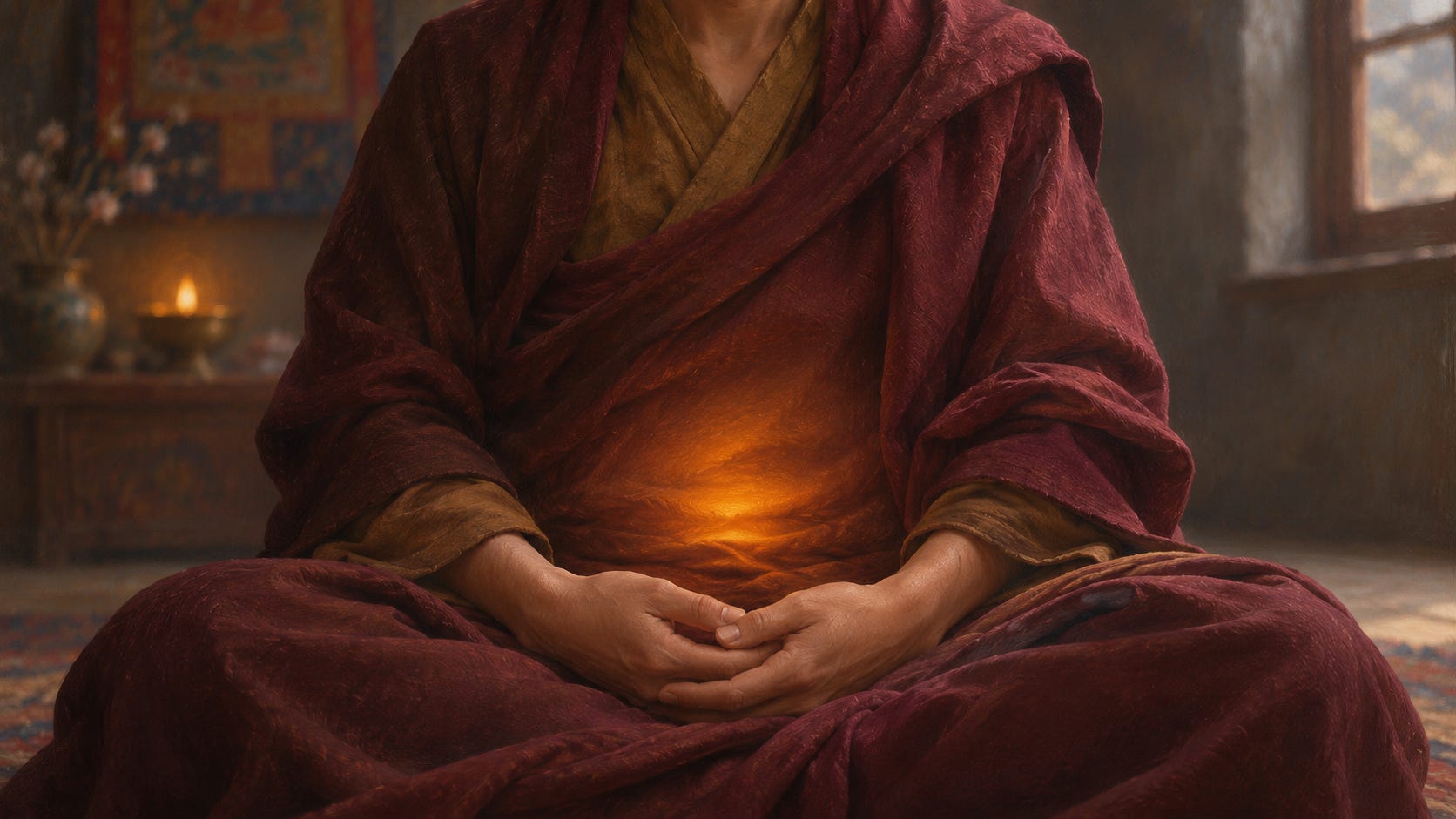
Experienced Tummo practitioners have produced measurable changes in body temperature during meditation. Researchers have recorded substantial warming in the fingers and toes. Later research found that armpit temperature continued to rise for longer when experienced practitioners included visualization in the physical practice. These findings offer a way to investigate how breathing, muscular effort, and focused attention work together. Benson and colleagues, 1982; Kozhevnikov and colleagues, 2013.
Tummo is commonly known as inner heat or inner fire. You may have encountered it through accounts of meditators practicing in Himalayan cold. Much of their work involves attention, imagery, and physical coordination that an observer cannot easily see.
Understanding Tummo means looking at that work alongside the tradition in which it developed. The physiology explains aspects of breathing and warming. The Buddhist teachings explain the purpose of the meditation and the place of inner heat within a path of spiritual development.
Tummo in Its Tibetan Buddhist Setting
Tummo belongs to the Tibetan Buddhist tradition of Vajrayana, in which meditation can involve detailed imagery and coordinated bodily methods. It has a prominent place in the Six Yogas of Naropa, a group of advanced practices transmitted through generations of teachers and students. Lama Yeshe’s teachings on these practices give particular attention to inner fire.
In this context, developing bliss supports cultivating concentration and insight. In Lama Yeshe’s explanation of inner heat meditation, a pleasurable, concentrated state of mind becomes a basis for investigating experience. The practitioner considers the nature of the feeling and the mind experiencing it, with awakening for the benefit of others as the larger aim. Motivation gives the method its direction.
Traditional teaching therefore addresses the student’s intention as well as the experience of practice. A teacher may be concerned with how a student understands the meditation, whether attention remains steady, and how the experience relates to Buddhist practice. These considerations help guide the student’s development.
A Coordinated Physical and Mental Practice
Tummo brings specialized breathing and muscular activity together with sustained visualization. These elements form a coordinated task. The practitioner follows a bodily method while maintaining an intended focus, often using imagery associated with inner fire.
Coordination is familiar from other learned skills. When you first learn to play an instrument, following the rhythm can compete with remembering where to place your fingers. With practice, the movements become more familiar and require less conscious checking. You have more attention available for the music. A complex meditation likewise involves learning to carry out several demands at once.
From outside, a person may appear to be sitting almost motionless. That appearance tells you little about the effort involved. Muscles can maintain tension without visible movement, and keeping a mental image steady requires attention. Breathing may also involve a workload quite different from ordinary resting breathing.
A short description of the technique captures little of this skill. Knowing the order of the actions and coordinating them are different accomplishments. Familiarity, timing, and the quality of instruction all affect how a person learns.
What Researchers Have Measured
In a 1982 Nature study, Herbert Benson and his colleagues recorded temperature changes in three experienced Tummo practitioners. Finger and toe temperatures rose during practice, with the largest increase reaching 8.3°C, nearly 15°F. Rectal temperature remained unchanged. The recordings showed substantial warming at the extremities while deeper body temperature stayed stable. Benson and colleagues.
That pattern is easier to understand when you think about your own hands on a cold day. Your fingers can feel very cold while your torso remains comfortably warm. As blood flow and conditions change, the fingers can warm considerably. Temperature varies across the body, and where you measure it tells you what has changed.
Maria Kozhevnikov and her colleagues later compared the physical components of Tummo with the fuller meditation. During a forceful form of the practice, experienced meditators reached higher armpit temperatures, and their temperatures continued rising for longer when they included their usual visualization. The highest reading was 38.3°C (about 101°F). The authors proposed that the physical component generated heat while the meditative component helped sustain the rise. Kozhevnikov and colleagues.
How the Body Produces and Distributes Heat
Your body produces heat continuously as it uses energy. Even when you sit quietly, your organs remain active, and your cells carry out the work needed to maintain life. Muscular effort adds to that energy use. Walking uphill makes the effect obvious, but muscles also produce heat when they hold a position.
Imagine holding a moderately heavy book at arm’s length. Once your arm is in place, there may be little visible movement, yet you can feel the continuing effort. The muscles maintain tension and use energy. This is an isometric contraction. A still posture can therefore involve considerable muscular activity.
Breathing muscles contribute as well. The diaphragm contracts during inhalation, and other muscles assist as breathing demands increase. More forceful breathing increases the work these muscles do. Deliberate contractions elsewhere in the body add further activity.
Circulation then helps distribute the heat. Blood exchanges heat with the tissues it passes through, carrying warmth from active areas toward other parts of the body. Changes in blood flow near the skin influence how warm the surface becomes and how readily heat passes into the surroundings.
The surroundings matter too. Clothing, air movement, and room temperature affect heat loss. You can produce more heat while also losing it more quickly, leaving your temperature relatively stable. Producing heat, moving it through the body, and retaining it are related processes, each contributing to what a thermometer records.
Why Breathing Deserves a Closer Look
Breathing normally continues automatically, yet you can deliberately change its pace and depth. You can alter a process that usually takes care of itself, with effects that involve both muscular work and the exchange of gases.
Oxygen supports the chemical reactions through which your cells obtain usable energy from fuel. Carbon dioxide is a product of that activity, and breathing helps regulate how much remains in the blood. Carbon dioxide also influences acidity and contributes to the signals that regulate breathing.
When breathing increases beyond what metabolism requires, carbon dioxide can fall. During a breath hold, carbon dioxide generally rises as the tissues continue producing it. These changes influence bodily sensations and the urge to breathe. The effects depend on how breathing changes, including its depth, pace, and pauses.
Breathing also changes pressures within the chest and abdomen. The diaphragm, abdominal muscles, and surrounding tissues participate in these changes, linking breathing to posture and muscular coordination.
For understanding Tummo, this gives you a more useful picture than counting breaths alone. The physical effects depend on how air movement, effort, and retention periods are arranged. Learning that relationship takes clear instruction and gradual familiarity with the method.
Visualization as a Mental Skill
Visualization involves forming and maintaining a mental image. You may recognize this ability when you picture a familiar room or the route to a friend’s home. Some images appear readily; others are faint or disappear as your attention moves elsewhere.
In meditation, the image becomes an object of sustained attention. The practitioner maintains the intended image while sensations and thoughts continue to arise. There is a difference between briefly bringing an image to mind and staying with it while carrying out a physical method.
Research outside Tummo provides an interesting example of imagery influencing the body. In a 2022 study, imagining bright shapes produced smaller pupils than imagining dark shapes. The response was greater when people reported more vivid imagery. An imagined visual quality was accompanied by a measurable physical response. Kay and colleagues, eLife.
In Tummo, visualization gives attention a defined object and connects bodily actions to the practice's traditional meaning. Thinking about a flame, maintaining its image, and experiencing warmth are distinguishable parts of the task, even when they occur together.
An image can be vivid yet difficult to sustain. A sensation can become strong enough to draw attention away from the intended focus. Maintaining the meditation through these changes is part of the skill a practitioner develops.
Warmth, Sensation, and Attention
Warmth is something you feel as well as something that can be measured. A sensation may seem concentrated in one area, spread across the skin, or become more noticeable when you attend to it. Your description tells another person what the experience is like from within.
A sensor records temperature at its location over time. Researchers can compare that record with what the person reports to examine how measured warming relates to the sensation.
You can recognize attention's role in ordinary experience. The pressure of a chair against your back may go unnoticed while you read, then become obvious when you think about your posture. The contact was already present. Directing attention toward it changed what you noticed.
This is useful when reading accounts of inner heat. A description of spreading warmth may tell you about the person’s experience, while a temperature trace shows what happened at the measured site. Understanding both allows you to appreciate the experience and follow the physiological explanation with greater precision.
Beginning with Understanding
If Tummo interests you, its background and physiology provide a substantial starting point. You can learn why muscular effort produces warmth, how breathing changes bodily conditions, and what it means to sustain a visualization. Each explanation makes the practice more intelligible before you encounter its detailed instructions.
The traditional setting also helps you decide what you want to study. You may be drawn primarily to the physiology of breathing, to meditation and attention, or to the Buddhist path in which Tummo has its place. Knowing your interest helps you choose appropriate material and instruction.
Demanding methods involving forceful breathing and retention call for preparation and a qualified teacher who can assess your technique. Understanding the principles helps you ask better questions and follow the reasons behind the guidance.
Explore Further with Understanding Tummo
My book, Understanding Tummo: The Science of Breathing, Inner Heat, and Attention, develops these subjects through illustrated explanations of the body, scientific research, and the practice's traditional background.
You can follow how the breathing muscles work together, how the body produces and distributes heat, and how attention shapes the meditation experience. The practical chapters develop the breathing material in greater detail, with guidance on posture, preparation, and recovery. A glossary and research guide support further study.
If you want to study inner heat in greater depth, the book gives you space to work through the explanations at your own pace, with illustrations you can refer to as you read.
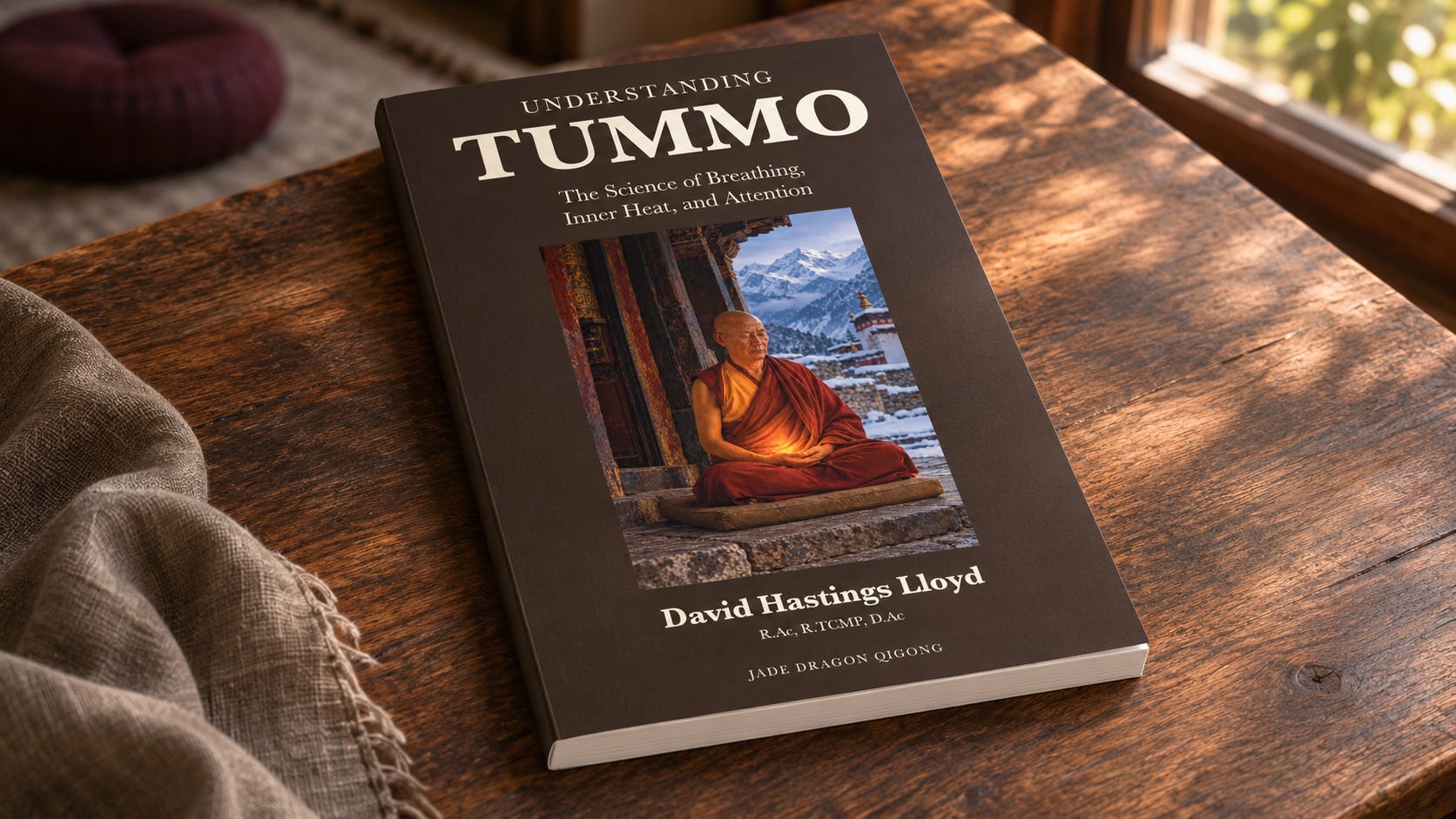
If this post resonated with you, you may enjoy my new book:
Understanding Tummo: The Science of Breathing, Inner Heat, and Attention
This illustrated book explores the Tibetan practice of inner heat through scientific research and traditional teachings. It explains how breathing, muscular effort, and focused attention work together during practice, with clear descriptions of the physiology behind warmth and breath retention.
The book explores:
Tummo’s traditional background and purpose
Breathing mechanics and muscular coordination
Heat production, circulation, and heat conservation
Carbon dioxide and the urge to breathe
Attention, visualization, and body awareness
Introductory breathing exercises and a separate modern breathing and visualization sequence
Posture, preparation, and recovery
Understanding Tummo connects the practical methods with explanations of what happens in the body. You can follow the illustrations at your own pace and use the glossary and research guide to explore the subjects that interest you most.
Available now in print and Kindle formats.
quick question: is the book AI written?