

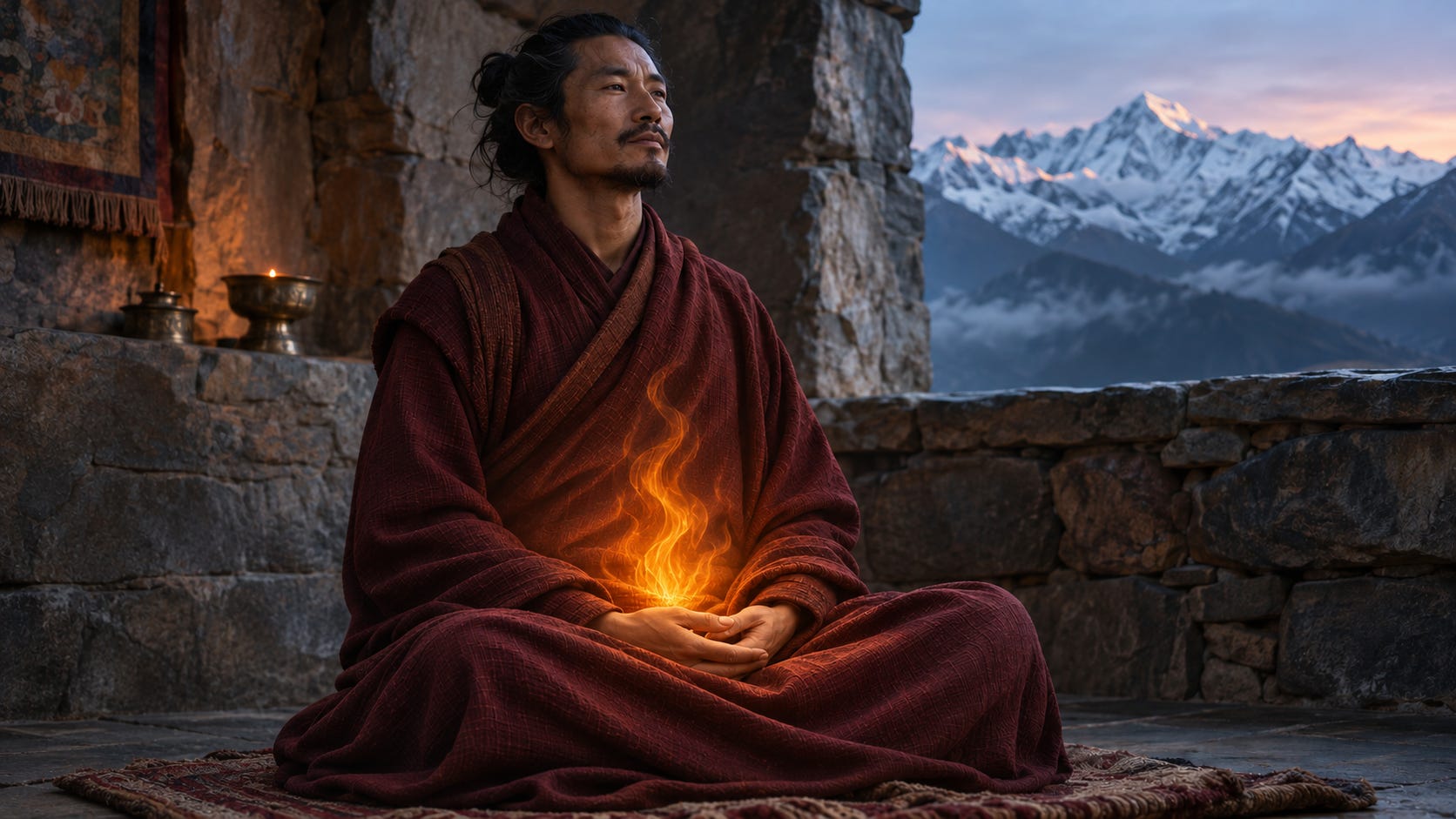
Tummo is a Tibetan Buddhist meditation practice often called “inner fire.” It brings together breathing, muscle tension, visualization, and sustained attention.
Research has recorded temperature increases during this practice. Understanding how those parts work together also highlights an interesting feature of breathing: carbon dioxide helps influence how readily your blood releases oxygen. Kozhevnikov et al., 2013; Collins et al., 2015.
That relationship is known as the Bohr effect.
Breathing within the traditional practice
Tummo includes a method called vase breathing. After inhaling, the practitioner holds the breath while engaging the abdominal and pelvic muscles. Breathing and muscular effort are coordinated with visualization and concentration. Kozhevnikov et al., 2013.
Lama Thubten Yeshe describes this practice in The Bliss of Inner Fire. His teaching draws on Je Tsongkhapa’s commentary on the Six Yogas of Naropa, a system of Buddhist meditation practices. Tsongkhapa’s commentary is also available in Glenn H. Mullin’s translation, The Six Yogas of Naropa.
In these teachings, inner fire belongs to a path of cultivating bliss and insight, with breathing, concentration, and visualization supporting that work.
How carbon dioxide helps oxygen reach your tissues
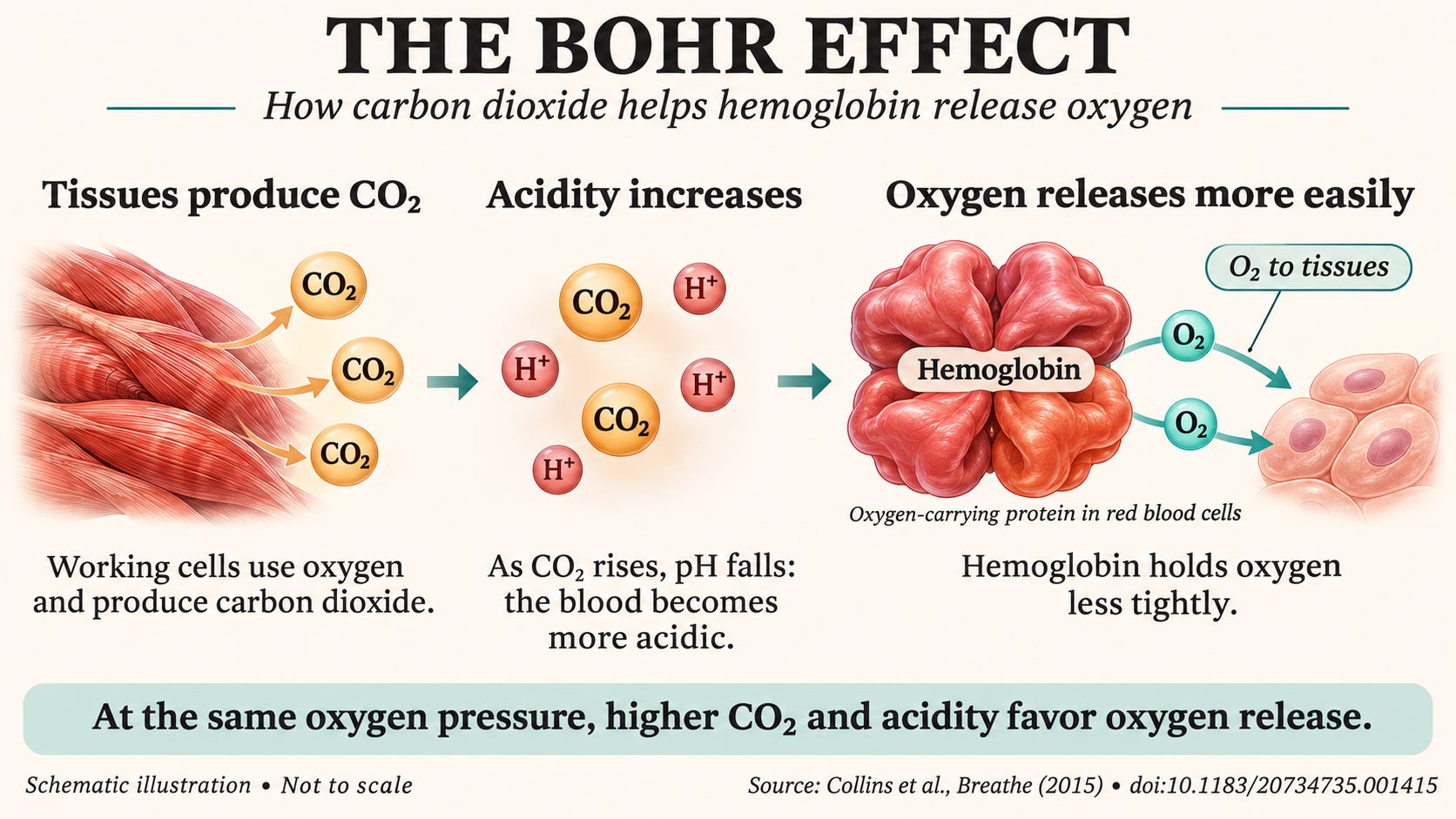
Most of the oxygen in your blood travels attached to hemoglobin, a protein inside red blood cells. Hemoglobin picks up oxygen in the lungs and releases it as blood travels through the body.
How tightly it holds that oxygen depends partly on carbon dioxide.
As your tissues use oxygen, they produce carbon dioxide. A rise in carbon dioxide can make the surrounding blood slightly more acidic. This change encourages hemoglobin to release oxygen more easily.
That is the Bohr effect. It helps oxygen become available in tissues that are actively using it. You may see this described as a change in pH, which measures how acidic or alkaline something is. A lower pH means greater acidity. Collins et al., 2015; Malte and Lykkeboe, 2018.
Warmth also encourages hemoglobin to release oxygen. This temperature response is separate from the Bohr effect, although both can influence oxygen release during practice that changes breathing and body temperature. Collins et al., 2015.
When breathing lowers carbon dioxide
Your carbon dioxide level reflects a balance between how much your body produces and how much you breathe out.
If you breathe more air than your body needs at that moment, you can remove carbon dioxide faster than your tissues produce it. This is called hyperventilation.
As carbon dioxide falls, the blood becomes less acidic, and hemoglobin holds oxygen more tightly.
Breathing forcefully does not necessarily mean you are hyperventilating. “Forceful” describes the effort involved. Hyperventilation means that breathing exceeds the body’s current needs. Collins et al., 2015.
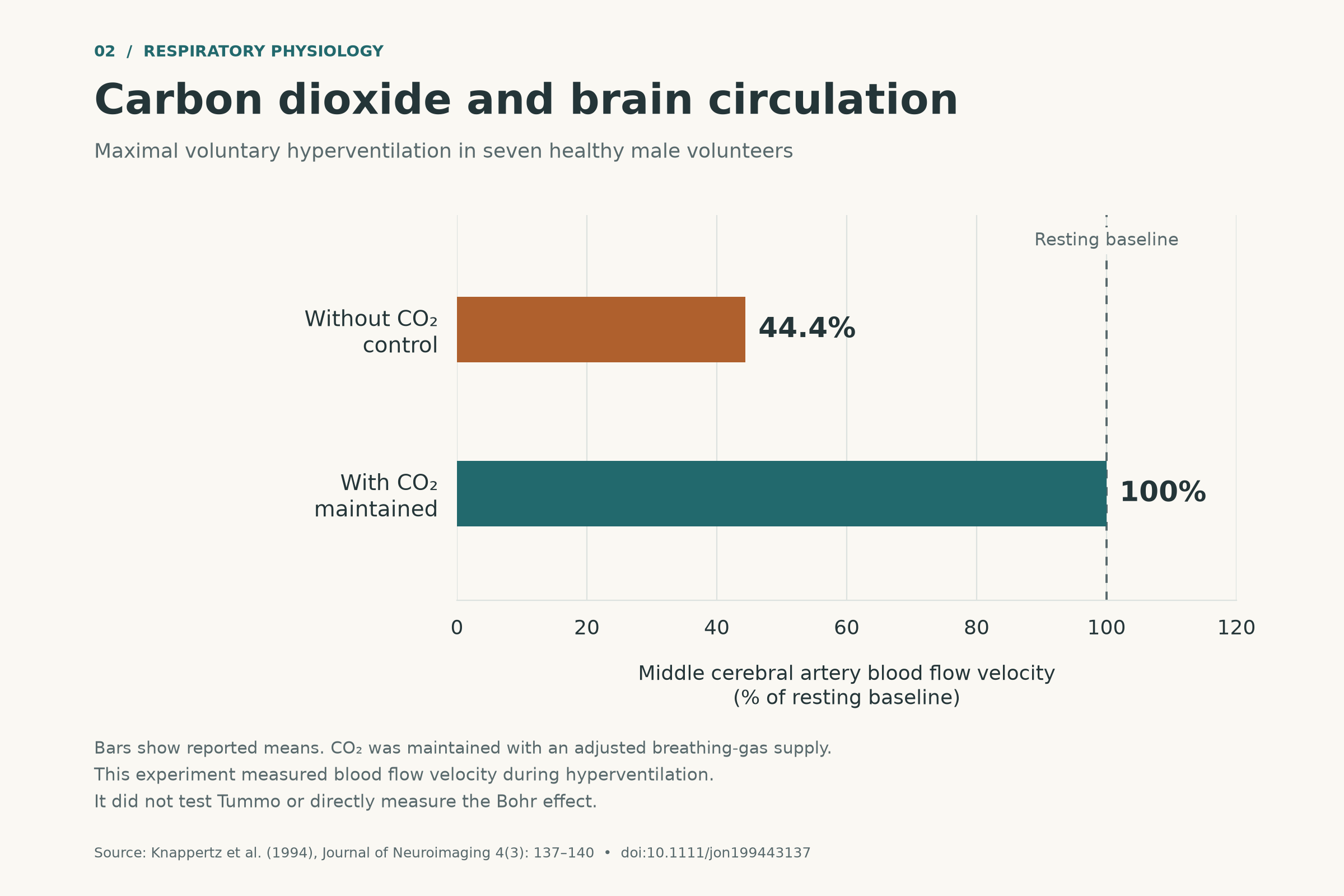
Carbon dioxide also affects circulation in the brain. Knappertz and colleagues measured how quickly blood moved through a major artery supplying the brain during voluntary hyperventilation. Blood flow velocity fell. When the researchers kept carbon dioxide levels steady during the breathing, that drop disappeared. Knappertz et al., 1994.
What happens when you hold your breath
During a breath hold, your body keeps working. Your tissues continue to use oxygen and produce carbon dioxide, even though fresh air is no longer entering your lungs.
Oxygen reserves gradually fall, while carbon dioxide rises from whatever level it had reached before the hold.
If the earlier breaths removed a substantial amount of carbon dioxide, the beginning of the hold may bring it back toward its usual level. A breath hold therefore begins with conditions created partly by the breathing that came before it. Parkes, 2006.
As carbon dioxide rises and the blood becomes more acidic, hemoglobin releases oxygen more easily. But the amount of oxygen remaining in the body is also decreasing.
To receive oxygen, your tissues need blood carrying enough oxygen to reach them, as well as hemoglobin that releases it. Easier release alone cannot tell us whether the tissues are receiving more oxygen overall. Collins et al., 2015; Parkes, 2006.
During vase breathing, breath-holding could affect oxygen release through changes in carbon dioxide and acidity. Whether the Bohr effect contributes to Tummo’s heat production remains a research question.
What researchers have measured during Tummo
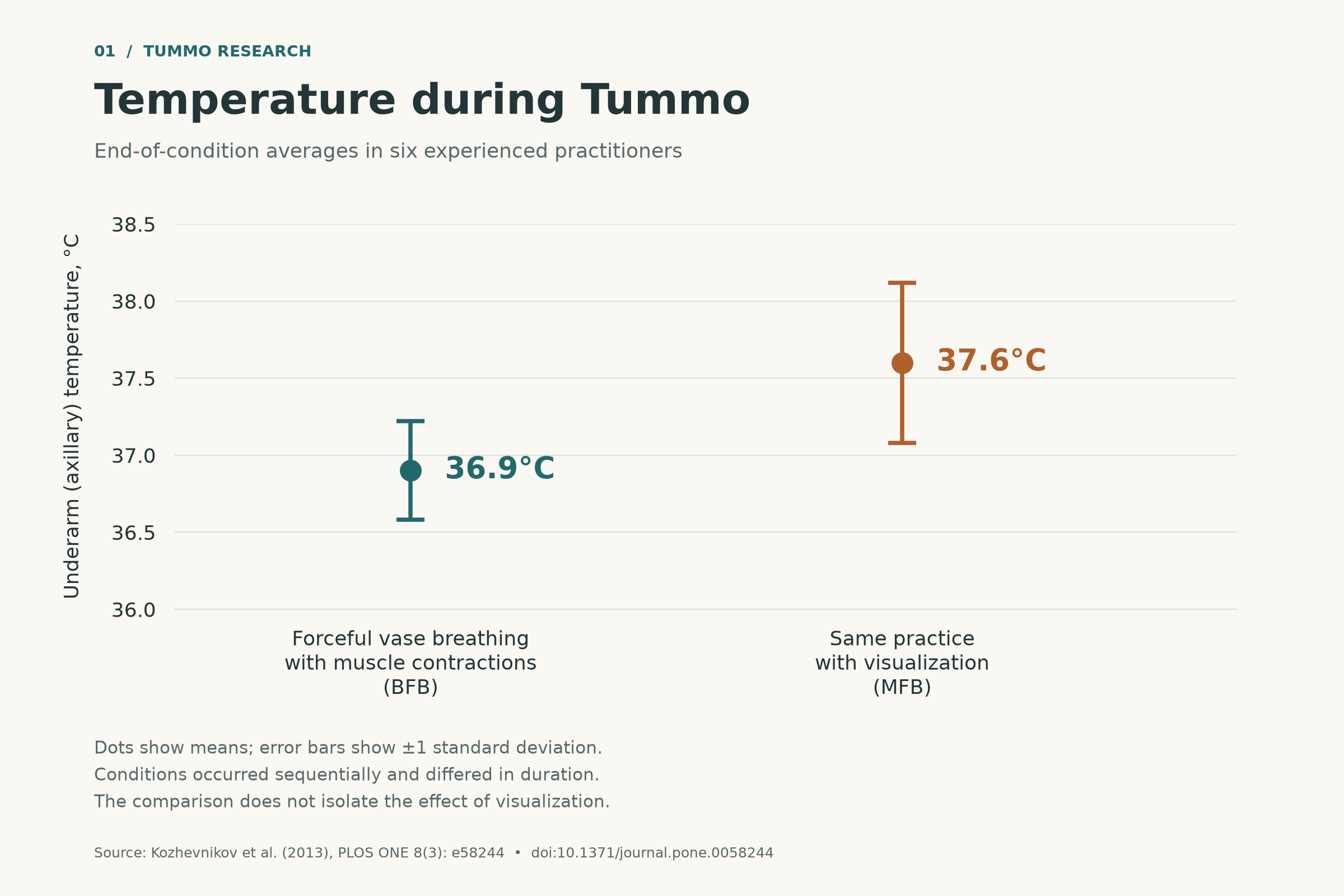
In 2013, Maria Kozhevnikov and colleagues studied temperature changes during Tummo. They recorded increases in underarm temperature during the forceful-breath form of the practice, with the highest measurement reaching 38.3°C, or about 100.9°F.
Breathing and sustained muscle contractions produced temperature increases even without visualization. Among experienced practitioners, the practice that included visualization was associated with larger, more sustained increases. Kozhevnikov et al., 2013.
Longer breath holds performed with muscle tension were also associated with faster warming. During those holds, practitioners continued to exert their muscles while breathing was paused. Kozhevnikov et al., 2013.
Breathing, muscles, and attention
The connection between Tummo and the Bohr effect begins with a simple observation: while you hold your breath, your body continues to work. Your tissues use oxygen and produce carbon dioxide. As that balance changes, so does the ease with which hemoglobin releases oxygen.
How much this contributes to Tummo’s heat production remains an open question. Researchers have measured warming during the combined work of breathing, muscle tension, and meditation, with visualization associated with larger, more sustained temperature increases. Kozhevnikov et al., 2013.
The traditional teachings place these elements within a practice of cultivating bliss and insight. Physiology helps us understand the bodily changes involved. Together, they give us a fuller picture of Tummo: a practice in which the breath, working muscles, and trained attention act together.
Books and peer-reviewed sources
Lama Thubten Yeshe. The Bliss of Inner Fire: Heart Practice of the Six Yogas of Naropa. Wisdom Publications. Chapter 16, “Vase Breathing Meditation,” is the principal source for the traditional breathing discussion.
Tsongkhapa. The Six Yogas of Naropa: Tsongkhapa’s Commentary. Translated by Glenn H. Mullin, 2005. Classical background to the tradition discussed here.
Collins, J.-A., et al. Relating oxygen partial pressure, saturation and content: the haemoglobin–oxygen dissociation curve. Breathe, 2015; 11:194–201. Physiological explanation and analysis of clinical blood samples.
Malte, H., and Lykkeboe, G. The Bohr/Haldane effect. Journal of Applied Physiology, 2018; 125:916–922. Mathematical modeling of gas exchange.
Knappertz, V. A., et al. Control for carbon dioxide-related changes in flow velocity by transcranial Doppler monitoring. Journal of Neuroimaging, 1994; 4:137–140. Human hyperventilation experiment.
Parkes, M. J. Breath-holding and its breakpoint. Experimental Physiology, 2006; 91:1–15. Review of human breath-holding physiology.
Kozhevnikov, M., et al. Neurocognitive and Somatic Components of Temperature Increases during g-Tummo Meditation: Legend and Reality. PLOS ONE, 2013; 8. Direct research on Tummo.
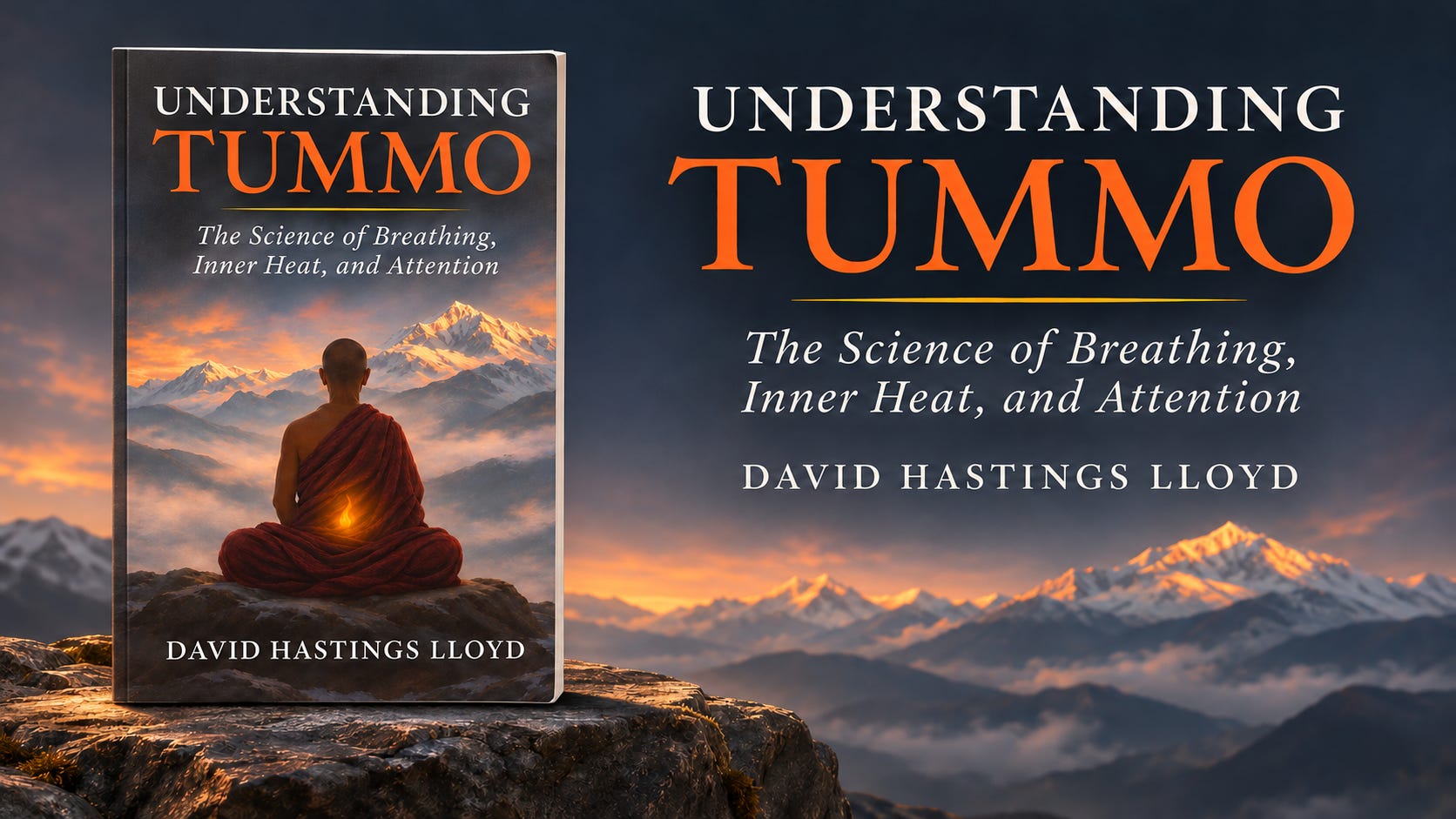
If this post resonated with you, you may enjoy my new book, Understanding Tummo: The Science of Breathing, Inner Heat, and Attention.
This illustrated book brings together traditional Tibetan teachings and scientific research to explain breathing, muscular coordination, heat production, carbon dioxide, and focused attention.
It includes introductory breathing exercises, a separate modern breathing-and-visualization sequence, and guidance on posture, preparation, and recovery. You’ll also find a glossary and research guide.
Available now in print and Kindle formats.