

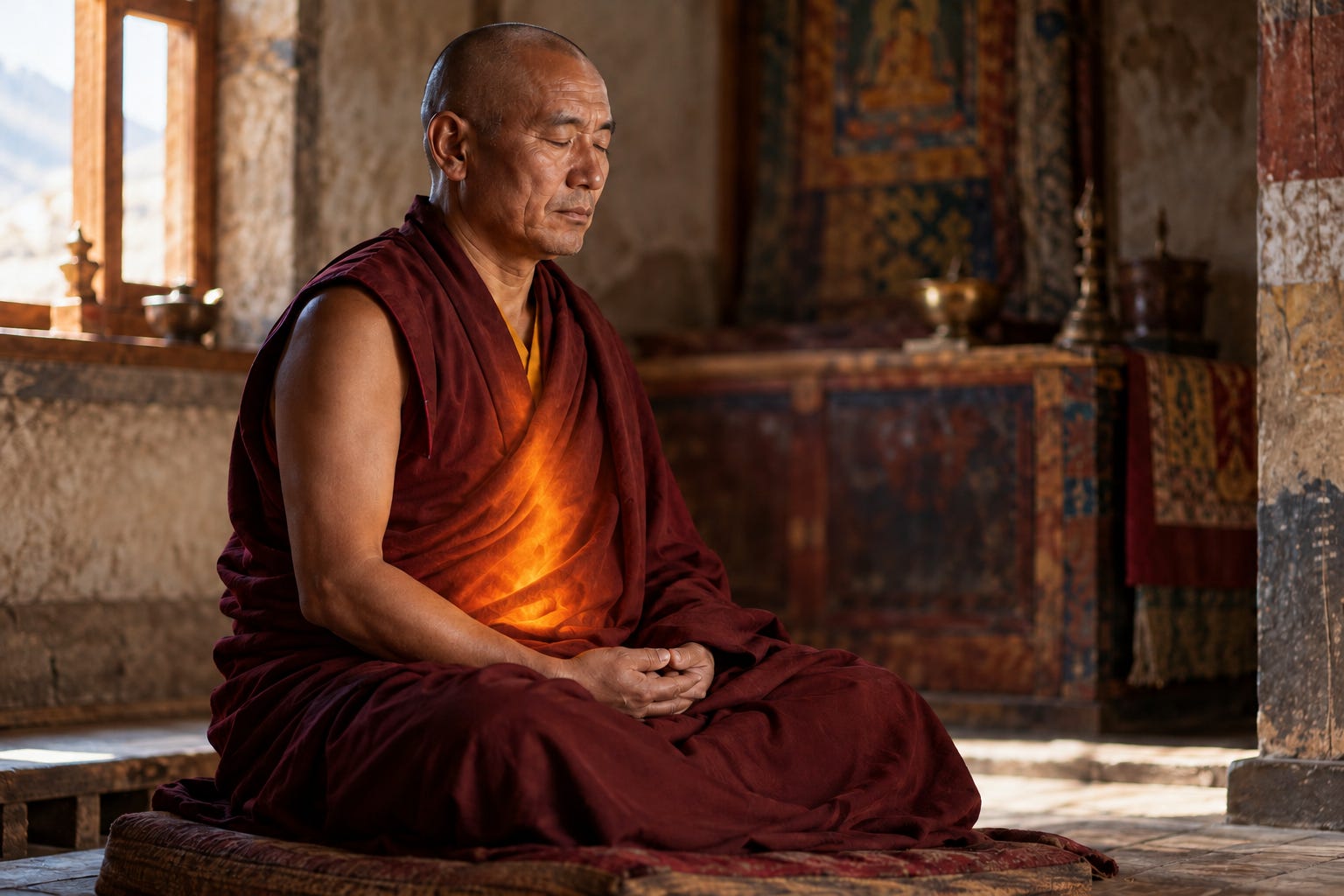
A Tibetan meditator’s toe temperature rose by 8.3 degrees Celsius, nearly 15 degrees Fahrenheit, during research conducted by Herbert Benson and his colleagues in 1981. Their findings, published in Nature, documented substantial warming in the fingers and toes of three experienced Tummo practitioners. Temperature measured deeper inside the body remained unchanged.
The observation brought scientific attention to Tummo, the Tibetan Buddhist practice commonly called inner heat or inner fire. It also offered a striking example of how a person sitting in meditation could influence bodily functions that usually operate outside conscious attention.
Tummo combines physical methods with sustained meditation. Within Tibetan Buddhism, it belongs to a broader path concerned with spiritual development, including the cultivation of bliss and insight. The warmth that attracts scientific interest occurs within a practice that has a much larger purpose for the person undertaking it.
For anyone interested in breathing and meditation, the research raises an intriguing subject: how physical effort and focused mental activity work together.
What the Early Temperature Findings Reveal
Benson’s observations are especially interesting because the warming occurred in particular parts of the body. Your fingers and toes can change temperature considerably while the temperature deeper inside your body remains relatively stable.
You may recognize this from ordinary experience. Your hands can feel cold while your chest remains warm. When circulation to the hands changes, their temperature can change with it. Heat production, blood flow, and heat loss all contribute to the temperature recorded at a particular location in the body.
The early Tummo findings therefore drew attention to how the body distributes heat. They also established a useful distinction for understanding later research: warming at the skin and a rise in temperature deeper inside the body describe different physiological changes.
What makes Tummo unusual is the setting in which these changes occur. A seated practitioner may appear relatively still, yet the practice involves physical effort and sustained concentration. The visible posture reveals only part of the activity.
The Contribution of Visualization
Some of the most interesting findings emerged when researchers examined the visualization alongside the physical techniques.
In a 2013 study led by Maria Kozhevnikov, experienced practitioners in eastern Tibet produced larger, more sustained increases in armpit temperature when they combined forceful Tummo’s physical actions with visualization. Readings reached 38.3 degrees Celsius, about 101 degrees Fahrenheit.
The physical components alone also produced warming, including in people without meditation experience. Among experienced practitioners, visualization accompanied a different response: they sustained the temperature increase for longer.
The researchers proposed that the physical actions generated heat while meditation helped maintain the increase, possibly by influencing heat loss. This gives the mental component a concrete place in the investigation. Understanding the breathing alone would leave out part of the practice associated with the observed warming.
Visualization in this setting is a sustained task. The practitioner maintains specific imagery while engaging in the physical aspects of the meditation. Attention and bodily activity occur together throughout the practice.
That relationship is one of the most compelling aspects of the research. A mental task performed alongside physical activity accompanied a measurable difference in temperature.
Meditation Can Involve Physical Activation
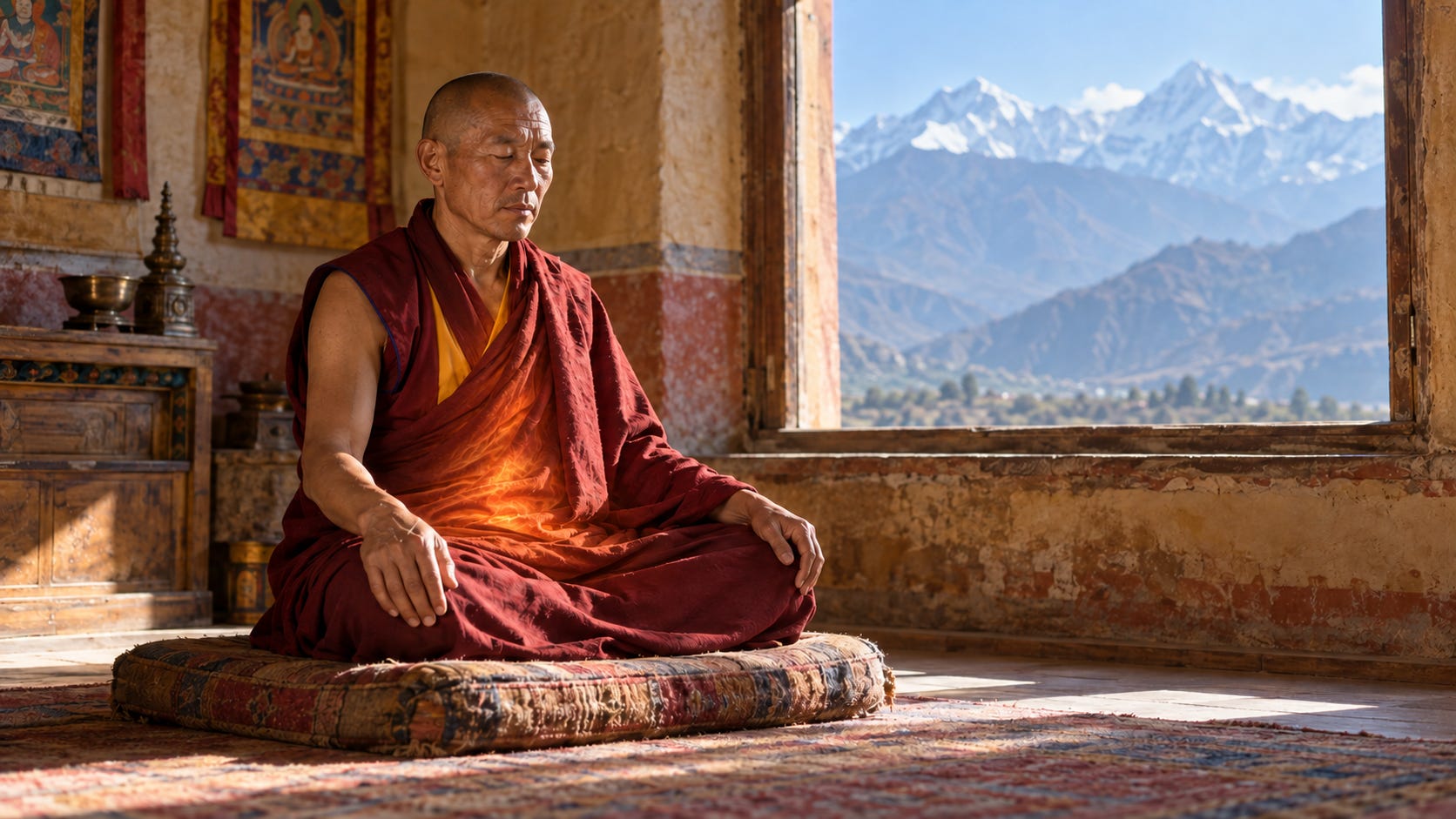
You may associate meditation with easy breathing, relaxation, and a gradual slowing of activity. Tummo offers another example of what meditation can involve.
In a 2022 study of experienced Vajrayana, or tantric Buddhist, practitioners, researchers recorded brain and heart activity during several meditations, including Tummo. They interpreted the Tummo findings as consistent with increased physiological arousal and changes in attentional control.
Here, arousal refers to physiological activation. Concentration can accompany that activation, just as a musician can remain intensely attentive while performing a demanding passage. Physical effort and focused attention can occur together.
This helps explain why different meditation methods can produce different experiences. The amount of muscular activity, the breathing method, and the task occupying attention all contribute to what the practitioner is doing.
Seeing Where the Body Warms
More recently, researchers have used thermal imaging to observe the distribution of warmth across the body.
A 2026 case report in Human Physiology followed one experienced monk across four sessions. Infrared images recorded warming over the abdomen during meditation that persisted afterward. The strongest warming occurred during a breathing stage accompanied by visualization.
These images add something useful to the earlier temperature readings: a view of where the skin warms and how that warmth changes during practice. They extend the investigation from a temperature recorded at one location to a pattern visible across the body’s surface.
The studies approach Tummo from different directions, but each helps make an aspect of the practice more understandable. Temperature measurements reveal warming. Comparisons between physical techniques and combined meditation examine the contribution of visualization. Brain and heart recordings offer another way to investigate the activity occurring during practice.
For practitioners, these physical changes belong within a contemplative tradition concerned with how they experience and understand the world. Keeping that context in view gives the scientific findings a fuller meaning.
If this post sparked your curiosity, you may enjoy my book, Understanding Tummo: A Scientific Analysis of Breathing, Inner Heat, and Physiology. It also comes with an abridged audio version that you can download as MP3s.
Through clear explanations and illustrations, it explores Tummo breathing, the role of visualization, and how the body produces and regulates heat. The book connects this research with Tummo’s Tibetan Buddhist background, helping you understand the physical practice alongside its traditional purpose.
The practical sections guide you through progressive exercises that lead up to “inner fire” breathing, with each stage preparing you for the next. The teaching respects Tummo’s history and traditional practice while drawing on modern research to explain how the breathing techniques affect the body.
