


In Qigong, one of the simplest instructions is to bring your attention to the lower abdomen and let it rest there as you breathe. If you place a hand below your navel, you can feel the movement almost immediately. During relaxed abdominal breathing, the abdominal wall moves outward as you inhale and draws back as you exhale. Stay with it for a few minutes, and you may notice a deeper sense of fullness, or a movement that continues after the breath has turned. The breath gives you a rhythm to follow. The abdomen has other rhythms of its own.
In Daoist cultivation, the region deep in the abdomen below the navel is called the xia dantian (下丹田), the Lower Dan Tian or lower cinnabar field. Traditional descriptions vary in how far below or behind the navel they place it, but they agree on its importance as a place where practitioners gather and refine qi. I find the word field helpful here. It invites you to attend to a region of the body over time. You can follow that instruction without having to locate a precise spot on your skin.
What interests me about the gut microbiome, the community of microorganisms living in the digestive tract, is that researchers have studied it in people practicing Qigong. By collecting stool samples before and after a period of practice, they could see whether particular bacteria became more or less abundant. One trial even examined a traditional method that explicitly asks practitioners to keep their attention on the Dan Tian. To understand what those findings offer, it helps to begin with what the bacteria in the abdomen are doing before practice starts.
What happens to the fiber in a meal
Consider what happens after you eat a bowl of beans. Your digestive enzymes break down much of the meal in the small intestine, where nutrients can be absorbed. Some of the carbohydrates, including certain kinds of fiber, pass on to the colon. Here they encounter the largest bacterial population in the body. These organisms have enzymes that allow them to break down material our own enzymes leave behind. Through fermentation, they produce gases and small molecules called short-chain fatty acids. Both can affect us in quite different ways.
In 2014, Kathryn Murray and her colleagues used MRI to track gas in the colon after healthy volunteers drank different carbohydrate solutions on separate days. One drink contained glucose, which is readily absorbed in the small intestine. Another contained inulin, a fiber that reaches the colon and is fermented there. Over the next five hours, the scans showed significantly more gas in the colon after inulin than after glucose. Yet the volunteers reported few symptoms. A change large enough to see on a scan could pass with little conscious notice.
That observation is relevant to standing meditation. As the diaphragm descends on an inhalation, it displaces the abdominal contents and the relaxed abdominal wall can move outward. You can recognize this movement because it follows the breath. Stretch in the bowel provides another source of sensory information. In human experiments, researchers have recorded the brain’s response when a small balloon briefly stretches the rectal wall. Stretch in the bowel may contribute to a feeling of fullness that you notice while following the breath. Fermentation is one possible contributor. How much gas is present and how strongly you feel the stretch are separate questions.
How the gut influences the rest of the body
Some of the most interesting activity in the abdomen produces no recognizable sensation at all. Take butyrate, one of the short-chain fatty acids produced by gut bacteria. Cells lining the colon absorb butyrate and use it as a major energy source. There is a remarkable partnership in that simple act of digestion. Fiber that passes through the small intestine still has nutritional value for you because bacteria transform it into something the cells of your bowel can use.
The effects of these compounds can also reach beyond the bowel. In a 2020 study involving 66 healthy men, Boushra Dalile and her colleagues used capsules designed to release a mixture of short-chain fatty acids in the colon. After a week, participants completed a laboratory stress test that included holding a hand in cold water and doing mental arithmetic while being observed. Compared with the placebo group, the men who received the fatty acids had a smaller rise in cortisol, a hormone the body releases in response to stress. Their mood ratings showed no corresponding difference.
Giving the men these fatty acids in capsules allowed the researchers to study their effect without relying on gut bacteria to produce them. Chemicals ordinarily produced during fermentation can influence the hormonal response to a challenge. One reason the Baduanjin research caught my attention is that it identified a change in a bacterium that produces butyrate.
What changed after six months of Baduanjin
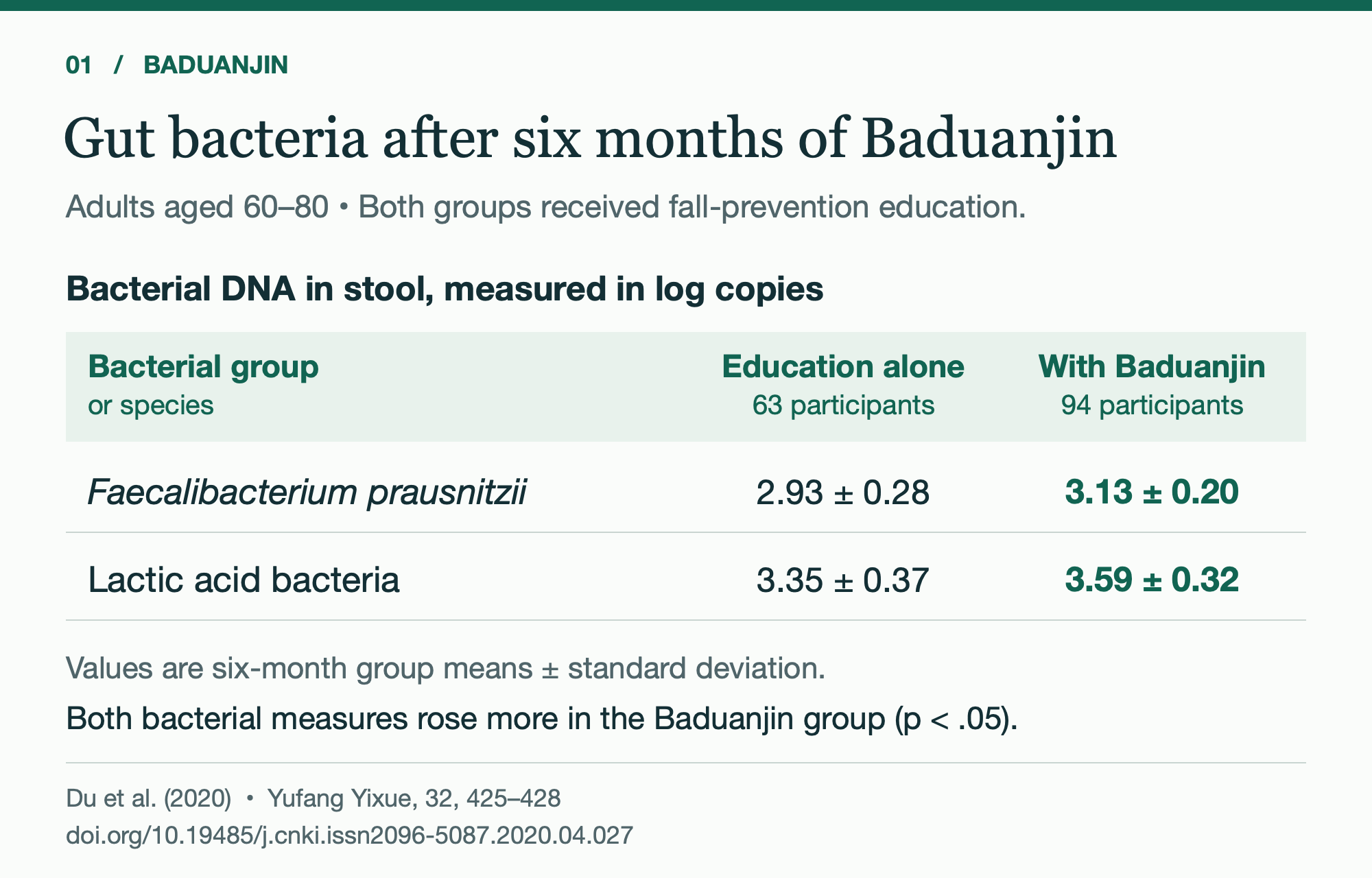
In 2020, Wenyuan Du and colleagues published a study of adults aged 60 to 80 in Shijiazhuang, China. Both groups received information about preventing falls. One group also practiced Baduanjin (the Eight Pieces of Brocade) for six months. The researchers assessed balance, as expected in a fall-prevention study. They also analyzed stool samples for five selected bacterial groups. The paper reports 94 people in the Baduanjin group and 63 in the education group.
Over those six months, the people practicing Baduanjin showed greater increases in lactic acid bacteria and in a species called Faecalibacterium prausnitzii. That long name is worth remembering. It belongs to one of the bacteria that produce butyrate, a fuel for the cells lining the colon.
Other groups have reported related findings. In their 2023 review, Yi-Yi Liu and Jun-Qiang Qiu describe an earlier study by Hongmei Sun in which 45 older adults practiced Baduanjin six days a week. After six months, stool cultures showed increases in bifidobacteria and lactobacilli compared with the participants’ own starting levels. In 2024, Runhong Zhang and colleagues found increases in these same two groups of bacteria after six months of Baduanjin in 30 adults with type 2 diabetes. The participants’ average blood glucose also fell. Both studies followed changes over time. Du’s fall-prevention study adds a useful comparison by showing which bacterial changes were greater among people who added Baduanjin to their routine.
Two groups of people can have similarly diverse gut bacteria even when particular kinds of bacteria are more common in one group. In 2026, Yaqi Qiu and colleagues reported findings from 32 adults with chronic heart failure. After 12 weeks, the researchers found that a group of bacteria called Dialister was more abundant among those who added Baduanjin to usual care. Overall microbial diversity did not differ significantly between the two groups. Looking at overall diversity alone would have missed the difference in Dialister.
A Qigong method that works directly with the abdomen
Baduanjin gives us evidence about a whole-body exercise. To look more closely at what happens when practitioners work directly with the lower abdomen, we can turn to Yan Nian Jiu Zhuan, the Nine-Turn Method. In their published descriptions of the practice, Fangfang Xie and colleagues explain how the sequence combines even breathing and attention to the Dan Tian with abdominal self-massage. The hands travel across the abdomen in prescribed patterns, including circles around the navel. Attention and touch are brought to the same region, giving the practitioner a different experience from performing a standing sequence such as Baduanjin.
What caught my attention about Jiahe Cui’s 2026 study was the choice of exercise. A research team studied the gut microbiome in people practicing the Nine-Turn Method, bringing their attention below the navel as they breathed evenly and massaged the abdomen. Of all the studies we’ve looked at, this one comes closest to the traditional instruction to attend to the Lower Dan Tian.
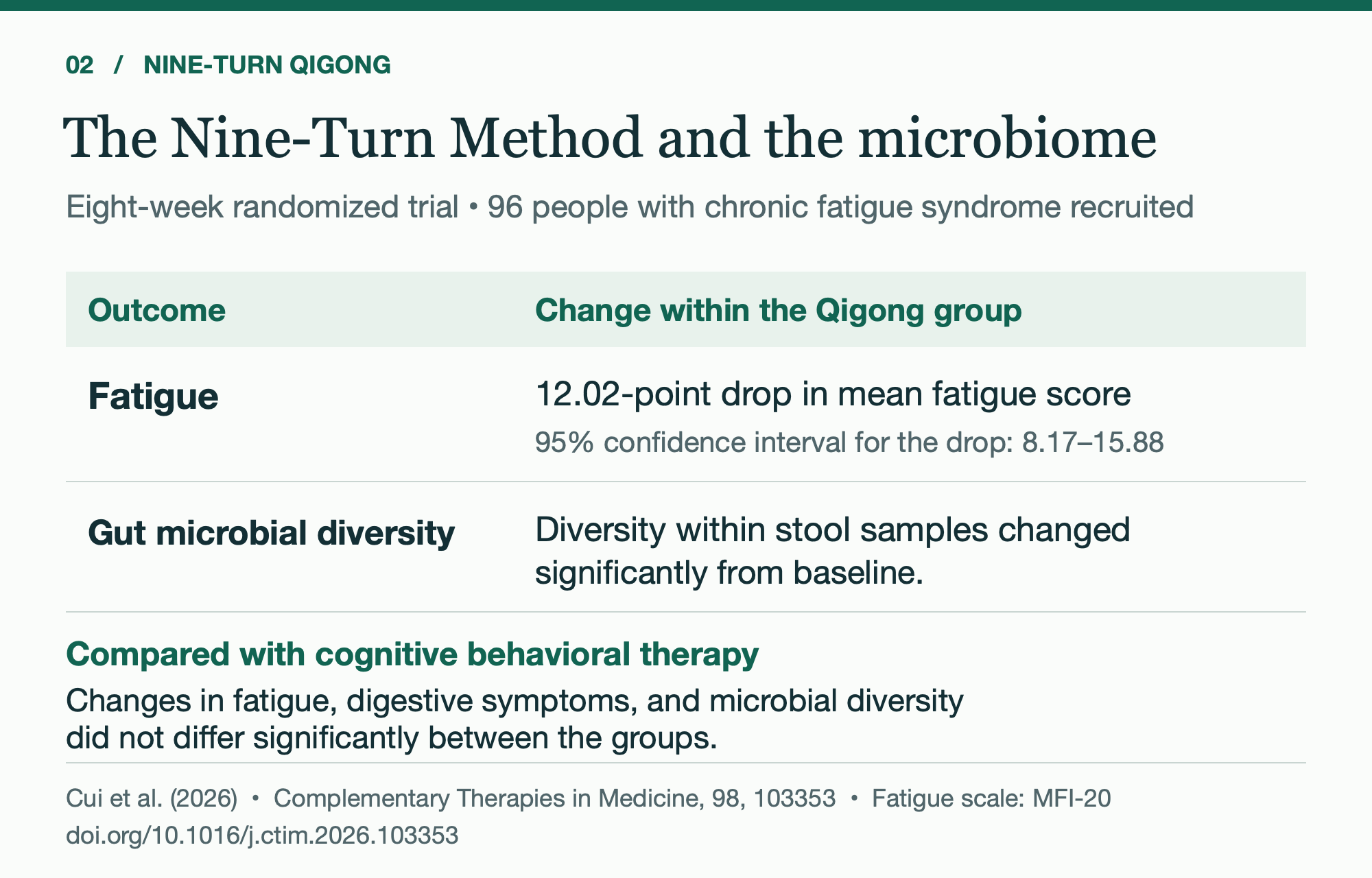
Cui and colleagues followed 96 people with chronic fatigue syndrome for eight weeks. Participants were randomly assigned to practice the Nine-Turn Method or take part in cognitive behavioral therapy. In the Qigong group, fatigue scores fell, and gut microbial diversity changed over those eight weeks. When the researchers compared the two groups, they found no significant difference in how much fatigue, digestive symptoms, or microbial diversity changed.
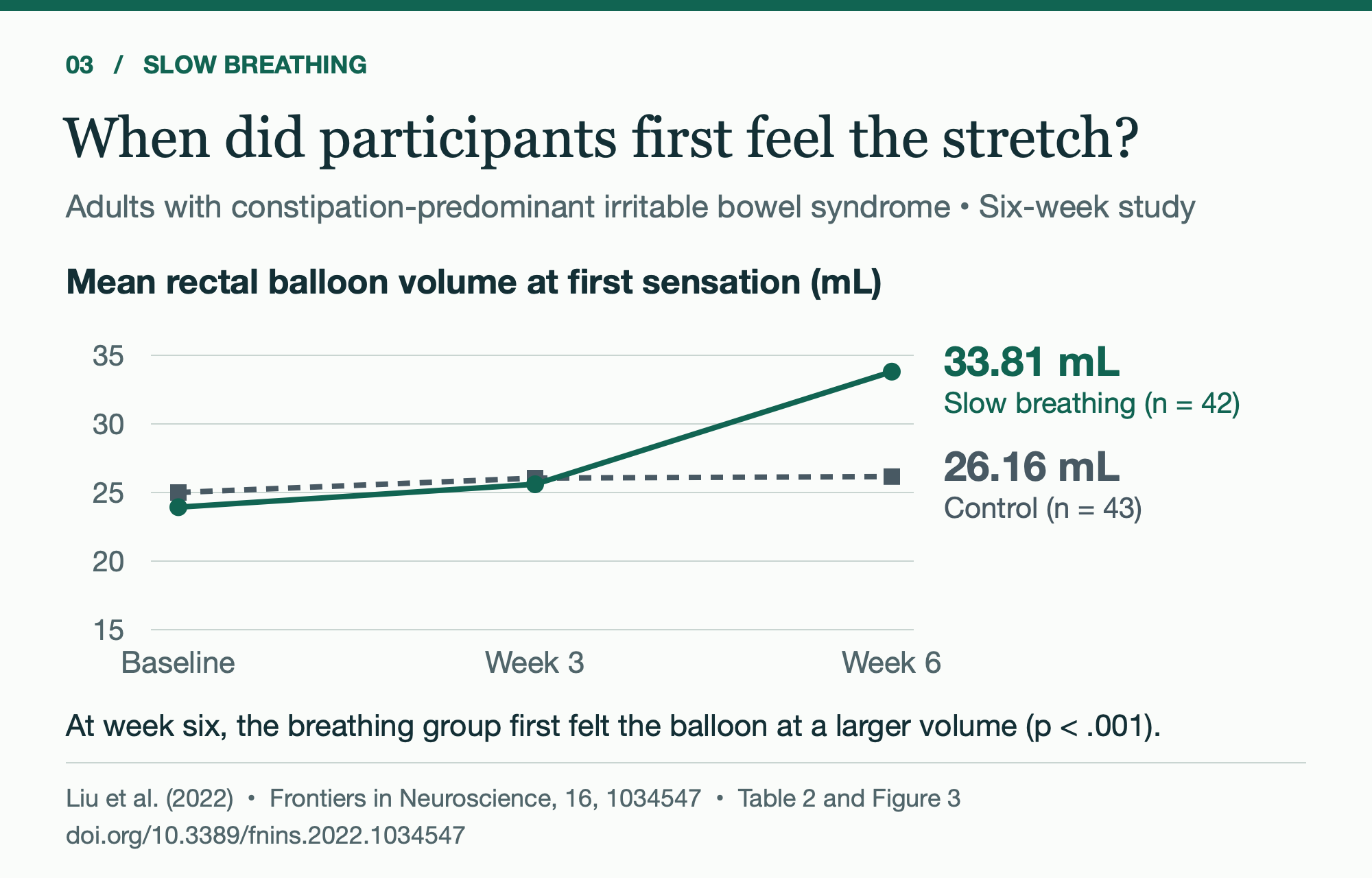
Breathing itself offers another way to understand why the abdomen might feel different with practice. In a 2022 trial, Jie Liu and colleagues studied people with constipation-predominant irritable bowel syndrome who practiced slow breathing at six breaths per minute. After six weeks, the researchers gradually inflated a small balloon inside the rectum and asked participants to report when they first felt it. On average, the balloon held about 34 milliliters before the breathing group detected it, compared with 26 milliliters in the control group. The breathing group felt the first stretch at a larger balloon volume. A change in sensitivity is one possible reason someone might notice a different sensation in the abdomen during practice.
When I consider the Lower Dan Tian in light of this research, what interests me most is how much can be happening in a region where the practical instruction is so simple. You bring your attention below the navel and follow the movement of the breath. Beneath your hand, the bowel is sensitive to stretch. Bacteria are turning the remains of a meal into fuel for its lining. Some of the compounds they produce can influence how the body responds to stress. And over months of regular Baduanjin practice, researchers have measured changes in some of those bacteria.
Think of the word field. The next time you rest a hand below your navel, feel the abdominal wall rise into your palm as you breathe in and draw back as you breathe out. Stay there for a few breaths. You may notice a deeper feeling of fullness that lasts through the whole breath. The familiar rise and fall is simply the easiest movement to feel when you begin.
Like what you read? Keep exploring …
If this post resonated with you, you may enjoy my new book:
The Science of Medical Qigong: How Breath, Movement, and Attention Transform the Body
This book examines the growing body of scientific research exploring how Qigong practice influences human physiology. Drawing from clinical trials and experimental studies, it explains how coordinated breathing, posture, movement, and focused attention interact with the body’s regulatory systems.
The book explores research on:
• autonomic nervous system regulation
• cardiovascular function and blood pressure
• respiratory mechanics and lung capacity
• sleep quality and recovery
• inflammatory and immune signaling
• brain function and neural plasticity
• cognitive performance and mental health
Rather than presenting Qigong through mystical language, The Science of Medical Qigong approaches the subject through physiology, neuroscience, and clinical research, offering a clear explanation of how regular practice can influence the coordination and harmony of the body’s systems.
Available now in print and Kindle formats.
Click here to get your copy on Amazon
References
Cui, J., Xie, F., Gu, Y., Yue, H., Xie, C., Han, H., Wu, Z., Wang, G., & Yao, F. (2026). Effect of Prolong Life With Nine Turn Method on chronic fatigue syndrome clinical symptoms and roles of gut microbiota: A exploratory randomized controlled trial. Complementary Therapies in Medicine, 98, Article 103353. https://doi.org/10.1016/j.ctim.2026.103353
Dalile, B., Vervliet, B., Bergonzelli, G., Verbeke, K., & Van Oudenhove, L. (2020). Colon-delivered short-chain fatty acids attenuate the cortisol response to psychosocial stress in healthy men: A randomized, placebo-controlled trial. Neuropsychopharmacology, 45(13), 2257–2266. https://doi.org/10.1038/s41386-020-0732-x
De Troyer, A., & Boriek, A. M. (2011). Mechanics of the respiratory muscles. Comprehensive Physiology, 1(3), 1273–1300. https://doi.org/10.1002/cphy.c100009
Du, W., Su, S., Zhao, Y., Guo, X., Zhang, Z., Yao, J., & Wang, S. (2020). Baduanjin gaishan laonianren pingheng nengli he changdao junqun xiaoguo pingjia [Effects of Baduanjin exercise on balance and gut microbiota in older adults]. Yufang Yixue, 32(4), 425–428. https://doi.org/10.19485/j.cnki.issn2096-5087.2020.04.027
Duncan, S. H., Holtrop, G., Lobley, G. E., Calder, A. G., Stewart, C. S., & Flint, H. J. (2004). Contribution of acetate to butyrate formation by human faecal bacteria. British Journal of Nutrition, 91(6), 915–923. https://doi.org/10.1079/BJN20041150
Fagundes, R. R., Belt, S. C., Bakker, B. M., Dijkstra, G., Harmsen, H. J. M., & Faber, K. N. (2024). Beyond butyrate: Microbial fiber metabolism supporting colonic epithelial homeostasis. Trends in Microbiology, 32(2), 178–189. https://doi.org/10.1016/j.tim.2023.07.014
Lelic, D., Nissen, T. D., Brock, C., Aziz, Q., & Drewes, A. M. (2015). Rapid balloon distension as a tool to study cortical processing of visceral sensations and pain. Neurogastroenterology & Motility, 27(6), 832–840. https://doi.org/10.1111/nmo.12557
Liu, J., Lv, C., Wang, W., Huang, Y., Wang, B., Tian, J., Sun, C., & Yu, Y. (2022). Slow, deep breathing intervention improved symptoms and altered rectal sensitivity in patients with constipation-predominant irritable bowel syndrome. Frontiers in Neuroscience, 16, Article 1034547. https://doi.org/10.3389/fnins.2022.1034547
Liu, Y.-Y., & Qiu, J.-Q. (2023). Yundong tongguo tiaojie SCFAs yanhuan shuailao ji qi zuoyong jizhi de yanjiu jinzhan [Research progress on the anti-aging effect of exercise-mediated SCFAs regulation and mechanisms]. Chinese Bulletin of Life Sciences, 35(6), 779–789. https://doi.org/10.13376/j.cbls/2023088
Murray, K., Wilkinson-Smith, V., Hoad, C., Costigan, C., Cox, E., Lam, C., Marciani, L., Gowland, P., & Spiller, R. C. (2014). Differential effects of FODMAPs (fermentable oligo-, di-, mono-saccharides and polyols) on small and large intestinal contents in healthy subjects shown by MRI. The American Journal of Gastroenterology, 109(1), 110–119. https://doi.org/10.1038/ajg.2013.386
Qiu, Y., Chen, G., Zhu, H., Dang, X., Fan, Y., Wen, Z., Lan, T., Lü, W., Chen, X., & Jiang, W. (2026). Baduanjin lianxi dui manxing xinli shuaijie huanzhe changdao junqun he xueqing daixiewu de tiaojie zuoyong [Modulatory effects of Baduanjin exercise on gut microbiota and serum metabolites in chronic heart failure]. Chinese Journal of Arteriosclerosis, 34(6), 527–536. https://doi.org/10.20039/j.cnki.1007-3949.2026.06.005
Sender, R., Fuchs, S., & Milo, R. (2016). Revised estimates for the number of human and bacteria cells in the body. PLOS Biology, 14(8), Article e1002533. https://doi.org/10.1371/journal.pbio.1002533
Steavu, D. (2016). Cosmos, body, and gestation in Taoist meditation. In A. Andreeva & D. Steavu (Eds.), Transforming the void: Embryological discourse and reproductive imagery in East Asian religions (pp. 111–146). Brill. https://doi.org/10.1163/9789004306523_005
Wu, Y.-L. (2016). The menstruating womb: A cross-cultural analysis of body and gender in Hŏ Chun’s Precious mirror of Eastern medicine (1613). Asian Medicine, 11(1–2), 21–60. https://doi.org/10.1163/15734218-12341377
Xie, F., Guan, C., Cheng, Z., Yao, F., & You, Y. (2020). Effects of the prolong life with nine turn method (Yan Nian Jiu Zhuan) Qigong on patients with chronic fatigue syndrome: Study protocol for a randomized controlled trial. Annals of Palliative Medicine, 9(5), 3571–3583. https://doi.org/10.21037/apm-19-461
Xie, F., You, Y., Guan, C., Xu, J., & Yao, F. (2022). The Qigong of Prolong Life With Nine Turn Method relieve fatigue, sleep, anxiety and depression in patients with chronic fatigue syndrome: A randomized controlled clinical study. Frontiers in Medicine, 9, Article 828414. https://doi.org/10.3389/fmed.2022.828414
Zhang, R., Liu, S., & Gao, J. (2024). Jiyu changdao junqun he xueqing yanzheng yinzi ji chang nianmo pingzhang gongneng tantao Baduanjin xunlian zai gaishan T2DM zhong de zuoyong [The role of Baduanjin training in improving type 2 diabetes based on gut microbiota, serum inflammatory factors, and intestinal mucosal barrier function]. Chinese Journal of Microecology, 36(11), 1303–1309. https://doi.org/10.13381/j.cnki.cjm.202411009