

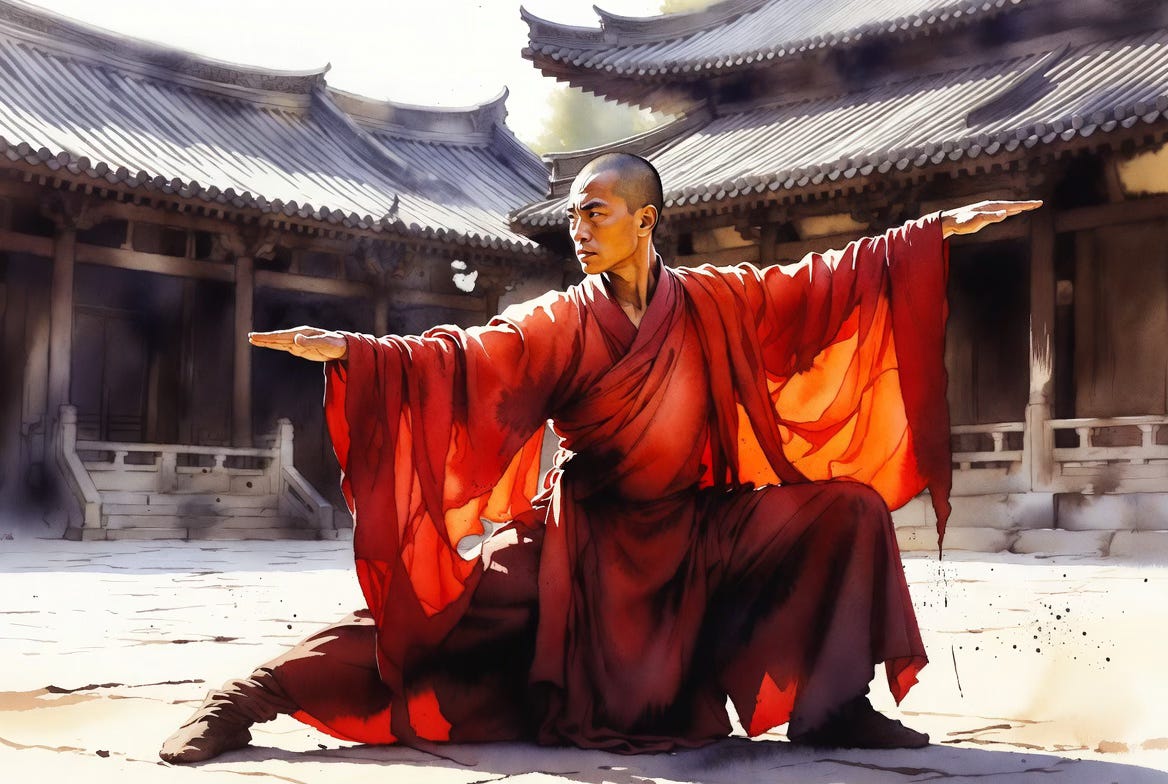
Yi Jin Jing, also called Muscle and Tendon Changing (易筋經) and Ba Duan Jin, also called the Eight Pieces of Brocade (八段錦), rank among the most important practices in the Shaolin Monastery system of qigong (氣功). They are also commonly studied qigong methods in the scientific literature as you can see throughout this blog.
Traditional Shaolin teachings present both as essential tools for cultivating internal energy, strengthening the body, and supporting longevity. Monks relied on them while balancing rigorous martial training with Chan Buddhist discipline. Although the practices grew out of broader Daoyin and health-preservation traditions, the Shaolin Encyclopedia by Shi Deqian (釋德虔) treats them as integrated parts of the monastery’s “soft gong” (柔功) and longevity curriculum.
Shi Deqian and the Shaolin Temple Martial Arts Encyclopedia
Shi Deqian (釋德虔), also known by his literary name Shao Shi Shan Ren (少室山人), is a highly respected Shaolin monk and scholar who devoted much of his life to safeguarding the monastery’s authentic martial and qigong heritage. In the 1980s and 1990s, during the revival of traditional Chinese culture after the Cultural Revolution, he recognized that many of Shaolin’s ancient forms, weapons routines, and internal training methods were at risk of being lost or diluted by modernization and tourism.
Determined to preserve the living tradition for future generations, Shi Deqian spent years meticulously collecting, verifying, and organizing teachings directly from senior temple masters, classical manuals, and monastic lineages. The result was the monumental Shaolin Temple Martial Arts Encyclopedia, a multi-volume compendium that systematically documents hundreds of fist forms, weapons, qigong exercises (including Yi Jin Jing and Ba Duan Jin), and internal cultivation methods. Through this landmark project, published by Jinghua Publishing House, he created one of the most authoritative and comprehensive records of authentic Shaolin knowledge ever compiled.
Yi Jin Jing in Shaolin Tradition: Text, Principles, and Practice
The Shaolin Encyclopedia (Volume 4) lists Yi Jin Jing as one of the monastery’s core longevity and soft-gong methods. It states simply that “there is also Shaolin Yi Jin Jing, Xi Sui Jing (洗髓經), etc., which are also essential methods for monks to strengthen the body and prolong life.”
Scholarly analysis in Lu Zhouxiang’s A History of Shaolin places the surviving manual in 1624. Daoist priest Zong Heng compiled it during the late Ming dynasty. The text carries two prefaces that later became tied to legendary Shaolin figures and Bodhidharma stories. Yet the core work belongs to the monastery’s evolving qigong and health-preservation practices.
A key historical point often overlooked: the original 1624 Yi Jin Jing text contains no specific physical exercises. Instead, it offers a theoretical framework and guiding principles for transforming muscles, tendons, and sinews through internal cultivation, qi circulation, and mindful body work. The familiar 12-posture sequence used today serves as a practical embodiment of those principles. In other words, the exercises act as a living bridge that brings the classic’s theory into daily monastic training.
The Yue Fei Legend and Its Link to Ba Duan Jin
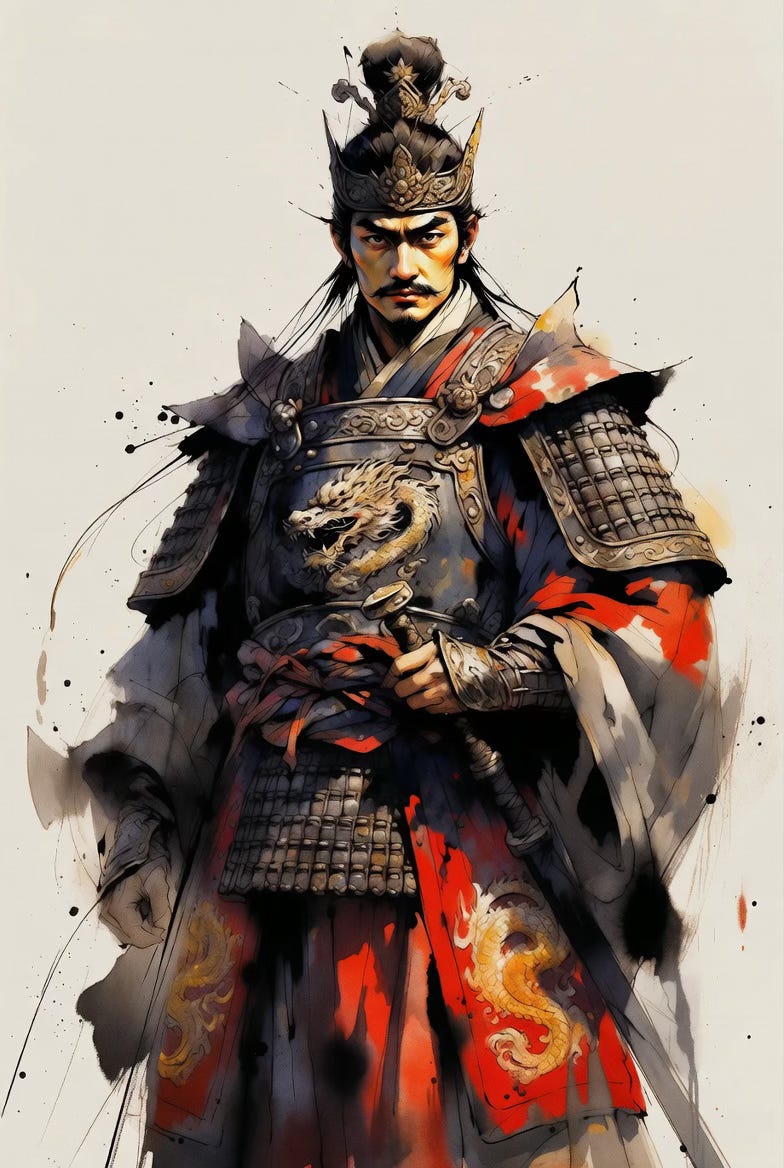
The same 1624 prefaces play another important role. One, signed by Niu Gao (presented as General Yue Fei’s lieutenant), claims that the Song-dynasty hero Yue Fei (岳飛, 1103–1142) was initiated into the Yi Jin Jing. As Meir Shahar explains in The Shaolin Monastery, this prestige-boosting reference gave rise to the later popular story that Yue Fei created or simplified Ba Duan Jin for his soldiers. The legend took hold in the 19th century, even though earlier records contain no such connection.
Ba Duan Jin as Part of Shaolin Soft Gong
The Shaolin Encyclopedia (Volume 4) also includes Ba Duan Jin as a dedicated practice. It sits alongside other soft exercises such as Tongzi Gong (童子功). The “Eight Pieces of Brocade” use flowing, accessible movements to promote qi flow, emotional balance, and foundational health. Monks found them ideal as preparation or support for both meditation and martial training.
The Shared Roots and Practical Connection in Shaolin Qigong
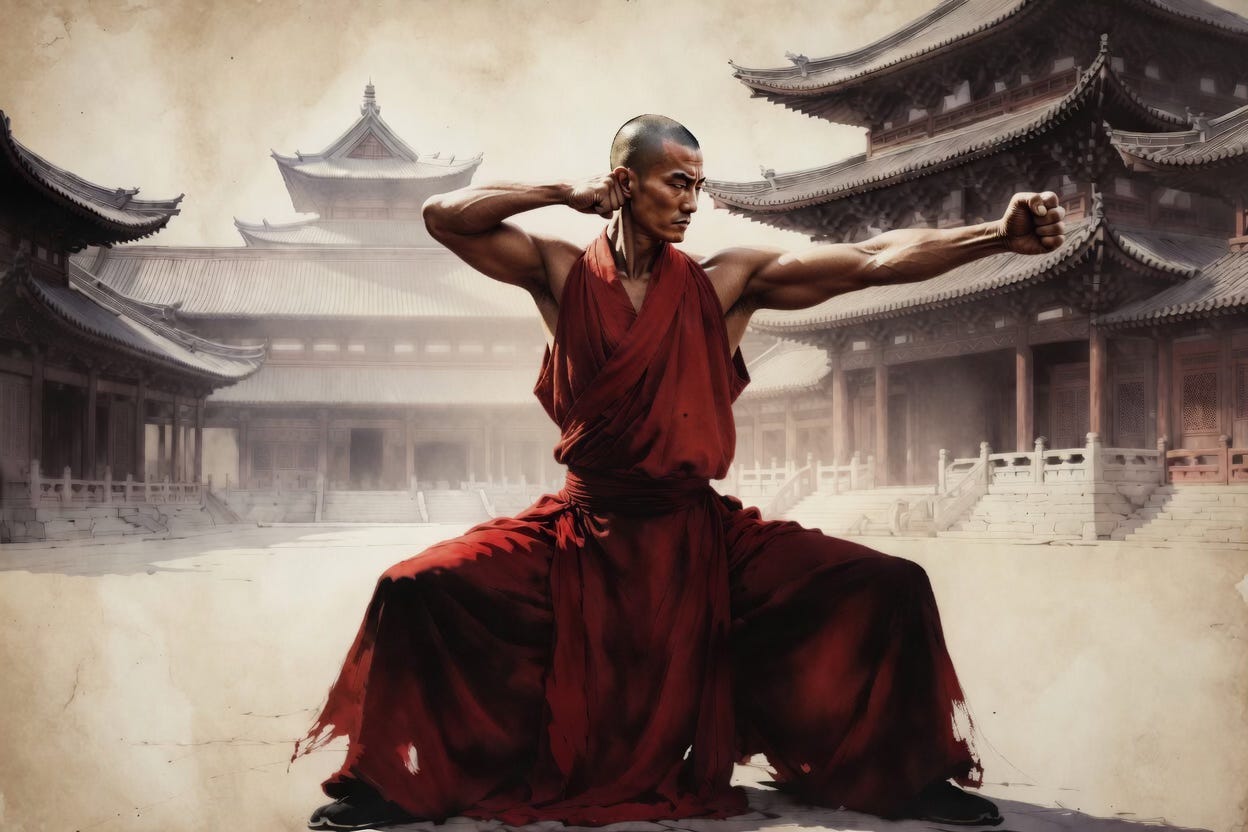
Shaolin sources mention no single founder who linked the two practices or passed one directly to the other. Instead, they show a clear practical and doctrinal connection. Both belong to the monastery’s internal cultivation system, designed to meet the physical and energetic demands of temple life.
Yi Jin Jing focuses on deeper structural transformation of muscles, tendons, and sinews while supporting longevity. Ba Duan Jin offers gentler, meridian-focused movements that regulate daily qi and nourish the organs. Together they create a balanced approach: one hardens the framework, the other nourishes the flow.
Both appear in the Shaolin Encyclopedia’s qigong and longevity chapters as living tools refined within Shaolin tradition. Yi Jin Jing’s documented compilation in the early 17th century also aligns with a flourishing period of Shaolin martial and health practices.
In short, the two classics represent parallel streams that merged within Shaolin’s qigong heritage. They embody the monastery’s practical wisdom for preserving health, building internal power, and sustaining spiritual discipline across centuries of Chan meditation and martial training.

Relevance for Today’s Practitioners
The Shaolin Encyclopedia makes one thing clear: Yi Jin Jing and Ba Duan Jin were never meant to stand alone. They form part of a complete system created to strengthen the body and extend life under the pressures of monastic training. Today, many who follow the Shaolin lineage still use them together. Ba Duan Jin serves as a gentle daily warm-up or tonic to regulate qi and calm the mind. Yi Jin Jing then provides deeper tendon and structural conditioning.
Understanding the historical background adds depth to your practice. The original Yi Jin Jing offered guiding principles rather than ready-made exercises, and the Yue Fei legend grew from its prefaces. This perspective turns the 12 postures into more than a sequence. They become a practical bridge that carries the classic’s theory into real life. The same thoughtful adaptation continues with Ba Duan Jin, letting each generation carry forward the monastery’s wisdom in ways that fit the present moment.
References
Lu, Z. (2019). A history of Shaolin: Buddhism, kung fu and identity. Routledge.
Shahar, M. (2008). The Shaolin monastery: History, religion, and the Chinese martial arts. University of Hawai‘i Press.
Shi, D. (n.d.). Shaolin si wushu baike quanshu [Shaolin Temple martial arts encyclopedia] (Vol. 4). Jinghua chubanshe.
Like what you read? Keep exploring…

If this post resonated with you, you may enjoy my new book:
The Science of Medical Qigong: How Breath, Movement, and Attention Transform the Body
This book examines the growing body of scientific research exploring how Qigong practice influences human physiology. Drawing from clinical trials and experimental studies, it explains how coordinated breathing, posture, movement, and focused attention interact with the body’s regulatory systems.
The book explores research on:
• autonomic nervous system regulation
• cardiovascular function and blood pressure
• respiratory mechanics and lung capacity
• sleep quality and recovery
• inflammatory and immune signaling
• brain function and neural plasticity
• cognitive performance and mental health
Rather than presenting Qigong through mystical language, The Science of Medical Qigong approaches the subject through physiology, neuroscience, and clinical research, offering a clear explanation of how regular practice can influence the coordination and harmony of the body’s systems.
Available now in print, Kindle, and audiobook formats.