

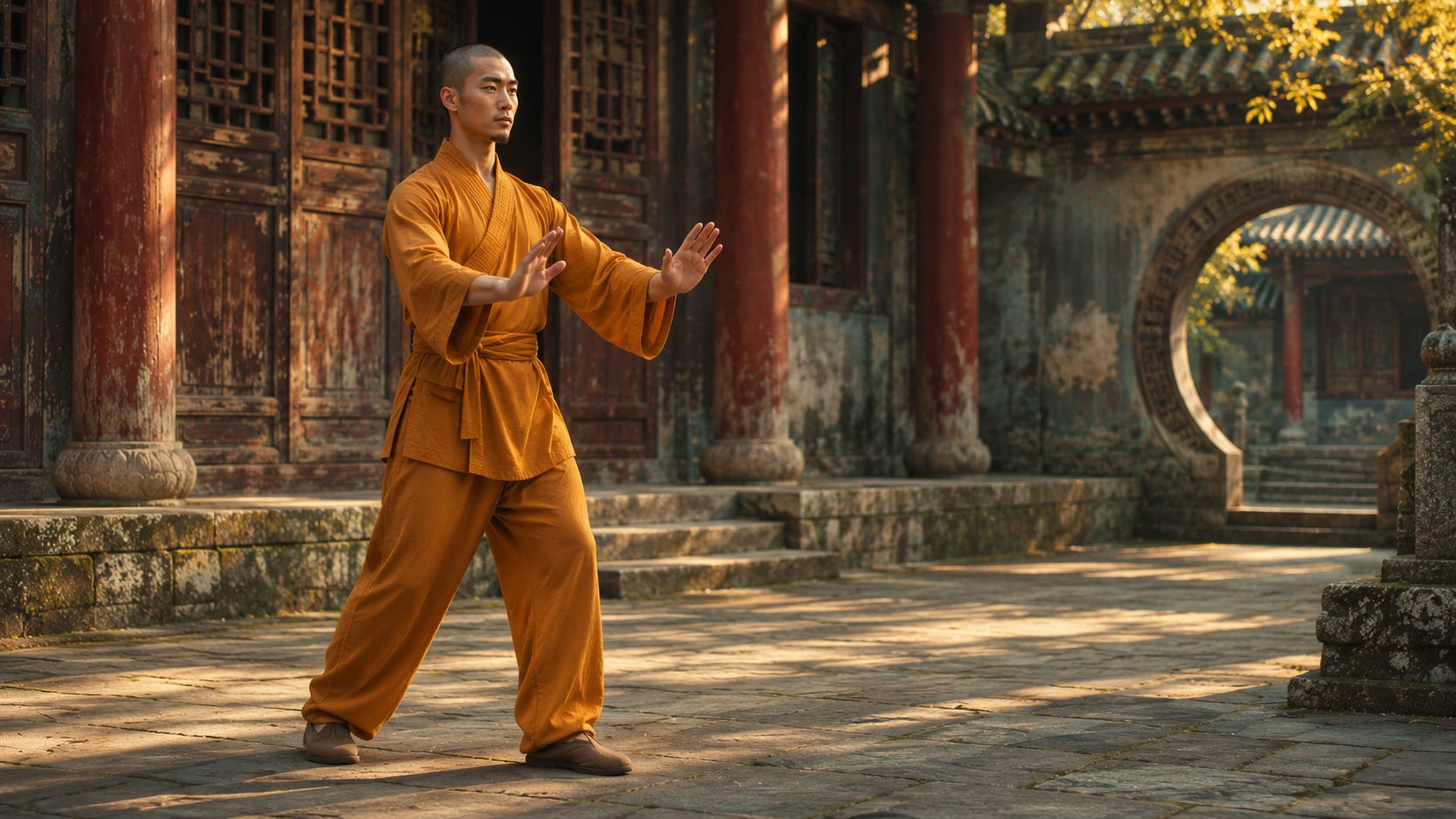
Tai Chi Qigong Shibashi (Shi Ba Shi), the eighteen-movement sequence, was the focus of a 2017 study examining attention, blood pressure, and exercise performance. After eight weeks of practice, participants completed an attention test more quickly, had lower resting blood pressure, and reached a higher workload during a cycling test. Researchers then followed them for another twelve weeks without Qigong, during which several improvements diminished. For anyone who practices or teaches Shibashi, this follow-up addresses a practical question: how much of the improvement remains when regular training ends?
Suphannika Ladawan and colleagues published their study of cognition, blood pressure, and exercise performance in Complementary Therapies in Medicine. They followed twelve adults aged 45 to 66 who had not exercised regularly for at least three months. Each person was tested before and after the program. This was a small study without a separate comparison group, so its findings describe changes during training rather than establishing how much of the change was attributable specifically to Qigong.
Eight Weeks of Shibashi Practice
The participants practiced Tai Chi Qigong Shibashi, a sequence of eighteen movements that combines gentle exercise with breathing, concentration, and relaxation. They attended three supervised sessions each week for eight weeks. Each hour-long session included ten minutes of stretching, forty minutes of Qigong, and another ten minutes of stretching afterward. The instructor had more than ten years of Qigong experience. Across the planned twenty-four sessions, the schedule provided sixteen hours of Qigong practice.
The sequence included lifting the hands, opening the chest, rowing the boat, cloud hands, and pushing the waves. These movements gave participants repeated opportunities to coordinate their arms and body with their breathing. Following the sequence also required concentration. You have to attend to the movement you are performing while preparing to continue into the next one. The program brought these physical and attentional demands together throughout each session.
Traditional Qigong teaching describes this combination through regulating the body, tiao shen 調身; regulating the breath, tiao xi 調息; and regulating the mind, tiao xin 調心. These terms refer to related aspects of practice. You attend to your posture and movement, coordinate your breathing, and maintain concentration on the exercise. Shibashi provides a familiar setting in which to practice them together. The researchers examined changes in attention, cardiovascular measures, and exercise performance after participants had followed this combined approach for two months.
Attention and Processing Speed
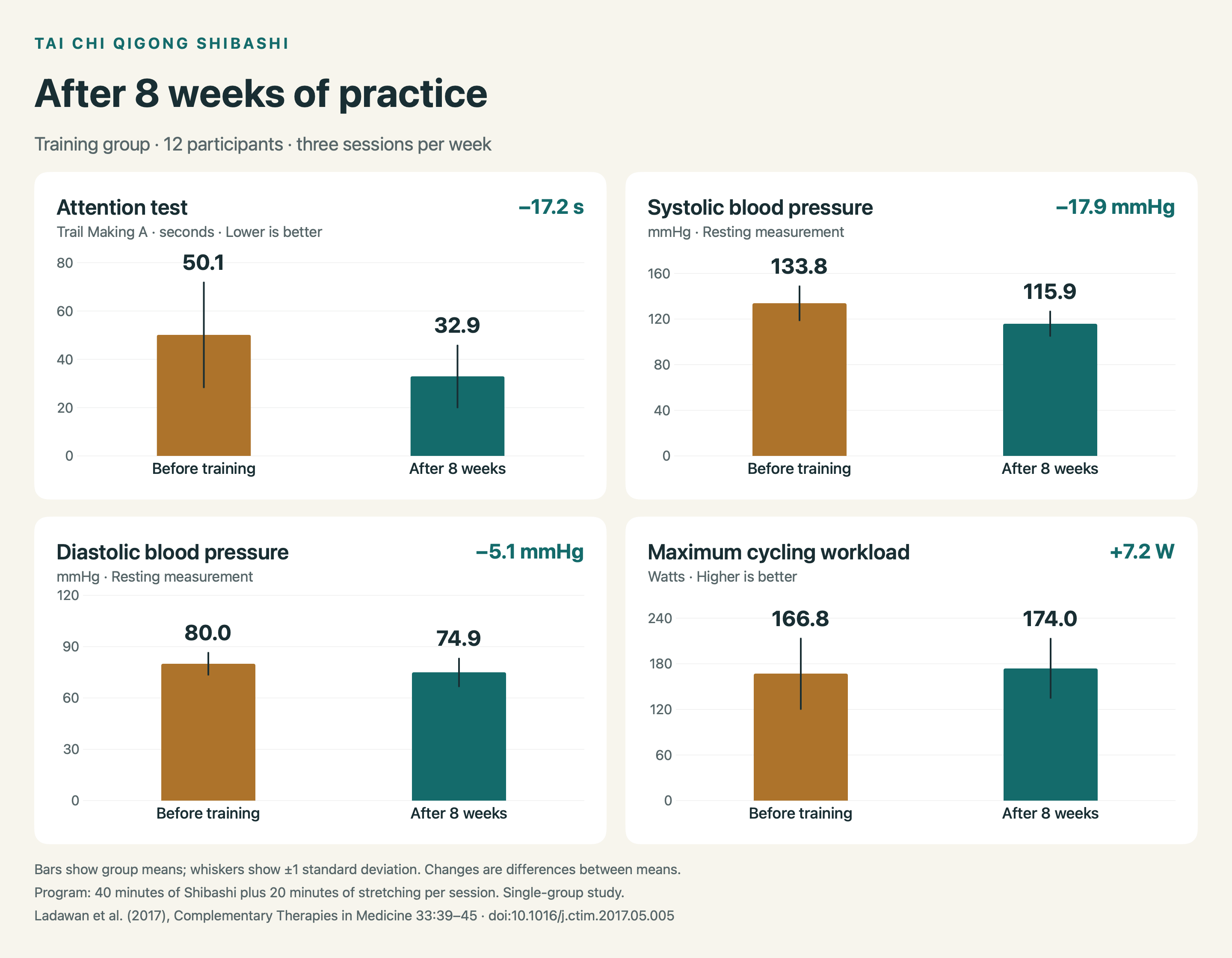
The clearest cognitive improvement appeared on Trail Making Test A. In this test, numbered circles are scattered across a page, and you connect them in order as quickly and accurately as possible. You must locate the next number, maintain the sequence, and guide your hand toward it. The task draws on visual scanning, attention, and processing speed. Average completion time fell from 50.1 seconds before training to 32.9 seconds afterward, approximately 17 seconds faster.
That was a reduction of about 34 percent in the time needed to complete the test. The change is easier to understand when the task is explained: participants became faster at finding and connecting the numbers. Attention, visual processing, and hand movement all contribute to that performance. The improvement concerned the speed of completing this particular task.
The other tests assessed different abilities. Trail Making Test B requires alternating between numbers and letters, such as 1, A, 2, B, 3, C. That extra requirement tests the ability to switch between sequences. Participants also completed digit-span tests, repeating numbers in their original order or backward to assess short-term and working memory. Neither these memory scores nor performance on Trail Making Test B changed significantly. Faster performance on the simpler sequencing task was the main cognitive finding.
Ladawan and colleagues proposed that practicing movement with sustained concentration could help explain this result. When you follow a Qigong sequence, your attention has a continuing task: monitor the present movement and coordinate what comes next. Breathing provides another part of that coordination. The authors’ explanation connects the demands of the practice with the attention-related improvement. It treats the combination of physical and mental activity as a possible contributor, consistent with how the participants trained.
Lower Resting Blood Pressure
Resting blood pressure also fell during the eight weeks. Average systolic pressure, the pressure during the heart’s contraction, decreased from 133.8 to 115.9 mmHg. Diastolic pressure, measured between contractions, decreased from 80.0 to 74.9 mmHg. These were reductions of approximately 18 and 5 mmHg, respectively. Researchers took the measurements with participants seated after at least five minutes of rest, during afternoon testing. The results therefore describe resting pressure rather than pressure measured while performing the exercises.
Mean arterial pressure decreased as well. This calculated value estimates average arterial pressure across the heartbeat cycle, using both systolic and diastolic readings. It fell from 97.9 to 88.6 mmHg. Together, these measurements show a consistent reduction in the group’s resting blood pressure during the program. The eighteen-point systolic change is substantial, although the small study’s average is not a prediction of how much an individual student’s pressure will change.
The authors discussed autonomic regulation as a possible explanation. The autonomic nervous system helps regulate the heart and the contraction of blood vessels. Changes in sympathetic activity can influence resting blood pressure through these functions. An earlier Qigong study involving people with hypertension reported reductions in blood pressure alongside lower circulating catecholamines, including norepinephrine and epinephrine. These chemical messengers participate in sympathetic responses. That related research supports autonomic regulation as a possible contributor to the blood pressure changes.
Movement, breathing, and relaxation were practiced together, so the proposed explanation concerns the combined activity. The cardiovascular and cognitive results also represent different observations. Researchers found no clear association between cognitive performance and blood pressure in this study. Participants’ lower pressure and faster attention-test performance are therefore separate findings; the analysis did not connect the amount of improvement in one with the amount of improvement in the other.
Improved Cycling Performance
Physical performance improved on a stationary cycling test in which resistance increased until participants reached their exercise limit. Average maximal workload rose from 166.8 to 174.0 watts, an increase of about 4 percent. Maximal oxygen uptake, commonly called VO2max, remained statistically unchanged. This measure reflects the capacity to take in, transport, and use oxygen during demanding exercise. Participants reached a higher cycling workload after training while their measured aerobic capacity remained similar.
The researchers suggested that muscular adaptations might explain the higher workload. Repeatedly supporting body weight and controlling position changes gives the legs physical work during Qigong. In previously inactive adults, this could contribute to better performance on an exercise test. The muscular explanation was a proposal rather than a measured strength result. It helps explain why the paper distinguishes improvement in cycling workload from unchanged oxygen-uptake measurements.
Twelve Weeks Without Practice
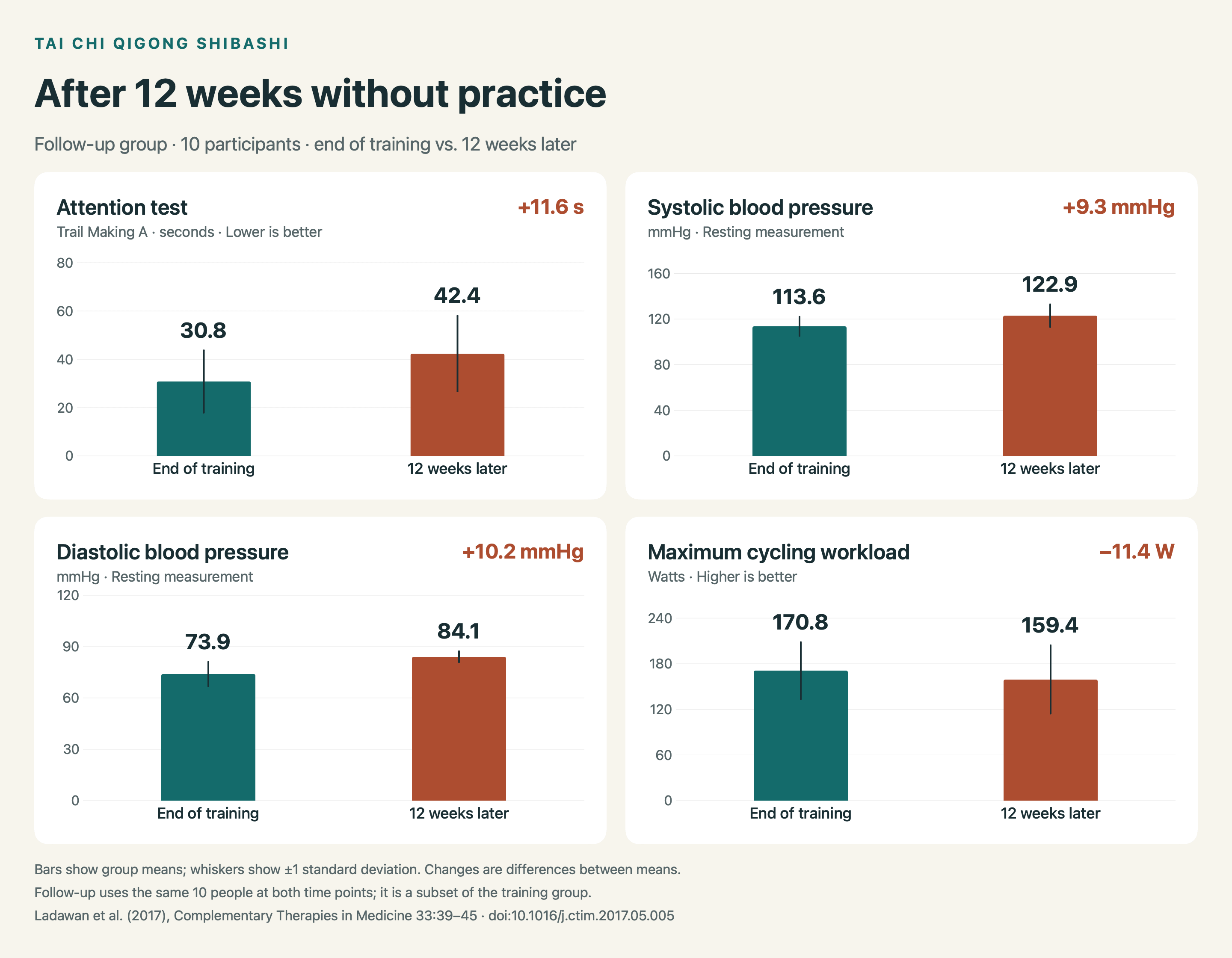
Ten participants were included in the follow-up after twelve weeks without Qigong. Two were excluded because they did not follow the instructions for the period without training. Among those ten, Trail Making Test A completion time increased from 30.8 seconds immediately after the program to 42.4 seconds at follow-up. Systolic pressure rose from 113.6 to 122.9 mmHg, while diastolic pressure rose from 73.9 to 84.1 mmHg. Maximal cycling workload fell from 170.8 to 159.4 watts.
After twelve weeks without Qigong, their attention-test performance, blood pressure, and cycling workload had moved back toward their pretraining levels. Several improvements observed during regular Shibashi practice diminished after that practice stopped.
The pattern suggests that continued practice helps maintain these gains. For Qigong teachers, it supports encouraging students to continue Shibashi beyond an introductory course. Learning the sequence provides a foundation for ongoing practice, through continued classes or a familiar routine at home.
Reference: Ladawan S, Klarod K, Philippe M, et al. Effect of Qigong exercise on cognitive function, blood pressure and cardiorespiratory fitness in healthy middle-aged subjects. Complementary Therapies in Medicine. 2017;33:39–45. doi:10.1016/j.ctim.2017.05.005.
Like what you read? Keep exploring …

If this post resonated with you, you may enjoy my new book:
The Science of Medical Qigong: How Breath, Movement, and Attention Transform the Body
This book examines the growing body of scientific research exploring how Qigong practice influences human physiology. Drawing from clinical trials and experimental studies, it explains how coordinated breathing, posture, movement, and focused attention interact with the body’s regulatory systems.
The book explores research on:
• autonomic nervous system regulation
• cardiovascular function and blood pressure
• respiratory mechanics and lung capacity
• sleep quality and recovery
• inflammatory and immune signaling
• brain function and neural plasticity
• cognitive performance and mental health
Rather than presenting Qigong through mystical language, The Science of Medical Qigong approaches the subject through physiology, neuroscience, and clinical research, offering a clear explanation of how regular practice can influence the coordination and harmony of the body’s systems.
Available now in print and Kindle formats.