


A single session of Liuzijue Qigong was followed by faster responses on a computerized attention task, with accuracy maintained. Participants sat with their eyes closed, coordinated their breathing with six traditional sounds, and then performed the task more quickly than after quiet rest. Researchers also recorded changes in brain signals that help them investigate the physiology behind that improvement.
The study, published in Frontiers in Neurology on September 3, 2026, examined seated Liuzijue breathing and vocalization without any additional treatment. YuQing Bi and colleagues recruited twenty young adults and studied the immediate effects of practice. Their findings connect the physical details of Qigong practice with measurable changes in performance on a task involving attention.
The practice behind the six sounds
Liuzijue (六字訣), often called the Six Healing Sounds, coordinates exhalation with six syllables: Xu, He, Hu, Si, Chui, and Xi. In this experiment, participants practiced the breathing and sounds while seated, without the accompanying movements used in many versions of the form. They inhaled through the nose and exhaled slowly through the mouth, repeating each sound six times. Their attention rested on mouth movements, airflow, and the sensations of vocalization.
In Liuzijue, you follow a sequence of breaths and sounds. Producing a sound shapes the exhalation and gives you something specific to hear and feel. Following those sensations gives attention a defined task. You are deliberately coordinating actions that usually happen without much conscious attention. From a Western scientific perspective, each provides a plausible route through which practice could influence your mental state.
Faster responses without more mistakes
To assess performance, the researchers used a version of the Stroop task. You might see the word “red” printed in blue. Here, participants pressed one key when the word and its color matched and another when they differed. The task requires you to recognize both pieces of information and select the appropriate response. It brings attention and response selection into a situation where competing information can slow you down.
You use related skills when you keep following a conversation despite nearby noise, or continue reading after something draws your attention away. The laboratory task isolates a small part of that larger ability to stay engaged and choose a response. It provides a specific, repeatable measure of performance, giving researchers something more precise than asking whether a participant feels clearer or more relaxed after practice.
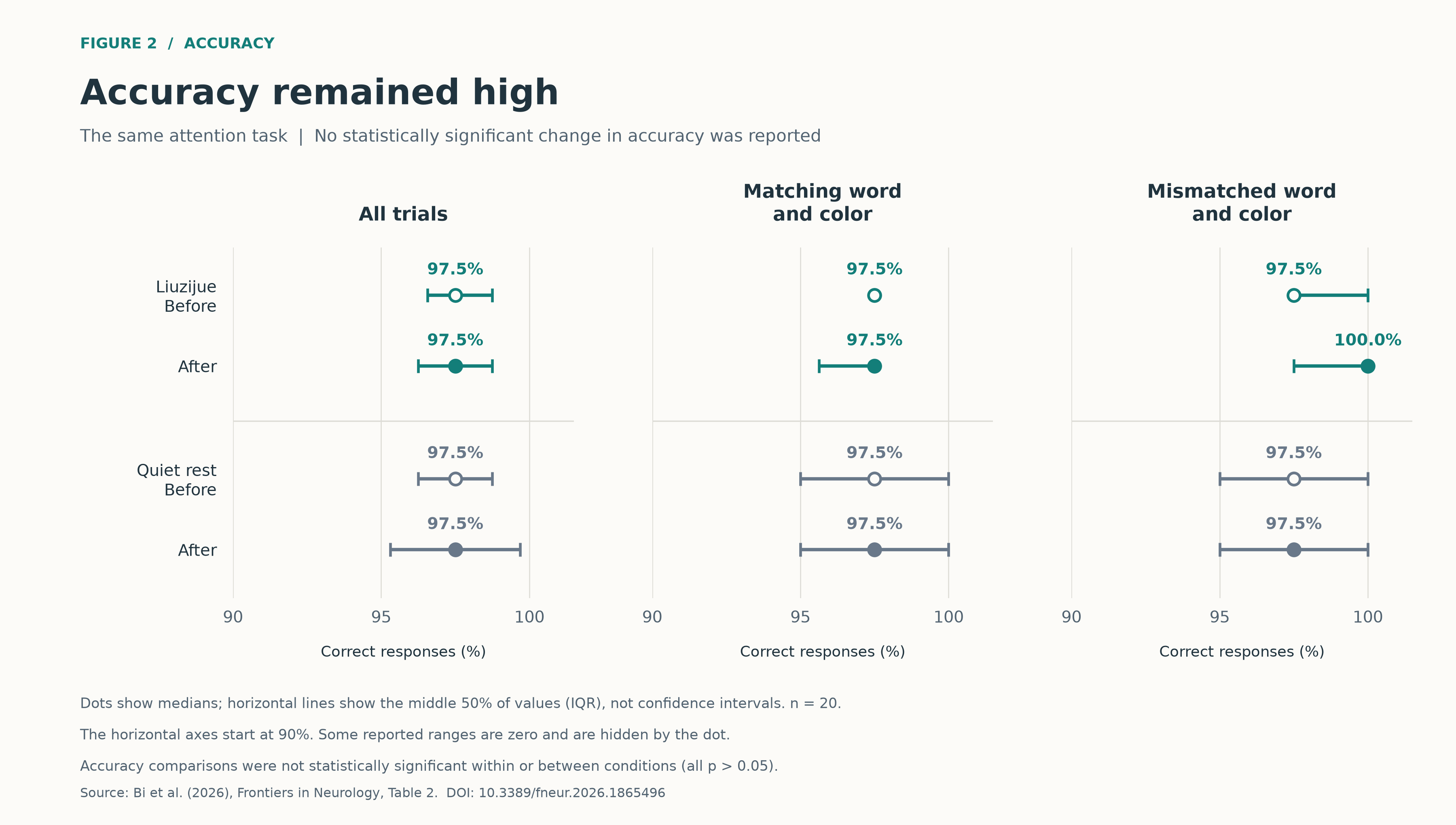
After Liuzijue, the median response time across the task fell from approximately 643 to 606 milliseconds, a difference of about 37 milliseconds. Responses also became faster on the mismatched trials, which create more interference. Accuracy remained high, with no statistically significant change. Participants responded more quickly without an accompanying increase in errors. Thirty-seven milliseconds is a small interval in everyday life, but repeated trials let researchers detect differences at that scale.
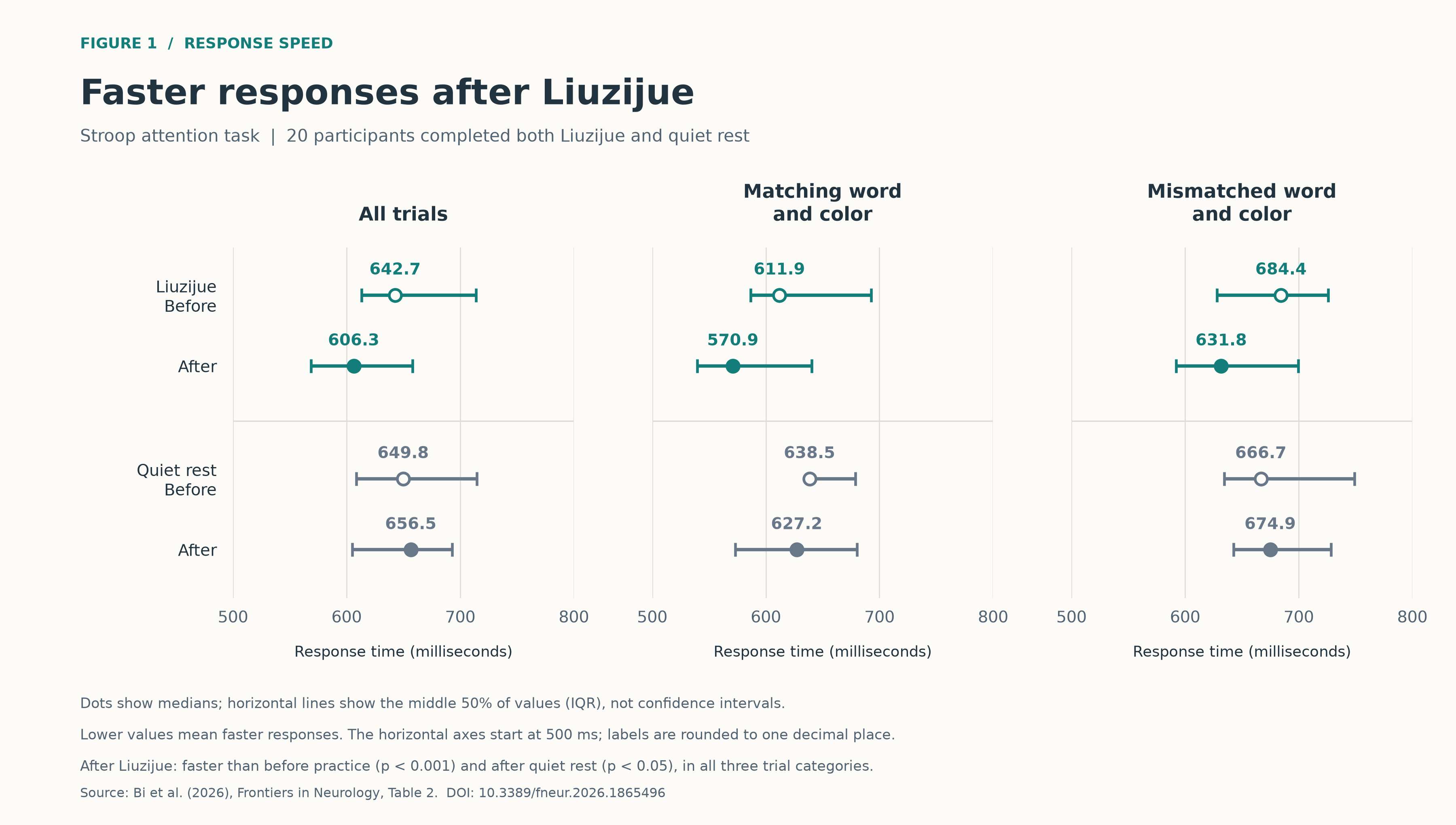
Each participant completed both Liuzijue and an equivalent period of quiet rest, in a randomly assigned order. That crossover design lets researchers compare a person with themselves, reducing the influence of differences in baseline ability. The team also checked whether doing one condition first affected the results. The advantage associated with Liuzijue remained after accounting for order and testing period, strengthening the behavioral finding.
How breathing and attention work together
Breathing operates automatically, yet you can deliberately change its pace and pattern. As you control each breath, you also feel the movement and airflow it produces. When you practice Liuzijue, you coordinate respiratory movement with sound production and sustained attention to bodily sensation. Those actions involve sensory and motor systems as well as the networks that help you stay focused on a task. Practicing that coordination may help prepare attention for the next task, one possible explanation for the faster responses observed here.
Research outside Qigong has already established connections between respiration and brain activity. In a 2016 study, Christina Zelano and colleagues recorded electrical signals directly from the brains of patients undergoing evaluation for epilepsy. They found that nasal breathing synchronized activity in regions involved in smell, emotion, and memory. Separate behavioral experiments linked breathing phase with performance on memory and emotion tasks. This offers physiological context for studying breathing practices, while Liuzijue combines breathing with additional sensory and attentional demands.
Following the brain’s response during practice
Bi and colleagues examined those demands using near-infrared light sensors placed over the scalp. The technique, called functional near-infrared spectroscopy, estimates changes in oxygenated blood near the brain’s surface. Because active nerve tissue and its blood supply interact, researchers use these measurements to investigate activity in the underlying cortex. The method lets researchers track these signals while participants practice Liuzijue.
During Liuzijue, oxygenated hemoglobin signals were lower in several frontal and motor regions than during a comparison task involving the syllable “Fu.” That comparison included vocalization, but participants breathed naturally and received no instruction to focus on respiratory sensations. The difference therefore concerns the coordinated Liuzijue practice, including its breathing pattern and attentional focus, compared with a simpler sound task.
These measurements require an explanation that goes beyond “more oxygen means better thinking.” Brain measurements based on blood oxygenation depend on circulation as well as neural activity. Breathing can alter carbon dioxide levels, which influence the diameter of cerebral blood vessels. Richard Wise and colleagues demonstrated that spontaneous carbon dioxide fluctuations contribute to changes in functional MRI signals. In breathing research, lower or higher signals can therefore reflect several interacting physiological processes.
The authors propose that the changes during Liuzijue may accompany a more relaxed state and altered demands on sensory and motor processing. The clearest behavioral result remains the faster responses afterward; the oxygenation measurements offer clues about physiology. The lower oxygenation signals occurred during Liuzijue itself. During the subsequent attention task, oxygenation measurements showed no statistically significant change.
Changes in coordination across brain regions
A separate MRI assessment examined resting brain signals before and after Liuzijue. The researchers found changes in regions involved in movement, bodily sensation, and auditory processing. They also found altered functional connectivity involving the temporal cortex and insula. Functional connectivity describes how closely signals from different regions fluctuate together over time. It gives researchers a way to study coordination across the brain, beyond examining each region separately.
The insula helps process signals from inside your body, while parts of the temporal cortex contribute to hearing and language. These regions are relevant because Liuzijue directs attention toward breathing and the sensations of making each sound. The MRI results suggest that practice was followed by a different pattern of coordination among some of these regions. Because this assessment used a before-and-after comparison, its findings are exploratory associations.
What magnetic stimulation revealed
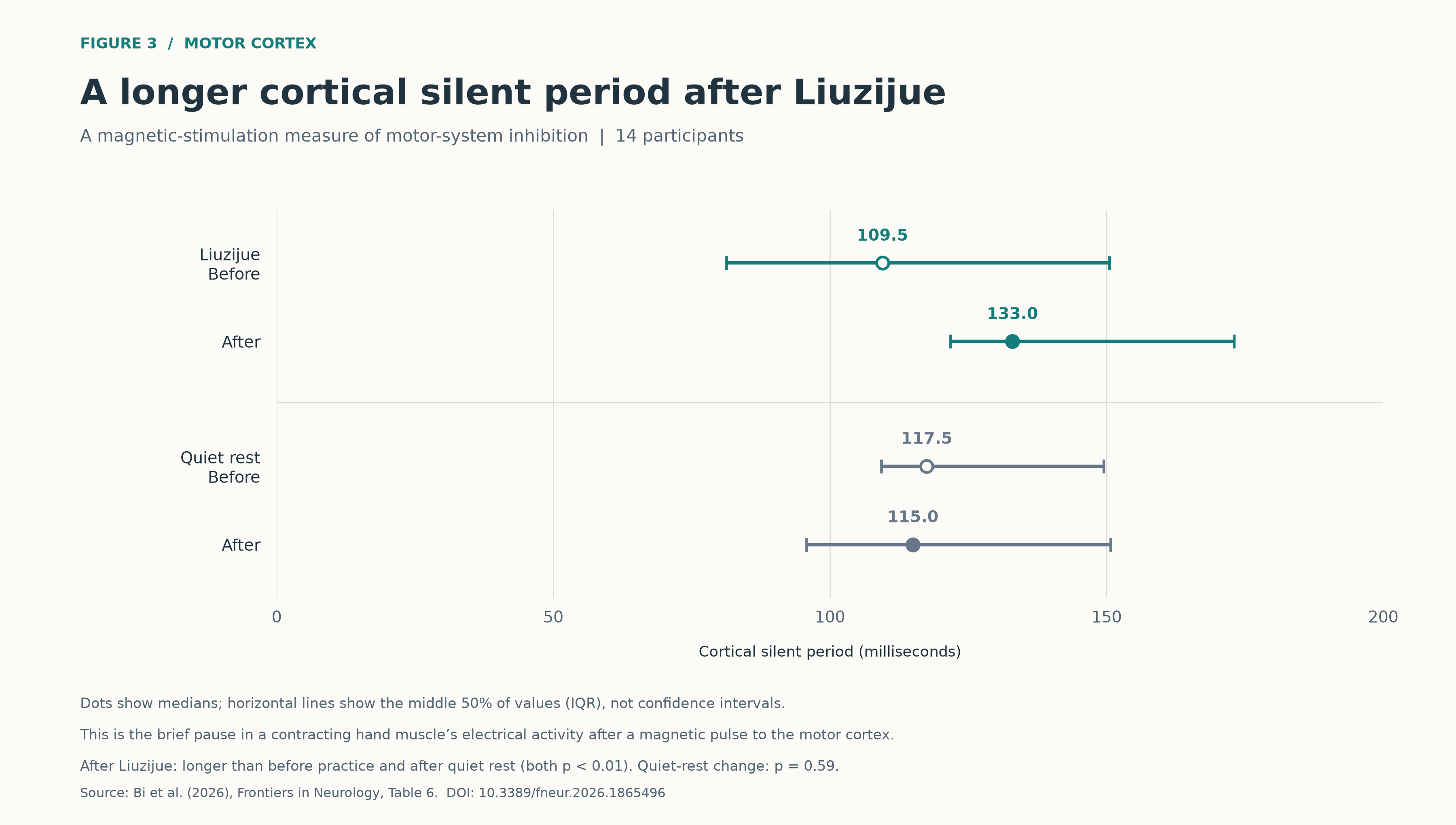
Another result came from transcranial magnetic stimulation, which the team used as a measurement tool. A brief magnetic pulse stimulates the motor cortex while electrodes record the response of a hand muscle. When the muscle is already contracting, the pulse can produce a short interruption in its electrical activity. Researchers call this the cortical silent period and use it to examine inhibitory processes in the motor system.
After Liuzijue, that silent period lasted longer. Among the fourteen participants who completed these measurements, its median duration increased from about 110 to 133 milliseconds. This measure is associated particularly with inhibitory signaling involving GABA-B receptors. GABA is one of the nervous system’s principal inhibitory chemical messengers. The finding points toward a change in motor cortical inhibition, providing a physiological lead that complements the attention results.
Inhibition is an essential part of nervous system function. It helps shape when nerve cells respond and how strongly they influence other cells. In movement, appropriately timed inhibition helps control output. During a cognitive task, suppressing an irrelevant response is also useful. These are related scientific questions, but connecting the motor measurement directly to the faster task responses remains a hypothesis for further testing.
What this means for your Liuzijue practice
The study gives us a practical reason to take the details of Liuzijue seriously. Its breathing, sounds, and attentional instructions form an integrated exercise. Comparing Liuzijue with quiet rest helps distinguish the effects of the practice from those of simply taking a break. A future comparison with equally paced breathing, matched vocalization, and similar expectations would help identify which features contribute most to the result. For now, the evidence concerns the coordinated practice as a whole.
The immediate response is also worth distinguishing from the effects of regular training. These participants were young adults, and the study examined the immediate effects of a single session. Whether those changes last, accumulate with practice, or help people with cognitive difficulties are questions for longer studies. The present finding gives those investigations a concrete starting point: a defined Qigong practice followed by faster task responses while accuracy remained high.
When you practice Liuzijue, the breathing and sound deserve attention alongside any visible movements. This experiment makes that especially clear by examining a seated form. Even with the arms and legs still, practice involves precise coordination and sustained engagement with sensation. If you already practice Liuzijue, this study gives you a reason to attend closely to those details: the sensations of breathing, the production of each sound, and your attention to the sequence.
Like what you read? Keep exploring …

If this post resonated with you, you may enjoy my new book:
The Science of Medical Qigong: How Breath, Movement, and Attention Transform the Body
This book examines the growing body of scientific research exploring how Qigong practice influences human physiology. Drawing from clinical trials and experimental studies, it explains how coordinated breathing, posture, movement, and focused attention interact with the body’s regulatory systems.
The book explores research on:
• autonomic nervous system regulation
• cardiovascular function and blood pressure
• respiratory mechanics and lung capacity
• sleep quality and recovery
• inflammatory and immune signaling
• brain function and neural plasticity
• cognitive performance and mental health
Rather than presenting Qigong through mystical language, The Science of Medical Qigong approaches the subject through physiology, neuroscience, and clinical research, offering a clear explanation of how regular practice can influence the coordination and harmony of the body’s systems.
Available now in print and Kindle formats.