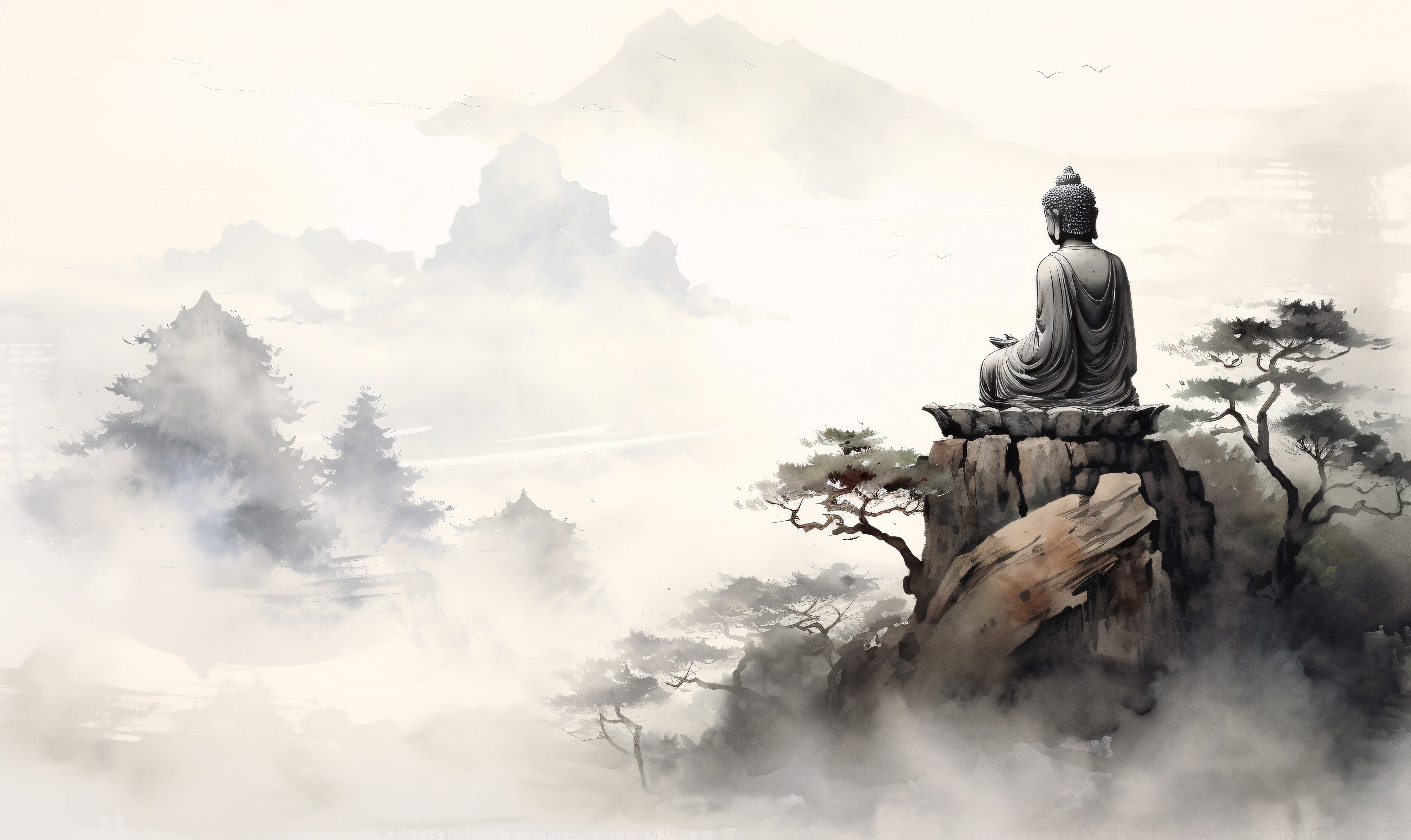
Seeing Is Not Enlightenment
Insight, Integration, and the Discipline of Living Clearly
Note: “Zen” and “Chan” Buddhism are essentially the same tradition expressed through different languages and cultures. Chan(禪) is the Chinese pronunciation of the Sanskrit term Dhyāna, meaning meditative absorption, and Zen is the Japanese pronunciation of the same word, reflecting the transmission of Chan Buddhism from China to Japan rather than a difference in doctrine or practice.
In Chan Buddhism, Jian Xing (見性), literally “seeing one’s nature,” refers to a moment of direct insight into the nature of mind and self. Such moments can arise suddenly and feel unmistakable. The ordinary sense of identity falls away, and experience appears clear, immediate, and unmediated. Yet Chan Buddhism has never treated these moments as conclusions. While modern spiritual culture often elevates insight experiences and treats them as evidence of arrival or completion, Chan Buddhism resists this assumption with unusual firmness. Seeing clearly, it insists, is not the same as living clearly.
From a neurological perspective, insight experiences are transient states rather than enduring structures. They involve temporary shifts in perception, attention, and self-referential processing. Narrative identity loosens, familiar mental patterns suspend, and experience feels immediate and unowned. These shifts can be profound, but they are often brief. What insight does not automatically produce is long-term reorganization of the nervous system. Without continued practice and behavioural embodiment, attention gradually returns to identity, emotional reflexes reassert themselves, and habitual patterns quietly resume control. Chan Buddhism recognized this dynamic long before neuroscience could describe it, which is why jian xing has never been equated with enlightenment. Insight opens a door, but it does not build a life.
Dramatic experiences often feel authoritative precisely because of their intensity. The collapse of self feels definitive, and the absence of narrative feels like truth. Yet intensity is not the same as integration. Neurological and psychological maturity does not reveal itself through peak moments but through stability across conditions. It appears under pressure, fatigue, disagreement, and disappointment, and it is expressed in conduct rather than description. Chan Buddhism is acutely aware of how easily insight becomes identity, how “I saw something” quietly transforms into “I am someone who knows.” This is not awakening but a refinement of self-concept. Chan training interrupts this tendency by refusing to grant insight special status. Experiences are not validated, narratives are not confirmed, and attention is returned to practice. What matters is not what was seen, but what changes afterward.
Lasting change in the brain requires repetition, context, and behaviour. Insight alone does not provide these conditions. Without embodiment, neural reorganization remains temporary. For this reason, Chan Buddhism places its emphasis on life after insight: how one speaks when clarity fades, how one acts when emotions surge, and how one responds when conditions are unfavourable. These are not moral tests but functional indicators. The nervous system learns through action, and from this perspective, ethics are not imposed ideals but stabilizing patterns. Conduct trains the brain as surely as meditation does. Insight that is not ethically embodied remains unstable, and Chan Buddhism does not trust it.
This distinction is echoed in Chinese medical psychology through the concept of shen ming (神明), often translated as clarity or brightness of spirit. Shen ming is not an experience but a quality of functioning. A person with stable shen ming demonstrates coherence, appropriateness, and responsiveness over time. Their clarity is visible not in what they claim to have realized but in how consistently they meet circumstances without distortion. From this view, insight that does not result in clearer conduct has not yet settled. Awareness may have been touched, but it has not been stabilized. Chan Buddhism aligns closely with this perspective, measuring awakening not by what one has seen but by what no longer needs to be defended.
Chan Buddhism’s resistance to modern “awakening culture” is therefore not conservative but practical. A culture that elevates insight over integration produces fragility, encouraging experience-chasing, narrative inflation, and subtle avoidance of the slower work of embodiment. Chan Buddhism insists that insight must survive ordinariness, withstand repetition, and function when nothing special is happening. Otherwise, it remains personal mythology. This is why Chan monasteries emphasize work, etiquette, and daily responsibility, not as distractions from awakening but as its testing ground.
From the Chan perspective, enlightenment is rarely dramatic. It appears as reduced reactivity, diminished narrative ownership, more appropriate responses, and fewer explanations. It looks like clarity that does not need to announce itself. Jian xing may initiate this process, but it does not complete it. Mistaking insight for enlightenment undermines practice by replacing cultivation with storytelling and turning transformation into performance. Chan Buddhism avoids this trap by refusing to conclude. There is no credential, no final experience, and no moment after which the work is finished. Insight opens the work, and life completes it again and again. Chan Buddhism does not deny insight experiences; it simply asks what remains when the experience is no longer available. That question, it insists, is where practice truly begins.
Like what you read? Keep exploring…
If this post resonated with you, you’ll love my book:
An Uncarved Life: A Daoist Guide to Struggle, Harmony, and Potential
This book blends timeless Daoist wisdom with real-world insight into how we can navigate struggle, cultivate inner peace, and live in alignment with our deeper potential. Drawing from classical texts like the Dao De Jing and integrating modern psychology and neuroscience, An Uncarved Life offers a grounded, poetic, and deeply personal guide to living well in a chaotic world.
Whether you’re seeking clarity, calm, or a more meaningful path forward, this book is a companion for anyone who wants to walk the Way with sincerity and strength.
Available now in print, Kindle, and audiobook formats.
Click here to get your copy on Amazon


