


Eight weeks of Qigong practice improved back and leg strength in young women who had previously exercised very little. Compared with women who continued their usual routines, they also had lower levels of a marker of oxidative damage and higher antioxidant capacity in their blood. For anyone interested in the physical effects of Qigong, these findings offer a useful account of how slow, repeated movement can provide a substantial training stimulus.
The 2020 study by Kultida Klarod and colleagues, published in the Journal of Exercise Rehabilitation, examined strength alongside the biochemical processes that accompany exercise. The researchers wanted to know whether strength gains were associated with changes in oxidative damage and antioxidant defenses. This brings together two aspects of training that are often discussed separately.
A sustained program of practice
The participants were female university students in Thailand, aged 21 to 23, who were not regularly physically active. Forty-one completed the study: 20 in the Qigong group and 21 in the comparison group. Much Qigong research focuses on older adults, so this study adds value by examining younger people whose muscles were relatively unaccustomed to exercise.
The training used 18 movements adapted from Taiji Qigong Shibashi (十八式), or “Tai Chi Qigong Eighteen Forms.” An experienced instructor led sessions combining slow movement with breathing, relaxation, and attention. Each session included 60 minutes of Shibashi, with two minutes of stretching before and afterward. Participants practiced five days a week for eight weeks.
The intervention involved about 40 hours of Qigong over two months, a substantial amount of practice. The findings describe the effects of sustained training, with repeated opportunities to become familiar with the movements and perform them more consistently.
The comparison group continued its usual lifestyle. Researchers tested strength and flexibility before and after the program and collected blood samples to examine oxidative stress and antioxidant responses.
How slow movement can develop strength
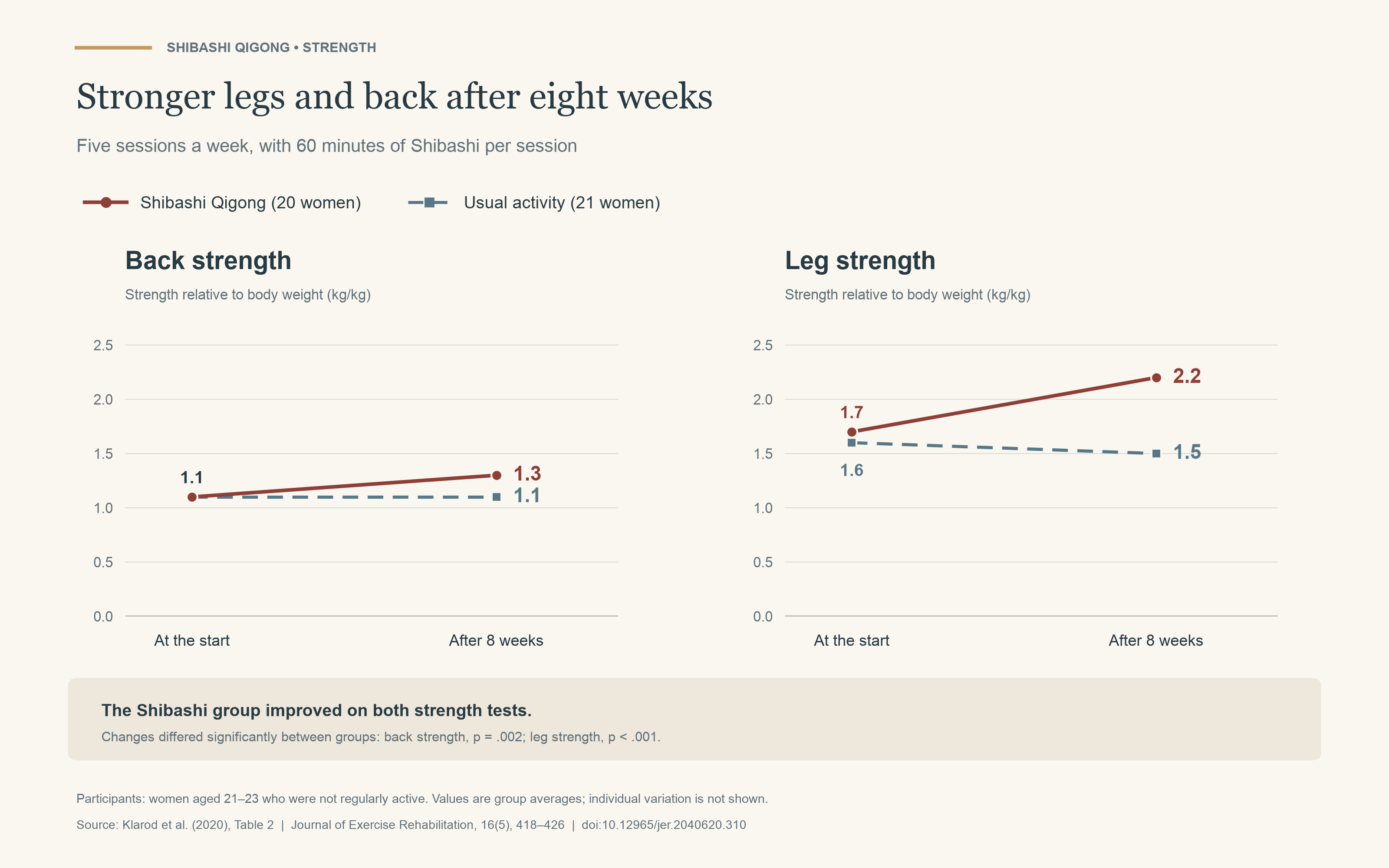
Back and leg strength improved significantly in the Qigong group, both compared with their starting measurements and compared with changes in the inactive group. Leg strength showed the larger improvement.
The researchers measured strength using a dynamometer, a device that records how much force a person produces while pulling against resistance. They adjusted the results for body weight. Average relative leg strength rose from 1.7 to 2.2 in the Qigong group, while the comparison group changed from 1.6 to 1.5. The Qigong group’s increase was approximately 30%, calculated from the reported rounded group averages. These are measurements of force relative to body mass, so they describe performance on a strength test rather than changes in muscle size.
You can understand the physical demands by considering what happens when you move slowly with your knees bent. Your leg muscles support your weight while controlling how far and how quickly you raise and lower your body or shift from side to side. Moving slowly extends the time spent controlling that load. The movement may look easy from across the room but still require sustained muscular work from the person performing it.
The authors point to the partially squatting posture and repeated weight shifts as plausible contributors to the strength gains. Muscles shorten to produce movement, lengthen while controlling movement, and maintain tension to support a position. Those demands are especially relevant when you begin from a low level of activity.
When you begin exercising, strength can also improve as your nervous system becomes better at recruiting and coordinating muscular activity. Repeated movements give you practice in controlling force and maintaining your posture. The authors discuss neural adaptation as one possible explanation for improved performance, alongside changes within the muscles themselves.
Flexibility changed less clearly. The sit-and-reach test measures how far you can reach forward while seated with your legs extended. The Qigong group improved its score by about 1.5 centimeters, but the difference in improvement between groups did not reach statistical significance. Strength was the clearer physical benefit in this experiment.
Understanding oxidative stress
The blood measurements address another aspect of exercise: how physical activity affects the chemical environment in which muscles work.
Your cells continually produce reactive oxygen species, molecules that can react with other cellular components. These molecules participate in normal signaling, including processes involved in adapting to exercise. When production exceeds the capacity of protective and repair systems, oxidative stress can develop and damage fats, proteins, and other cellular structures.
Antioxidant defenses help regulate this activity. They include enzymes and other substances that limit potentially damaging reactions. Regular exercise can stimulate these defenses. The temporary demands of a session provide a stimulus, followed by adaptation over repeated sessions. Researchers are interested in this process because it helps explain how exercise can temporarily increase reactive molecules while improving antioxidant protection over time.
Exercise adaptation depends partly on regulating these reactions, including preserving their useful signaling functions. Small, controlled changes can contribute to useful signals. The amount, timing, and surrounding cellular conditions influence whether the response supports adaptation or contributes to damage.
Klarod and colleagues investigated this relationship using several blood measurements. Two were central to their findings: malondialdehyde, a substance formed during oxidative damage to fats, and total antioxidant capacity, a laboratory estimate of the combined antioxidant activity detected by a particular test. The antioxidant test measures how effectively substances in a blood sample carry out a particular chemical reaction. Its name sounds comprehensive, but it captures one aspect of antioxidant activity. Other tests examine individual enzymes or specific forms of damage.

What changed in the blood
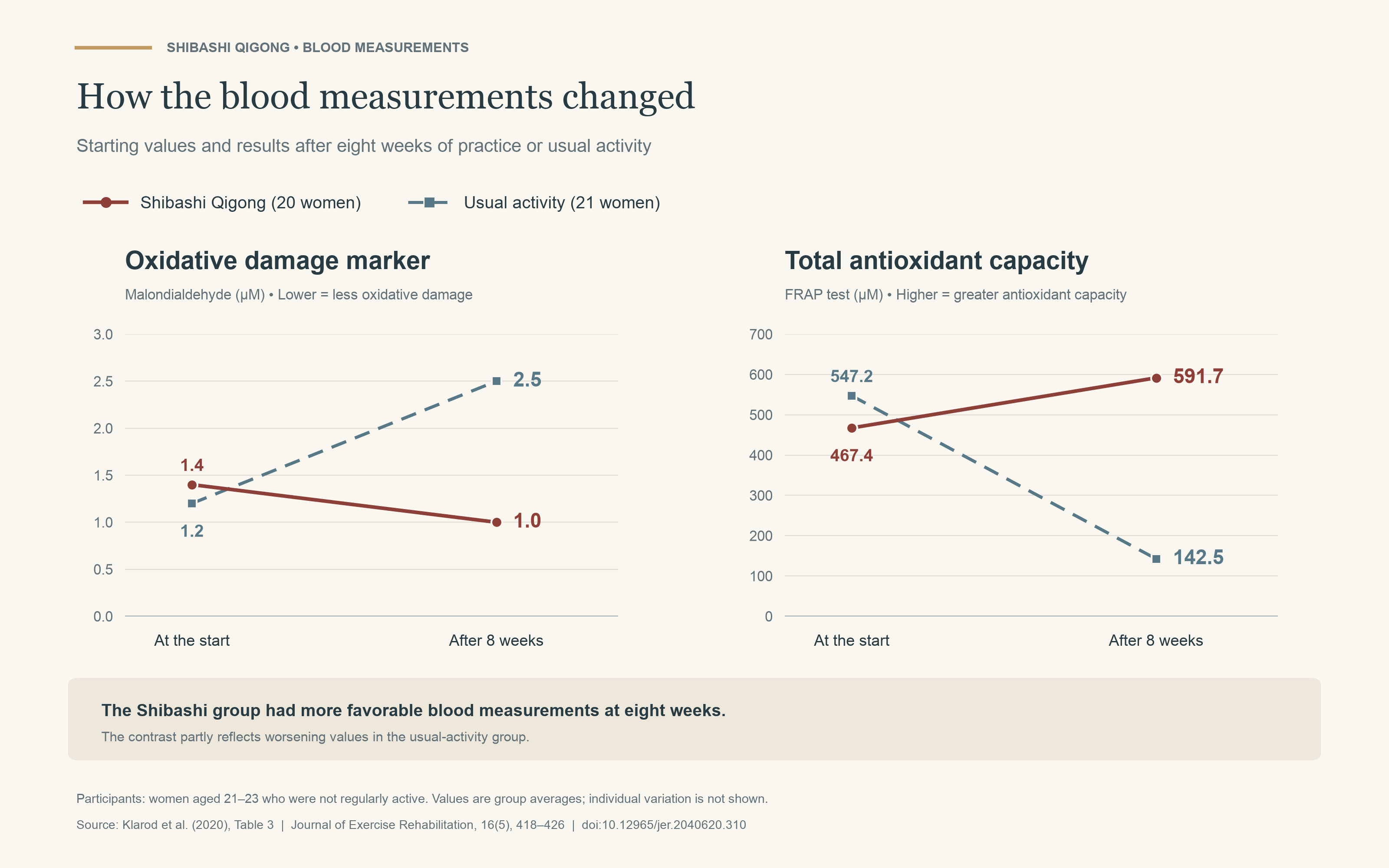
At the end of eight weeks, the Qigong group had lower malondialdehyde and higher total antioxidant capacity than the comparison group. The pattern was consistent with a more favorable balance between oxidative damage and antioxidant protection among those practicing Qigong.
Average antioxidant capacity rose in the Qigong group, while it fell considerably in the comparison group. The oxidative damage marker decreased in the Qigong group and increased in the comparison group. The clearest statistical finding concerned the differences between groups; the table did not identify the Qigong group’s changes in these two markers as statistically significant.
The authors therefore also described the training as preventing the deterioration observed in the inactive group. The difference between groups was partly driven by worsening measurements in the inactive group. This makes maintenance of antioxidant protection a useful part of the explanation.
The researchers also examined whether changes in strength were related to changes in these markers. Across participants from both groups combined, greater strength improvements were associated with greater reductions in the oxidative damage marker. Improved leg strength was also associated with increased antioxidant capacity.
These relationships support the authors’ proposal that the chemical environment may contribute to changes in muscle performance. Because the analysis combined both groups, some of the relationships may reflect the overall difference between exercising and remaining inactive. The biological explanation remains a hypothesis accompanying the observed strength gains.
Muscle contraction depends on chemical signals, including the release of calcium inside muscle cells. Reactive oxygen species can influence force-generating processes. The authors discuss experimental work suggesting that low and high concentrations can affect contraction differently. This suggests a possible link between antioxidant regulation and muscle performance, and the Qigong study adds evidence that changes in both can occur together.
The training effect and its context
Several features make this study useful. It examined a clearly described practice schedule, included a comparison group, and measured physical performance alongside blood chemistry. The strength gains give the biochemical discussion a concrete connection to what participants could actually do.
The study was small, and group assignment depended on practical circumstances rather than random allocation. Differences in motivation, schedules, or other habits could therefore have influenced the results. Participants were asked to maintain their diets, but food intake was not strictly controlled, which is relevant when interpreting antioxidant measurements. The findings are most directly relevant to previously inactive young women undertaking a similar program.
The program also combined movement, breathing, relaxation, and attention. Its results belong to that complete practice. The muscular demands offer a straightforward explanation for the strength gains, while the blood findings suggest another aspect of the training response worth investigating.
For your own practice, the schedule is a reference point, not a tested minimum. The study examined one training dose, so the benefits of shorter sessions remain a separate question. The participants practiced frequently, accumulating hours of controlled movement over the eight weeks.
For people starting from inactivity, the results are encouraging: measured strength improved substantially during a program of controlled, low-impact movement. The accompanying blood findings suggest that regular practice may also help maintain a favorable balance between oxidative stress and antioxidant defenses. Qigong’s physical value becomes easier to understand when you consider the work involved in each movement and the hours of practice accumulated over time.
Reference
Klarod, K., Singsanan, S., Thamwiriyasati, N., Ladawan, S., Luangpon, N., Boonsiri, P., & Burtscher, M. (2020). Effects of Qigong exercise on muscle strengths and oxidative stress/antioxidant responses in young sedentary females: A quasi-experimental study. Journal of Exercise Rehabilitation, 16(5), 418–426. https://doi.org/10.12965/jer.2040620.310

Like what you read? Keep exploring…

If this post resonated with you, you may enjoy my new book:
The Science of Medical Qigong: How Breath, Movement, and Attention Transform the Body
This book examines scientific research on how Qigong practice influences human physiology. Drawing from clinical trials and experimental studies, it explains how coordinated breathing, posture, movement, and focused attention interact with the body’s regulatory systems.
The book explores research on:
• autonomic nervous system regulation
• cardiovascular function and blood pressure
• respiratory mechanics and lung capacity
• sleep quality and recovery
• inflammatory and immune signaling
• brain function and neural plasticity
• cognitive performance and mental health
The Science of Medical Qigong draws on physiology, neuroscience, and clinical research to explain how regular practice affects the body.
Available now in print and Kindle formats.