Qigong and Strength in Older Adults
A Research Review
In a 2024 study published in Frontiers in Medicine, Xiaoping Zhang, Wenda Jiang, Zhenqi Chen, Guang Yang, and Zhongyu Ren examined whether the traditional Chinese exercise Yi Jin Jing can improve muscle strength and physical performance in older adults. The authors conducted a systematic review and meta-analysis of randomized controlled trials to determine whether this classical Qigong system produces measurable changes in strength and functional mobility.
The question matters because muscle loss and declining mobility are among the most consistent physical changes associated with aging. Exercise programs that improve strength without imposing excessive strain are increasingly important for maintaining independence in later life.
As populations age worldwide, clinicians and public health researchers are paying closer attention to conditions linked to declining muscle mass and strength. One of the most widely discussed conditions is sarcopenia, which refers to a progressive loss of muscle mass and physical function that occurs with aging. This condition increases the likelihood of falls, fractures, disability, and mortality while reducing overall quality of life.
Because sarcopenia develops gradually, many health organizations emphasize early intervention through exercise and lifestyle strategies. Programs that are safe for older adults and require minimal equipment have received particular attention.
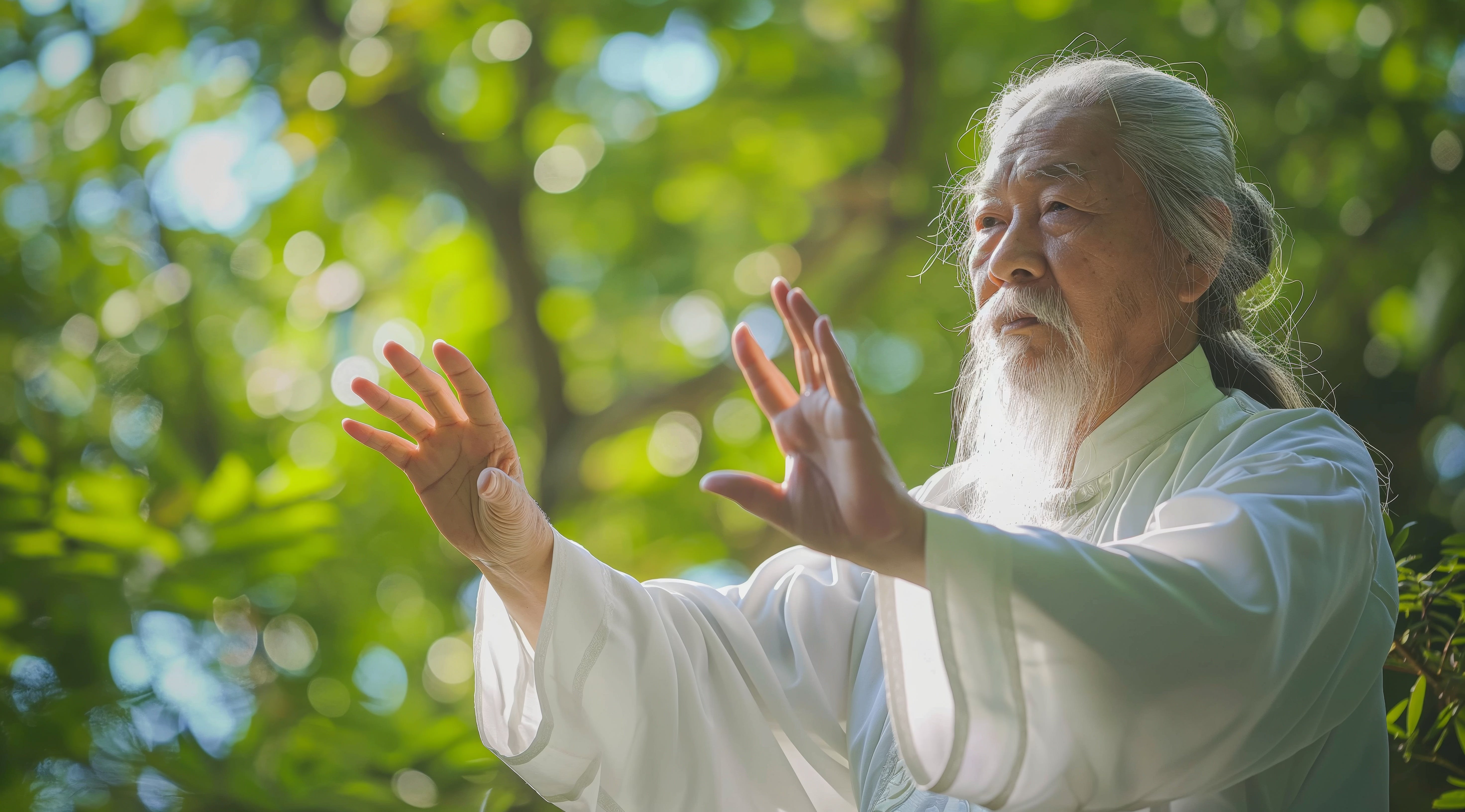
Yi Jin Jing is one such intervention. The practice consists of a sequence of twelve slow, coordinated movements involving stretching, twisting, and controlled squatting. These movements are designed to mobilize the spine and limbs while gradually strengthening muscles and connective tissues.
Despite its long history, research findings on Yi Jin Jing have not always been consistent. Some trials report improvements in muscle strength and mobility, while others show smaller or mixed results. The purpose of this meta-analysis was to combine available studies and determine the overall pattern of outcomes.
What the Researchers Did
The authors conducted a systematic search across seven major scientific databases, including PubMed, Web of Science, Cochrane Library, Embase, and several Chinese research databases. The search focused on randomized controlled trials that examined Yi Jin Jing practice in adults over the age of sixty.
After screening more than four hundred articles, ten randomized controlled trials met the inclusion criteria. Together these studies involved 590 participants, the majority of whom were women. Some trials included healthy older adults, while others involved participants with conditions such as sarcopenia or knee osteoarthritis.
In every study, the intervention group practiced Yi Jin Jing while the control group either received no exercise intervention or only health education. Practice programs varied across studies but commonly involved sessions lasting twenty to sixty minutes performed several times per week over periods ranging from eight to twenty-four weeks.
The researchers analyzed several types of outcomes. Muscle strength was measured using handgrip strength and laboratory assessments of knee muscle performance. Physical performance was measured using functional tests such as chair sit-to-stand, squatting-to-standing, shoulder flexibility, and sit-and-reach tests.
What Changed
When the results from the ten trials were combined, a consistent pattern emerged.
Yi Jin Jing produced measurable improvements in several indicators of muscle strength. Handgrip strength increased modestly across studies, indicating a small but statistically reliable improvement in upper-body strength. Knee extensor and flexor strength measured with isokinetic testing also increased, with effect sizes in the small-to-moderate range depending on the measurement method.
Functional mobility showed the largest changes. Two common mobility tests demonstrated particularly strong improvements. The chair sit-to-stand test, which measures how quickly a person can repeatedly stand from a seated position, showed a large overall improvement effect. A similar pattern appeared in the squatting-to-standing test, another indicator of lower-body functional strength.
Other outcomes were less consistent. Shoulder flexibility improved on one side of the body in the combined analysis but did not show the same pattern on the other side. The sit-and-reach test, a common measure of hamstring and lower-back flexibility, did not show a significant improvement across studies.
Taken together, the results show that the strongest changes occurred in tasks that depend on coordinated lower-body strength and repeated standing movements.
The Numbers
Across the ten randomized controlled trials included in the analysis, a total of 590 participants over the age of sixty were studied. The pooled results showed a clear pattern in functional strength outcomes. Performance in the chair sit-to-stand test improved with a large effect size (Hedges’ g = 1.06), while the squatting-to-standing test demonstrated a similarly large effect (Hedges’ g = 1.08). Measures of muscular strength showed smaller but consistent improvements. Handgrip strength increased with a small effect (g = 0.25). Laboratory measures of knee muscle performance showed small to moderate gains, including extensor peak torque at 60°/s (g = 0.47), extensor average power (g = 0.31), extensor total work (g = 0.29), flexor peak torque (g = 0.42), and flexor average power (g = 0.37). Some measurements did not change significantly, including several higher-speed muscle tests at 180°/s and the sit-and-reach flexibility test. Taken together, the data indicate that Yi Jin Jing produces its strongest effects in functional lower-body tasks that resemble everyday movements such as standing up from a chair.
Mechanism and Interpretation
The pattern of results aligns with the physical structure of Yi Jin Jing practice.
The sequence contains multiple movements that require controlled squatting, rising, and shifting body weight through the legs. These actions repeatedly activate the large muscle groups of the hips and thighs. Over time, this type of repeated loading can increase muscle activation efficiency and improve functional strength.
The improvements in chair sit-to-stand performance likely reflect this mechanism. Standing from a chair requires coordinated activation of the quadriceps, hip extensors, and trunk stabilizers. Repeated practice of similar movements during Yi Jin Jing training gradually strengthens these muscle groups and improves neuromuscular coordination.
Handgrip strength improvements are smaller because the exercise sequence places less direct demand on the forearm muscles. The movements primarily involve the shoulders, trunk, and lower body, which explains why improvements appear strongest in mobility tasks rather than isolated grip strength.
System-Level Framing
Viewed from a systems perspective, the outcomes form a coherent pattern.
Lower-body muscle strength, balance control, and mobility are closely connected in older adults. Improvements in one domain often influence the others. When leg strength increases, standing and walking tasks become easier. This reduces fall risk and supports independent movement.
Yi Jin Jing movements combine slow joint mobilization, controlled loading of the lower limbs, and repeated transitions between standing positions. This combination targets the same functional capacities that decline with aging. Improvements in chair sit-to-stand performance therefore reflect broader changes in muscular coordination and functional mobility.
From this perspective, the intervention acts less like isolated strength training and more like a coordinated movement practice that gradually restores functional capacity.
Limitations
Several limitations appear in the evidence base.
Only ten randomized controlled trials were included in the analysis, and many of the studies had relatively small sample sizes. Although the overall risk of bias was considered low, most studies did not report blinding procedures or allocation concealment. These methodological details are difficult to implement in exercise trials but still influence evidence quality.
The intervention programs also varied across studies in terms of duration, session length, and training frequency. Differences in participant health status may also influence outcomes. Some trials involved individuals with sarcopenia or joint disease, while others studied generally healthy older adults.
Because of these variations, the certainty of evidence for several outcomes was rated as low to moderate.
Final Perspective
When the available randomized trials are considered together, Yi Jin Jing appears to produce measurable improvements in lower-body functional performance in older adults. The largest changes occur in tasks that require repeated standing and squatting movements.
Strength improvements measured in laboratory tests are smaller but still present. Flexibility outcomes show less consistent patterns.
These findings position Yi Jin Jing as a structured movement practice that can support functional mobility during aging. Its slow pace and controlled movements allow older adults to engage in strength-building exercise without the joint stress associated with higher-intensity training.
Reference
Zhang, X., Jiang, W., Chen, Z., Yang, G., & Ren, Z. (2024). Effects of Yi Jin Jing on enhancing muscle strength and physical performance in older individuals: A systematic review and meta-analysis. Frontiers in Medicine, 11, 1441858.
Like what you read? Keep exploring…
If this post resonated with you, you may enjoy my new book:
The Science of Medical Qigong: How Breath, Movement, and Attention Transform the Body
This book examines the growing body of scientific research exploring how Qigong practice influences human physiology. Drawing from clinical trials and experimental studies, it explains how coordinated breathing, posture, movement, and focused attention interact with the body’s regulatory systems.
The book explores research on:
• autonomic nervous system regulation
• cardiovascular function and blood pressure
• respiratory mechanics and lung capacity
• sleep quality and recovery
• inflammatory and immune signaling
• brain function and neural plasticity
• cognitive performance and mental health
Rather than presenting Qigong through mystical language, The Science of Medical Qigong approaches the subject through physiology, neuroscience, and clinical research, offering a clear explanation of how regular practice can influence the coordination and harmony of the body’s systems.
Available now in print, Kindle, and audiobook formats.
Click here to get your copy on Amazon


