

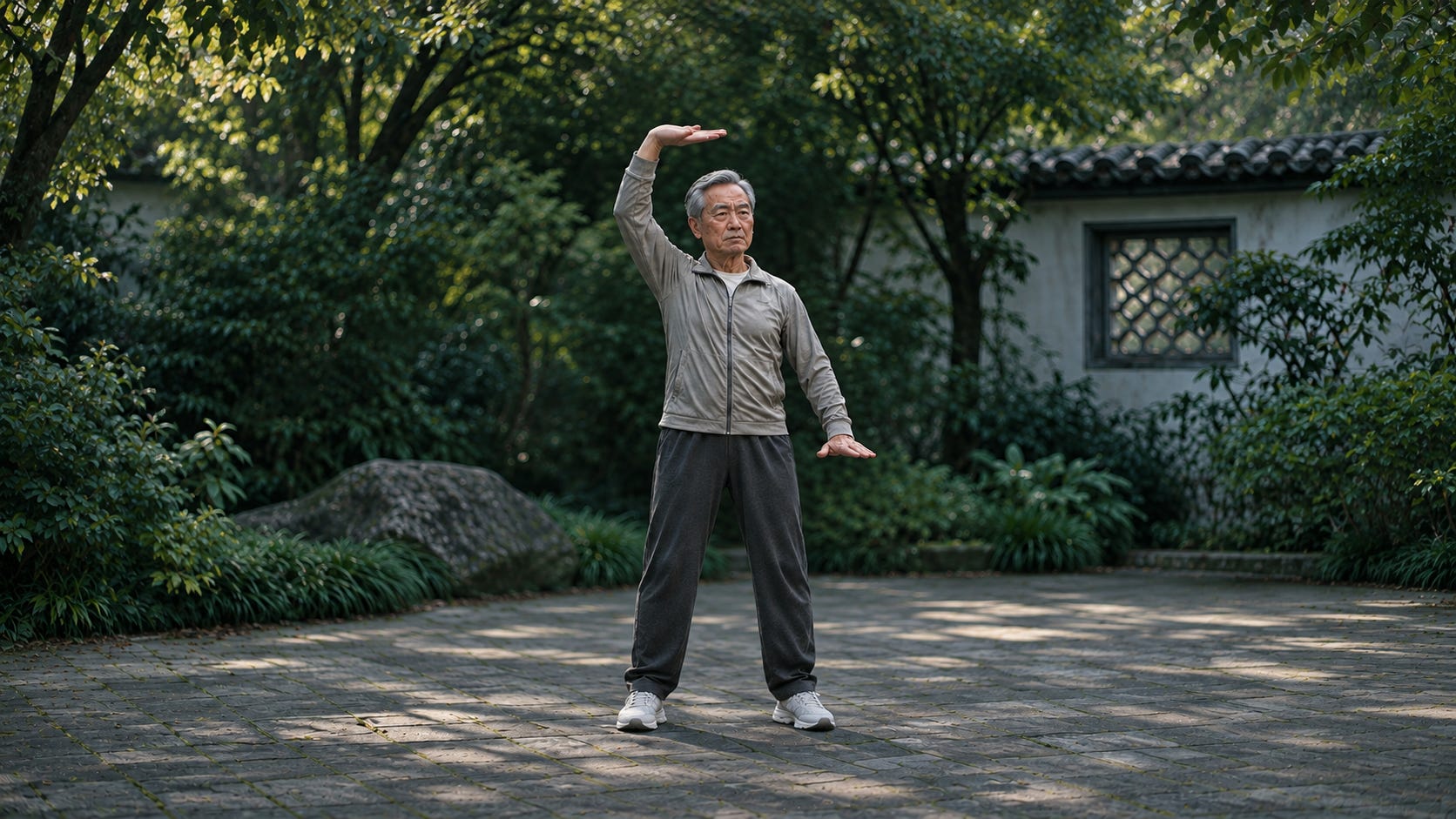
Combining Baduanjin Qigong with cognitive training produced the clearest improvement in cognitive test performance in a new review of exercise programs for older adults with cognitive frailty. Programs combining several forms of exercise also showed promise. For anyone concerned about declining strength alongside changes in memory or thinking, the findings offer an encouraging direction: physical activity and deliberate mental practice may work well together.
The review, by Liyao Su and colleagues in BMC Geriatrics, examined exercise approaches ranging from resistance training to Tai Chi, Baduanjin, and programs combining movement with cognitive tasks. Its most useful contribution is the distinction between outcomes. An approach that looks promising for cognition may differ from one that looks promising for mobility. Understanding those differences helps you look beyond general exercise advice and consider what a program actually trains.
Understanding Cognitive Frailty
Cognitive frailty describes the combination of physical frailty, or its earlier stage, and measurable cognitive impairment in a person without established dementia. Physical changes may include weakness, slower walking, or reduced endurance. Cognitive changes can make it harder to remember instructions, plan activities, or manage everyday tasks. When these problems occur together, maintaining independence becomes more challenging. Researchers regard cognitive frailty as potentially modifiable, making it a worthwhile focus for intervention before difficulties become more disabling.
You can appreciate the connection through an ordinary activity such as walking to the store. You need sufficient strength and balance to move comfortably, while also remembering your destination and responding to what happens around you. Physical weakness can reduce how often you go out. Difficulty with attention or planning can make the same outing harder to manage. Exercise programs that engage both movement and thinking address abilities you use together throughout daily life.
The Findings for Baduanjin and Cognitive Training
Su and colleagues brought together 19 publications representing 17 independent randomized trial datasets and 1,691 participants. They searched research published through August 16, 2026, and examined two cognitive tests alongside measures of mobility, grip strength, and lower-body performance. Their method, a network meta-analysis, combines direct comparisons within trials with indirect comparisons across trials. If two programs have each been compared with usual care, the analysis can estimate how they might compare with each other. This expands comparisons while making the similarity of the underlying studies important.
The strongest cognitive finding involved Baduanjin combined with structured cognitive training. Participants receiving this combination scored an estimated 4.25 points higher than the comparison group on the Montreal Cognitive Assessment (MoCA). This 30-point screening test examines several thinking abilities, including memory and attention. The estimated advantage had a 95% credible interval from 0.22 to 8.39 points. In ordinary language, the analysis favored the combined program, although the size of its benefit remained uncertain. It was the only intervention in the primary MoCA network whose interval stayed entirely above zero.
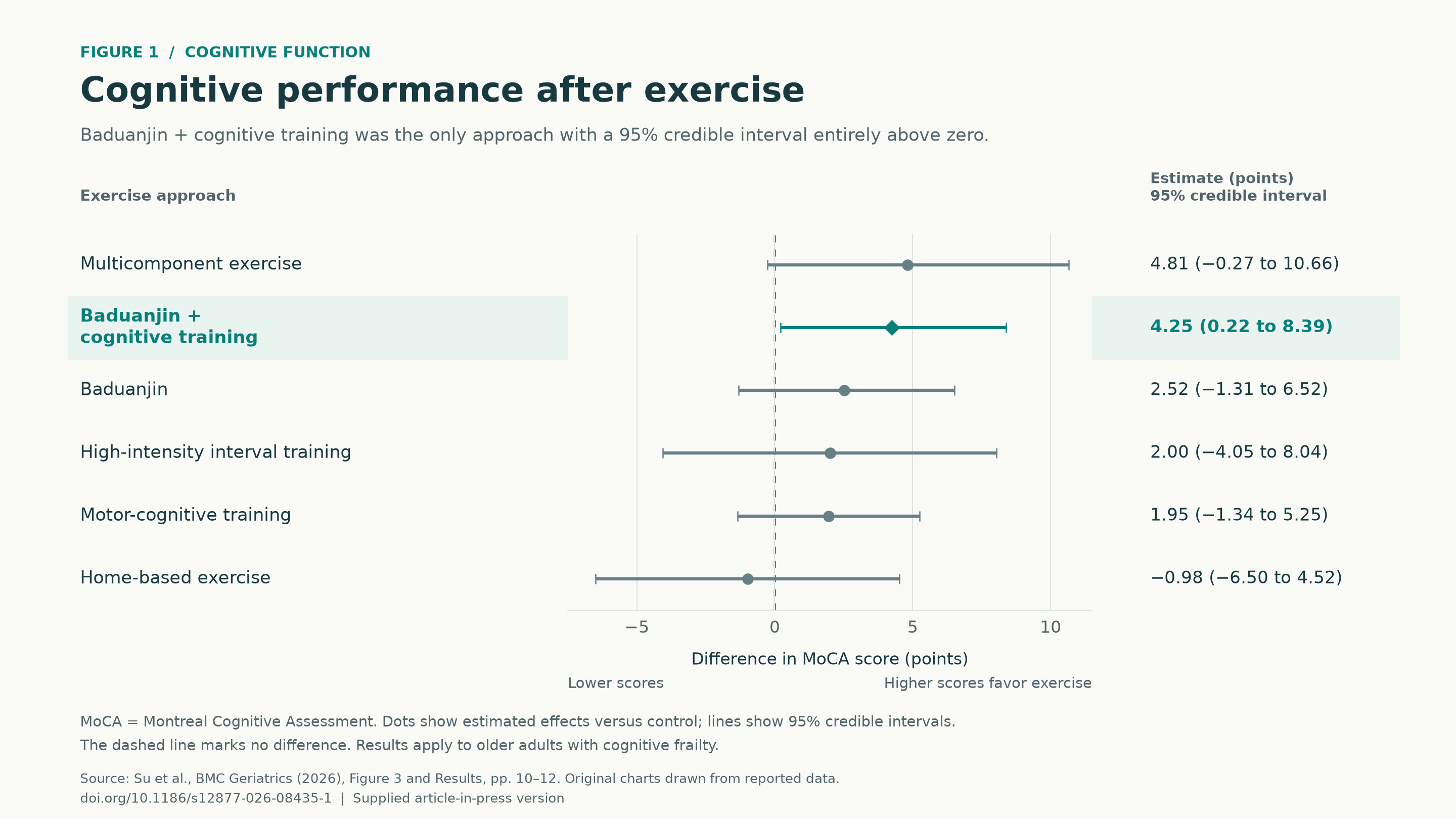
Figure 1. Cognitive performance after exercise. Dots show estimated differences in MoCA scores compared with control; horizontal lines show 95% credible intervals. Only the interval for Baduanjin combined with cognitive training remained entirely above zero. Data: Su and colleagues, BMC Geriatrics (2026).
Baduanjin, also known as the Eight Pieces of Brocade, is a traditional Qigong practice involving a sequence of movements coordinated with breathing and mental focus. You attend to posture and movement as you practice. Structured cognitive training adds exercises specifically intended to challenge thinking abilities. This review's results come from that combined program. Its relevance is the opportunity to combine organized physical and cognitive practice in the same training program.
One underlying trial makes that combination more concrete. Yang and colleagues studied older adults with diabetes and cognitive frailty who practiced Baduanjin with cognitive training three times weekly for 12 weeks. By the end, the intervention group had better cognitive scores and improved physical frailty, walking speed, and grip strength than the control group. These findings link cognitive outcomes to physical abilities that matter in daily life. Read the original trial.
In Yang and colleagues’ trial, cognitive training included recognizing and recalling pictures of famous people and landmarks, finding and naming numbers from 1 to 25 in a scrambled grid, doing simple arithmetic, and sorting playing cards by suit and numerical order. Participants also practiced finger exercises and responded to spoken directions by moving in the opposite direction. Each cognitive training session lasted 25–30 minutes and covered one or two types of activity, three times a week. These sessions alternated with Baduanjin practice during the 12-week program.
A reporting discrepancy is worth resolving: Su and colleagues label that trial’s comparator as daily activities, while the original report describes routine exercise and health education. The amount and structure of comparison-group exercise can affect a program's estimated advantage. This detail adds uncertainty to the precise pooled estimate, even as the original trial provides an encouraging result for combined training.
Comparing Exercise Approaches
Multicomponent exercise ranked highest on the MoCA, with an estimated advantage of 4.81 points. These programs generally combine aerobic exercise, strength work, and balance training. Their variety makes practical sense when several physical abilities need attention. However, the uncertainty interval extended slightly below zero, so the higher ranking was less conclusive than the Baduanjin combination’s result. Rankings show where an intervention falls within the statistical comparison; the accompanying range shows how precisely its effect has been estimated.
The second cognitive measure, the Mini-Mental State Examination, produced a different ranking. Rehabilitation focused on daily living activities ranked highest, although the estimate was too imprecise to establish a clear advantage. The two tests assess overlapping aspects of cognition, but their tasks and sensitivity differ. Different trial groups also contributed to each analysis. This helps explain why different exercise approaches ranked highest in different comparisons. The practical question remains which abilities improve, by how much, and for whom.
The physical outcomes showed different patterns. Otago exercise, a program emphasizing strength and balance, ranked highest for a timed task involving standing up, walking, turning, and sitting down. Multicomponent exercise ranked highest for grip strength. Tai Chi ranked highest on the Short Physical Performance Battery, which assesses standing balance, walking speed, and repeated chair rises. Each leading estimate had a wide uncertainty range that included no difference from the comparison group. These results identify promising approaches for particular abilities, with considerable uncertainty about their relative benefits.
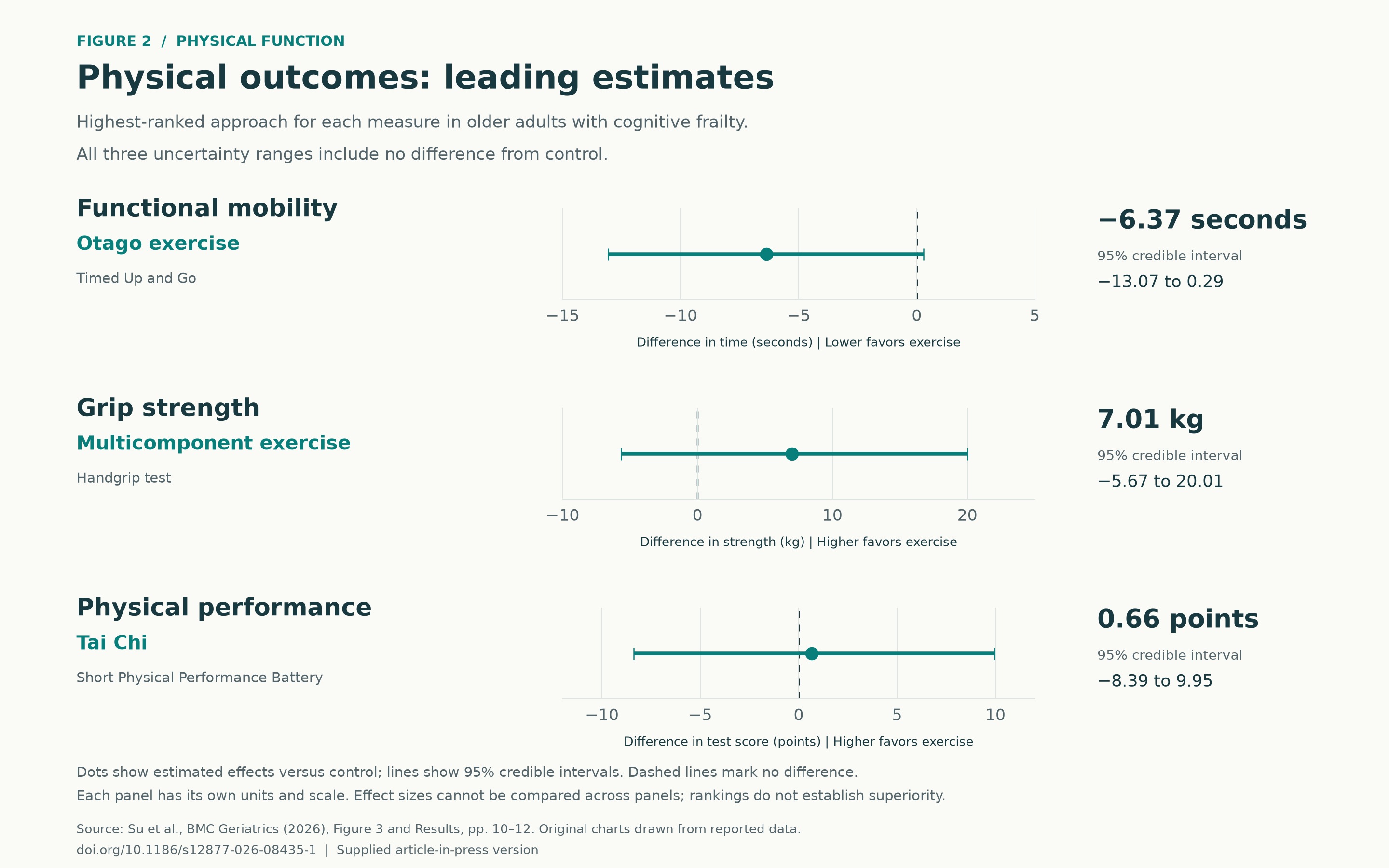
Figure 2. Physical outcomes: leading estimates. Otago exercise, multicomponent exercise, and Tai Chi ranked highest for the respective measures shown. All three 95% credible intervals included no difference from control. Each panel uses different units and a separate scale. Data: Su and colleagues, BMC Geriatrics (2026).
If you practice Qigong or Tai Chi, these differences matter. Baduanjin with cognitive training had the clearest cognitive signal, while Tai Chi’s favorable ranking concerned combined physical performance. Each practice has its own movements and demands. A slow sequence can require sustained attention, coordination, and repeated posture adjustments, even when it looks undemanding from the outside. Those features offer a sensible reason to investigate traditional movement practices in people experiencing physical and cognitive difficulties together.
The authors discuss several possible biological explanations. Exercise may improve blood supply to the brain and support the nervous system’s capacity to adapt through experience, known as neuroplasticity. Changes in metabolism and inflammatory activity may also contribute. These proposed explanations draw largely on related research. A separate 24-week Baduanjin trial cited in the review reported improvements in cognition and frailty alongside changes in blood markers related to cell damage and immune activity. Such studies help researchers investigate how physical practice and cognitive improvement might be connected. Read the Baduanjin trial.
From Research to Regular Practice
The review also examined training frequency and duration. Cognitive improvements tended to be larger in studies using three sessions per week and programs lasting 12 to 16 weeks. Those patterns came from comparisons across different studies, where the participants and training content also differed. They offer a reasonable schedule to investigate further, but the best frequency and duration remain unsettled. If you are considering a program, consistency over several months aligns more with the research than expecting a few isolated sessions to produce comparable changes.
Several features explain why the findings are encouraging without establishing a preferred exercise prescription. Some interventions were represented by only one trial, and cognitive results varied substantially between studies. Definitions of frailty and the participants’ starting abilities also differed. The authors rated confidence in most comparisons as moderate or low, with some very low. Reporting of adverse events and attendance was inconsistent. Evidence about lasting benefits after training ended was also inadequate. The strongest evidence concerns improvements measured at the end of structured programs.
For practical use, begin with the abilities you want to improve and the support you need to practice regularly. If weakness and cognitive difficulties are occurring together, an assessment can help identify appropriate exercise and learning demands. A suitable program might combine manageable strength and balance work with repeated movement sequences and structured cognitive exercises. When balance or following instructions is difficult, supervision and clear demonstrations become particularly useful. The review supports exploring these combinations while adapting the work to the person’s present abilities.
Progress is also worth observing in ordinary terms. You might notice whether getting out of a chair feels easier, whether you can follow a familiar movement sequence with fewer prompts, or whether walking feels more secure. These observations can help you discuss changes with an instructor or clinician alongside formal assessments. Keep the goals specific enough that you can recognize progress, and choose practice you can repeat with appropriate support. That gives the training a clear purpose in your everyday life.
For those already practicing Qigong or Tai Chi, these findings support valuing learning, repetition, and attentive movement. For older adults experiencing cognitive frailty, Baduanjin paired with cognitive training deserves further investigation as a practical option. The broader opportunity is to build programs around the physical and mental abilities people need to remain active and involved in daily life.
Reference
Su, L., Abudoureheman, W., Jin, Y., Wang, Y., Bai, S., & Liu, S. (2026). Exercise-based interventions for cognitive frailty in older adults: A systematic review and network meta-analysis. BMC Geriatrics. Advance online publication. https://doi.org/10.1186/s12877-026-08435-1
Like what you read? Keep exploring…

If this post resonated with you, you may enjoy my new book:
The Science of Medical Qigong: How Breath, Movement, and Attention Transform the Body
This book examines scientific research on how Qigong practice influences human physiology. Drawing from clinical trials and experimental studies, it explains how coordinated breathing, posture, movement, and focused attention interact with the body’s regulatory systems.
The book explores research on:
• autonomic nervous system regulation
• cardiovascular function and blood pressure
• respiratory mechanics and lung capacity
• sleep quality and recovery
• inflammatory and immune signaling
• brain function and neural plasticity
• cognitive performance and mental health
The Science of Medical Qigong draws on physiology, neuroscience, and clinical research to explain how regular practice affects the body.
Available now in print and Kindle formats.
Thanks for your summary and for including the link to the article in pubmed. Nice that it’s a full access article.