


Your muscles use fat and glucose to sustain movement, maintain their cells, and support the work of repair. Repeated muscular activity also stimulates changes in the tissues themselves. With an appropriate training stimulus, adequate nourishment, and recovery, muscles can become stronger and better able to meet the demands placed on them. Physical alchemy in Yijin Jing can be understood as the deliberate cultivation of these transformations, along with the attention and mental discipline you bring to your practice.
The traditional terms jing, qi, and shen describe related aspects of this cultivation. Jing 精, usually translated as essence, includes the inherited foundations of life and the nourishment acquired after birth. Qi 氣 refers to the energy and activity through which life is sustained. Shen 神 refers to spirit, including mental vitality, clarity, and the spiritual dimensions of cultivation. Their relationship gives physical alchemy direction: nourish and conserve your resources, use them effectively, and cultivate the mind that directs your actions.
How your body uses nourishment and movement to support strength and repair
Food provides a concrete starting point for understanding acquired jing in physiological terms. Digestion supplies glucose, fatty acids, amino acids, and other nutrients. Some are used promptly; others are stored or incorporated into tissues. Muscle stores carbohydrate as glycogen and also contains stores of fat. These reserves help meet the changing energy demands of activity. Inherited constitution and hormonal regulation belong to a different part of the comparison with jing: they influence how the body develops and functions. Hormones regulate these processes rather than serving as the fuel consumed during exercise.
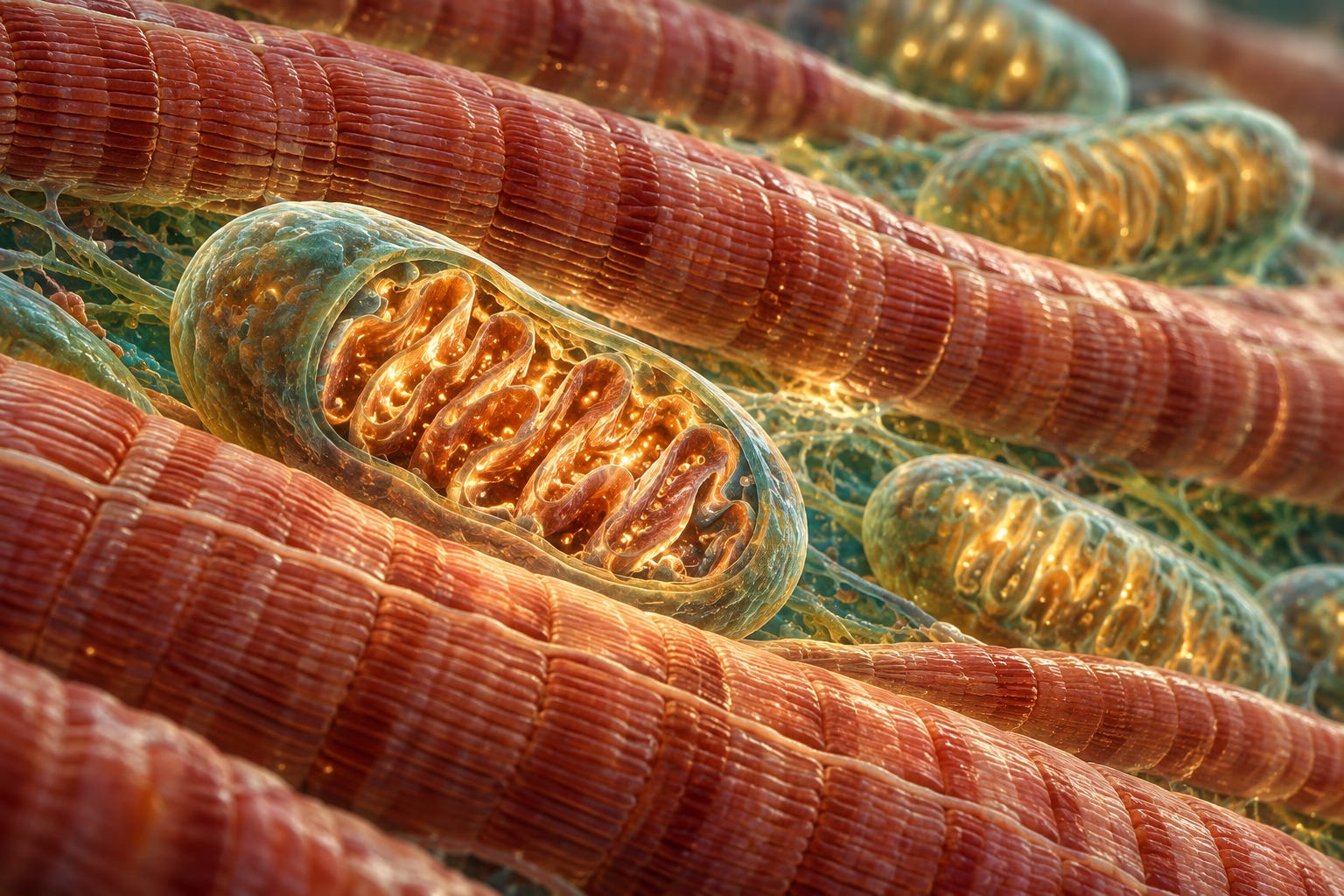
Converting nourishment into usable energy gives a physical meaning to refining jing into qi. When your muscles work, they use a mixture of fuels drawn from the bloodstream and their own reserves. The contribution of fat and carbohydrate changes with the intensity and duration of the activity. Chemical reactions transfer energy from these fuels into ATP, a molecule that supplies energy for cellular work. Mitochondria produce much of this ATP through oxygen-dependent processes, while other pathways regenerate ATP without directly using oxygen. Muscle fuel metabolism
ATP powers the interactions between muscle proteins that produce contraction. It also supports repair and the pumps that maintain electrical charge differences and ion concentrations across cell membranes. These differences enable nerve signaling and muscle excitation. Metabolism and bioelectricity are therefore closely connected. These mechanisms give us specific physiological processes to consider within the broader traditional concept of qi. ATP and ion transport
Muscular activity also changes how glucose enters the working tissue. Contraction moves glucose transporters called GLUT4 toward the muscle cell surface, where they help glucose pass from the blood into the cells. This allows active muscle to increase glucose uptake without requiring more insulin. Movement creates an energy demand and helps the muscle obtain the fuel to meet it. Exercise and glucose transport
Fuel use and tissue building are connected through the energy required for adaptation. Fat and glucose supply much of that energy, while amino acids supply the building blocks for muscle proteins. Resistance exercise stimulates muscle protein synthesis, and adequate amino acids support the rebuilding that follows. Over time, repeated periods in which protein building exceeds breakdown can increase muscle tissue. This transformation involves both using existing resources and building new tissue. Muscle protein synthesis after exercise
What muscle metabolism can teach us about physical cultivation in Yijin Jing
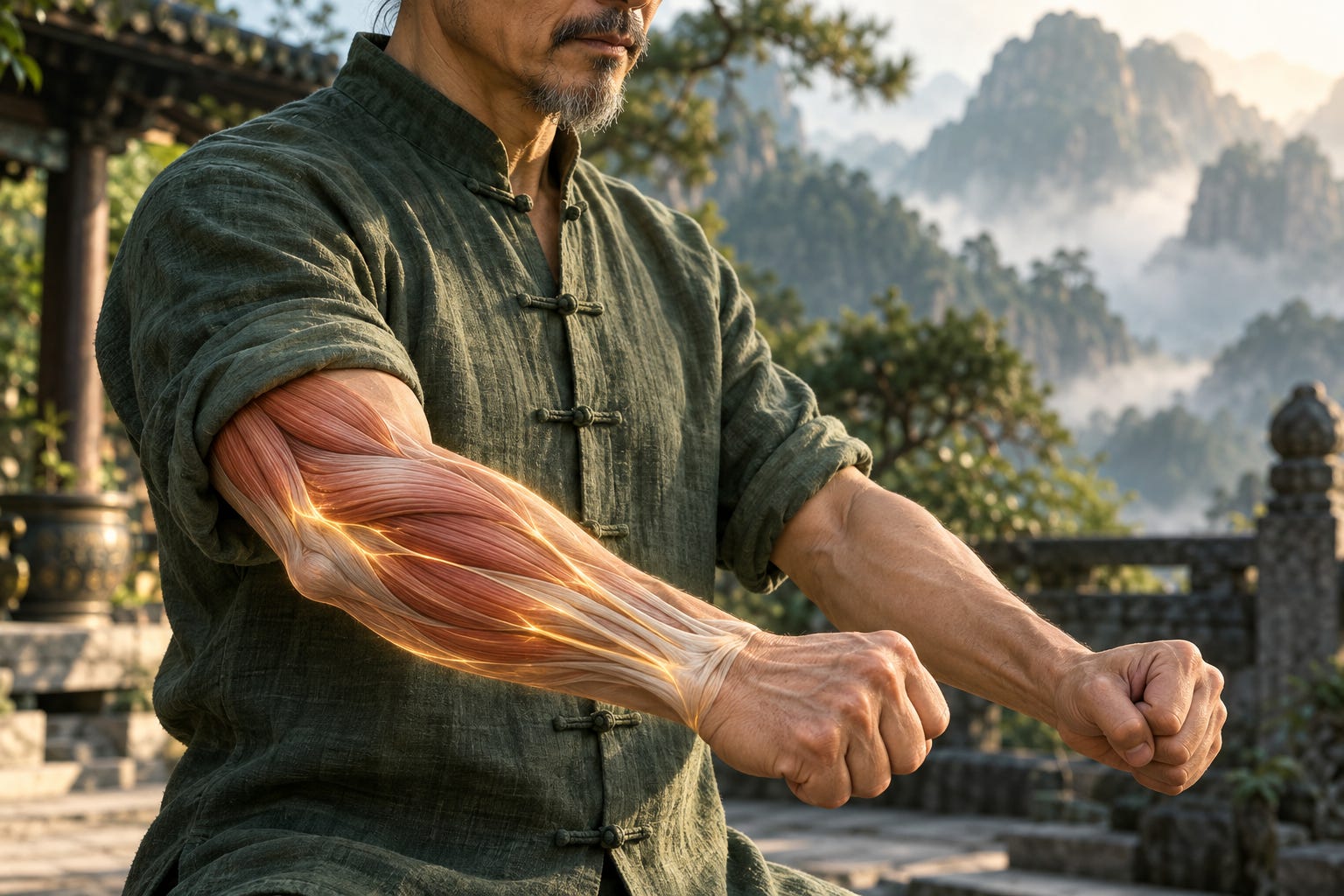
This helps explain why sustained postures and muscular effort matter in Yijin Jing. Holding the arms away from the body requires effort even with little visible movement. Tightening the fists adds muscular contraction. This effort uses ATP and loads the tissues. Whether that load produces greater strength or structural change depends on its intensity, duration, repetition, and progression. Research on isometric training, in which muscles produce force without substantial joint movement, shows that sufficient loading can increase muscle strength and alter the mechanical properties of tendon structures. These findings help explain why the actual muscular demands of a Yijin Jing method matter. Isometric training and tendon adaptation
Cultivating Shen through attentive practice
Cultivating shen includes developing a clear, steady mind and the vitality to fully engage with what you are doing. Intention, or yi 意, gives your actions direction. As you practice, you attend to your posture, judge your effort, and notice unnecessary tension. You can then change how you move or how strongly you contract. The traditional relationship between shen and qi includes this coordination of mental activity and bodily action, alongside its spiritual meaning.
Nourishing shen also has a straightforward physical foundation. Your brain depends on a continuing supply of energy to sustain attention, perception, and the control of movement. Nourishment supports mental activity, and mental activity helps direct how you use the body. In Yijin Jing, you practice this relationship whenever you maintain a posture with attention, adjust excessive effort, or perform a movement with greater precision. The refinement includes both the condition of your tissues and how skillfully and attentively you practice.

Balancing training and recovery for lasting strength
Training and recovery contribute in different ways to this work. Practice demands stimulate adaptation, while food and recovery support the rebuilding that follows. A posture that once required substantial effort may eventually become easy, so further physical development depends on an appropriate progression. For cultivation to remain sustainable, that progression must fit your current capacity and leave you able to recover. The aim is to develop a body you can use with strength and control, supported by a mind capable of steady, attentive practice.
Like what you read? Keep exploring…

If this post resonated with you, you may enjoy my new book:
The Science of Medical Qigong: How Breath, Movement, and Attention Transform the Body
This book examines the growing body of scientific research exploring how Qigong practice influences human physiology. Drawing from clinical trials and experimental studies, it explains how coordinated breathing, posture, movement, and focused attention interact with the body’s regulatory systems.
The book explores research on:
• autonomic nervous system regulation
• cardiovascular function and blood pressure
• respiratory mechanics and lung capacity
• sleep quality and recovery
• inflammatory and immune signaling
• brain function and neural plasticity
• cognitive performance and mental health
The Science of Medical Qigong draws on physiology, neuroscience, and clinical research to explain how regular practice affects the body.
Available now in print and Kindle formats.