


During meditation, you may notice pressure beneath your legs, an itch, or an urge to change position. You may then begin wondering how long the discomfort will last or whether you should stop. Paying attention to this sequence allows you to distinguish the physical sensation from the thoughts and reactions that accompany it.
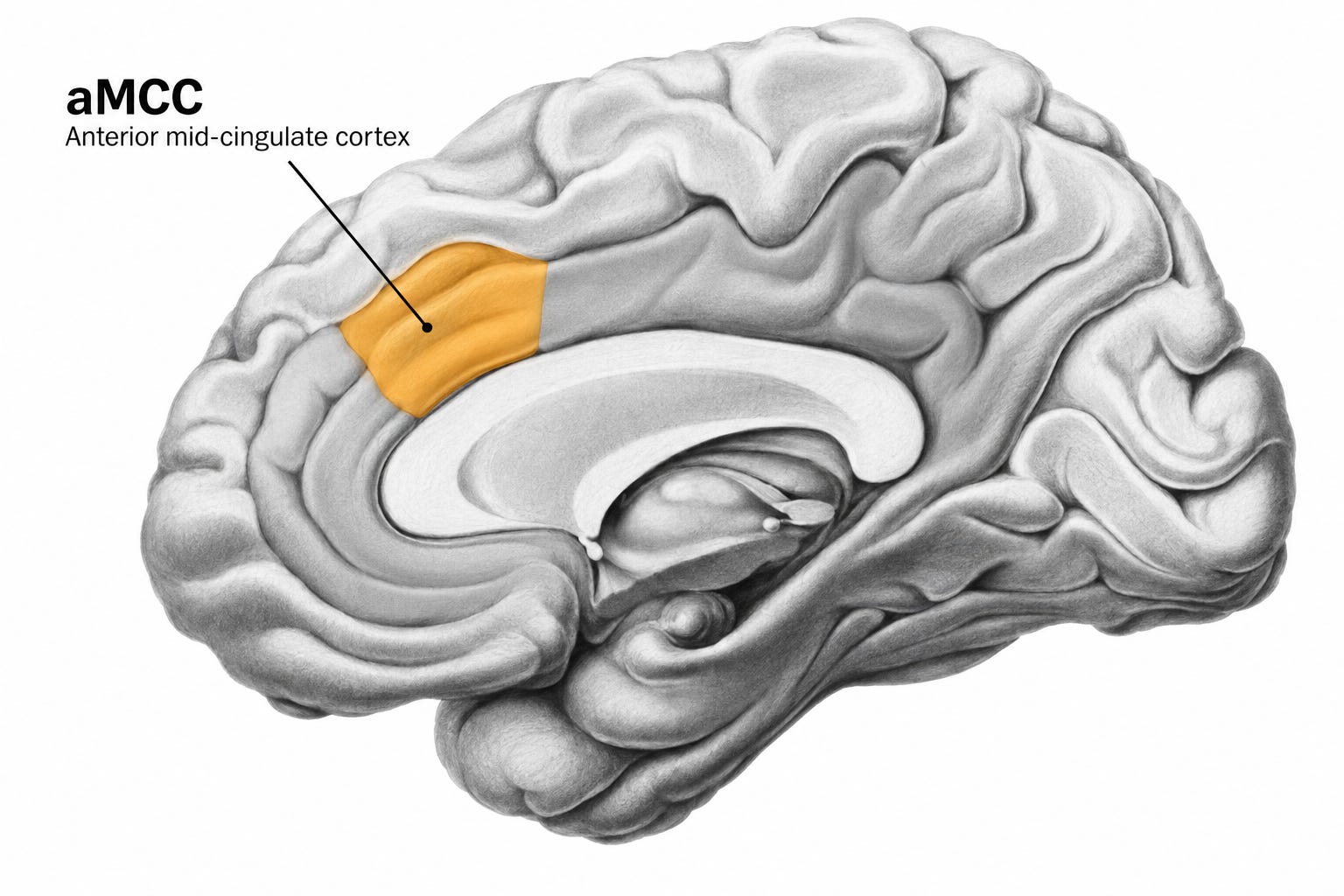
The anterior mid-cingulate cortex, or aMCC, is involved in processes relevant to effort, pain, and action. Meditation research has examined its activity while practitioners anticipate and experience painful stimulation.
What the aMCC does
A review published in Cortex by Touroutoglou and colleagues describes the aMCC as part of a network that evaluates effort and supports goal-directed behavior. It integrates information relevant to whether an action is worth pursuing, including its demands and potential benefits. Its connections with systems involved in movement, emotion, and the regulation of bodily functions help explain why it appears in research on both persistence and pain (Touroutoglou et al., 2020).
Some imaging studies use the term dorsal anterior cingulate cortex, or dACC, for areas classified elsewhere as aMCC. The boundaries depend on the anatomical framework used. Lutz and colleagues explicitly identified the aMCC; the structural study discussed below used the term dACC.
Meditation during painful stimulation
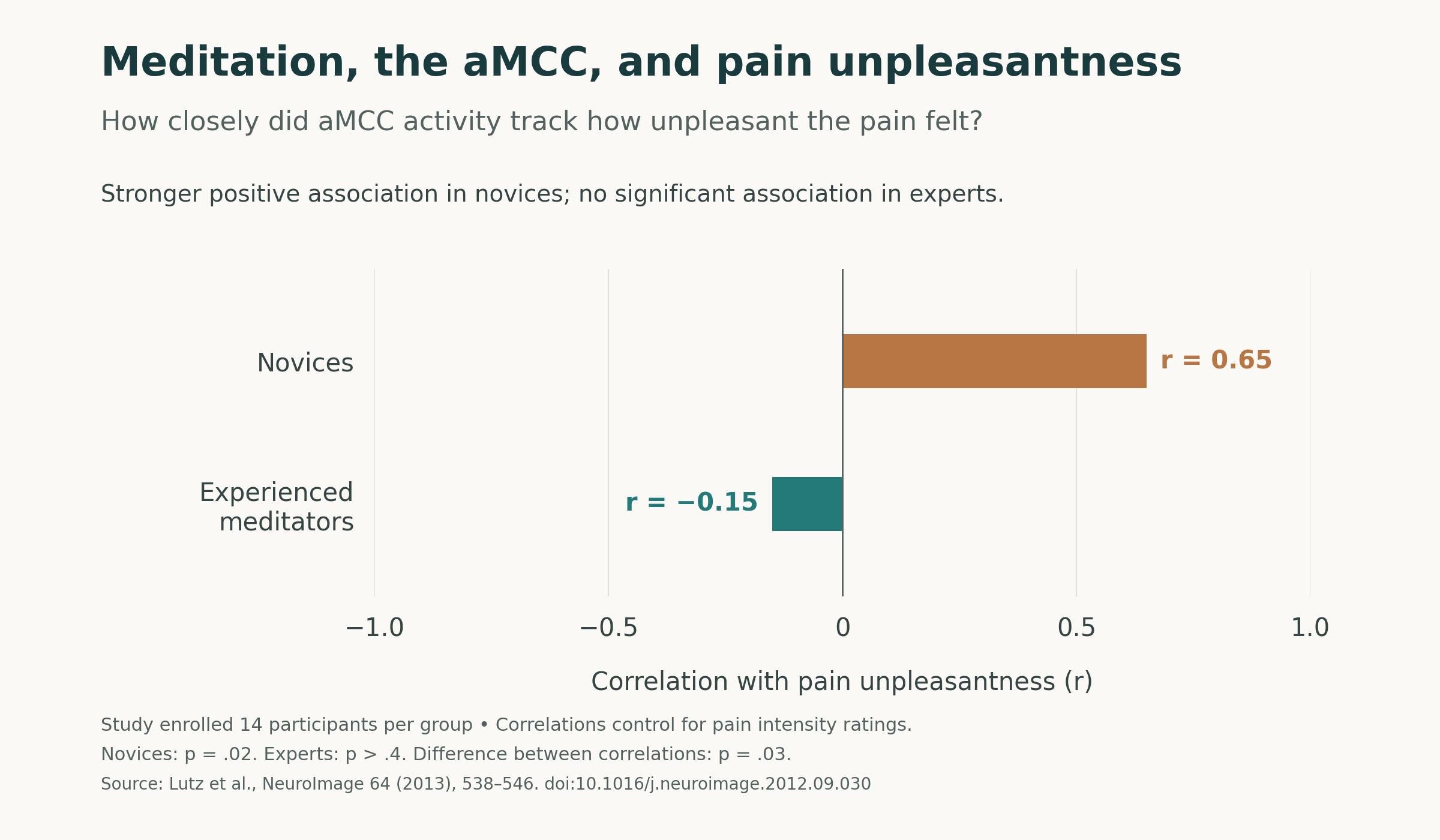
In a study published in NeuroImage, Antoine Lutz and colleagues used functional MRI to compare expert meditators with novices during meditation and thermal stimulation. Participants practiced open presence, remaining receptive to ongoing experience rather than focusing exclusively on one object. The experts had more than 10,000 hours of meditation experience.
Experts reported similar pain intensity but less unpleasantness. Compared with novices, experts showed lower activity in the aMCC and anterior insula while anticipating pain, but greater activity during the painful stimulation. How severe pain feels and how unpleasant it feels can therefore differ (Lutz et al., 2013).
The experts’ lower unpleasantness ratings occurred alongside greater activity in these regions during pain, showing that reduced unpleasantness did not simply correspond to less activity there.
Brain activity and brain structure
A separate study by Grant and colleagues examined structural MRI scans and heat-pain sensitivity in 17 Zen meditators and 18 controls. Meditators had lower pain sensitivity and thicker cortex in a region the authors called the dorsal anterior cingulate. Across participants, cortical thickness in several pain-related regions was associated with lower pain sensitivity (Grant et al., 2010).
This study examined cortical thickness rather than moment-to-moment brain activity. It provides related evidence about brain structure and pain sensitivity, without establishing that the dACC finding precisely matches the aMCC region examined by Lutz and colleagues.
Observing discomfort during practice
For practice, I would begin with an ordinary experience such as restlessness. Sit comfortably and attend to the movement of the abdomen with each breath. If you feel an urge to move, notice what accompanies it. There may be pressure beneath your legs, muscle tension, boredom, or a thought about ending the session.
Notice the urge to move and identify any physical discomfort. If your posture needs adjusting, adjust it, then return to the breathing sensation.
After a session, consider what happened before you changed position. Did you first notice physical discomfort, impatience, or a thought about stopping? Recognizing that sequence gives you something specific to observe during the next session.
Like what you read? Keep exploring…

If this post resonated with you, you may enjoy my new book:
The Science of Medical Qigong: How Breath, Movement, and Attention Transform the Body
This book examines scientific research on how Qigong practice influences human physiology. Drawing from clinical trials and experimental studies, it explains how coordinated breathing, posture, movement, and focused attention interact with the body’s regulatory systems.
The book explores research on:
• autonomic nervous system regulation
• cardiovascular function and blood pressure
• respiratory mechanics and lung capacity
• sleep quality and recovery
• inflammatory and immune signaling
• brain function and neural plasticity
• cognitive performance and mental health
The Science of Medical Qigong draws on physiology, neuroscience, and clinical research to explain how regular practice affects the body.
Available now in print and Kindle formats.
Click here to get your copy on Amazon
References
Grant, J. A., Courtemanche, J., Duerden, E. G., Duncan, G. H., & Rainville, P. (2010). Cortical thickness and pain sensitivity in Zen meditators. Emotion, 10(1), 43–53. Research paper.
Lutz, A., McFarlin, D. R., Perlman, D. M., Salomons, T. V., & Davidson, R. J. (2013). Altered anterior insula activation during anticipation and experience of painful stimuli in expert meditators. NeuroImage, 64, 538–546. Research paper.
Touroutoglou, A., Andreano, J., Dickerson, B. C., & Barrett, L. F. (2020). The tenacious brain: How the anterior mid-cingulate contributes to achieving goals. Cortex, 123, 12–29. Research review.