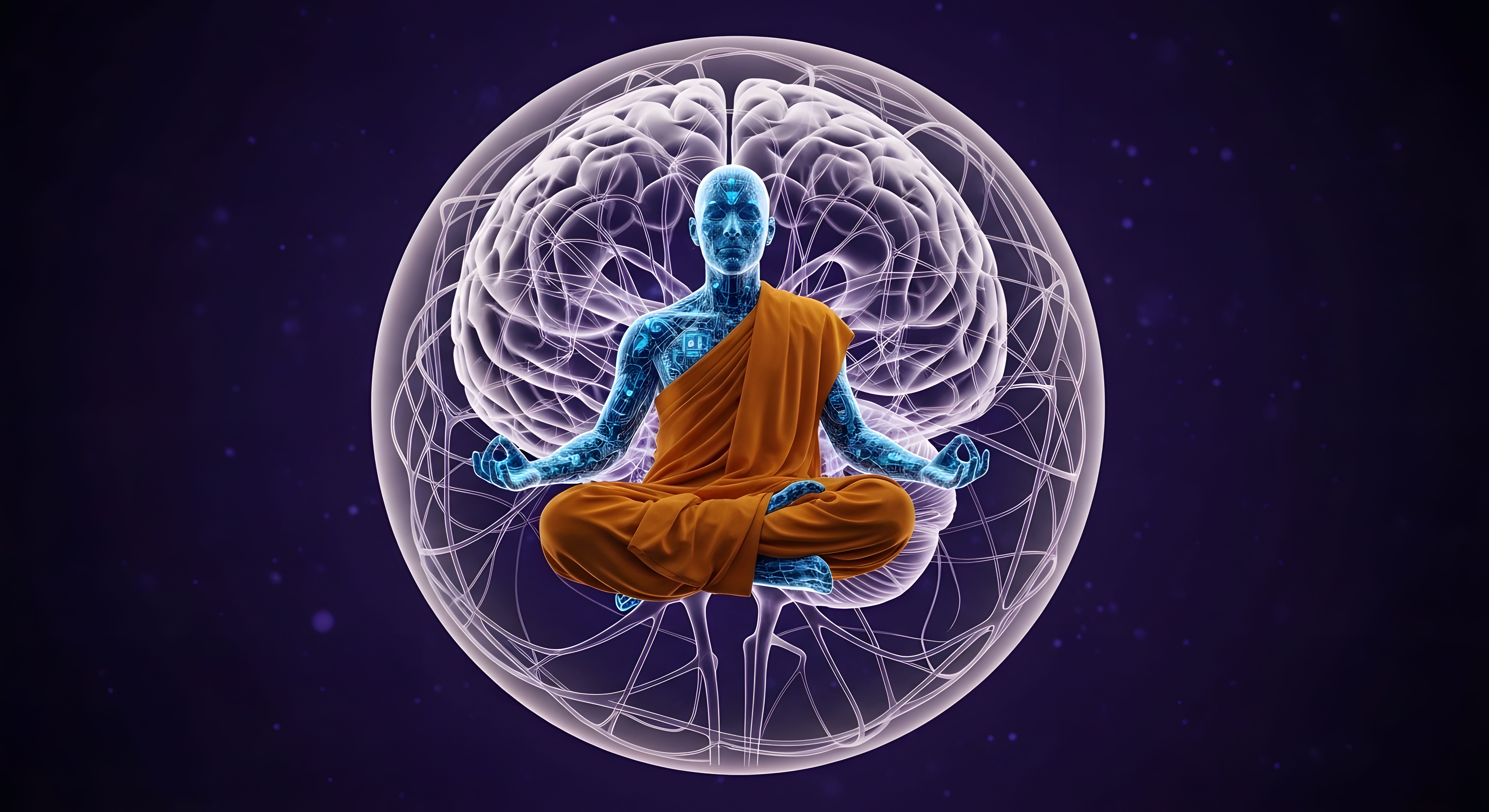
Is There Any Common Ground Between Zen and the Brain?
Why Neuroscience Struggles with Awakening
Note: Chan Buddhism and Zen Buddhism are essentially the same tradition, expressed through different historical and cultural settings. What is called Chan in China later became known as Zen in Japan, but the core emphasis remained unchanged: direct insight, ongoing practice, and a refusal to treat awakening as a final achievement. This shared orientation is crucial for understanding how Zen relates to modern neuroscience.
Shared Concerns, Different Aims
At first glance, Zen Buddhism and neuroscience appear to share significant common ground. Both are concerned with attention, perception, and the nature of experience. Both question naïve assumptions about the self and emphasize careful observation over belief. Yet when the subject turns to awakening, they repeatedly miss one another. The issue is not whether Zen practice changes the brain—it clearly does—but whether awakening itself can be meaningfully studied, explained, or captured through neurological frameworks. This is where apparent alignment begins to fracture.
What Neuroscience Explains Well
Neuroscience excels at describing mechanisms. It can map attentional systems, track changes in emotional reactivity, and identify networks involved in self-referential thinking. It can show how meditation alters neural activity and how sustained practice reshapes regulation over time. These findings are valuable and legitimate. From a scientific standpoint, it is reasonable to ask how shifts in awareness correspond to changes in brain function. Zen practice clearly engages these systems, and no serious practitioner denies this. The difficulty is that Zen is not concerned with mechanisms. It is concerned with seeing.
Where the Mismatch Begins
The mismatch begins at the level of assumption. Neuroscience assumes that clarity comes from articulation: defining processes, naming systems, and building explanatory models. Zen takes a different view. It sees articulation as something that often reinforces the very structure that obscures clarity. From the scientific side, Zen can appear evasive or anti-intellectual—relying on silence, paradox, or refusal instead of explanation. From the Zen side, neuroscience can appear sincere but misplaced, describing conditions while mistaking them for conclusions. Neural activity explains how experience is organized; it does not explain what remains when that organization loosens.
Different Questions, Not Competing Answers
This difference reveals itself in the questions each asks. Neuroscience asks what happens in the brain during awakening. Zen asks what happens when the need to explain no longer governs attention. These are not competing answers to the same question; they are different questions altogether.
The Limits of Explanation
Zen practice repeatedly exposes the limits of explanation. Language stabilizes experience, while Zen destabilizes it. Scientific models rely on reduction and classification, and this is precisely their strength. But Zen reveals a subtle problem: the drive to explain can become another form of self-maintenance. Insight is quickly turned into narrative, clarity becomes ownership, and understanding hardens into identity. Zen refuses this move not because explanation is wrong, but because explanation closes what practice opens. To reduce awakening to neural correlates is to make it manageable, repeatable, and subtly possessable. Zen avoids this not to preserve mystery as romance, but to prevent premature closure.
Understanding Is Not Transformation
This leads to a crucial distinction: understanding is not transformation. Neuroscience can help someone understand meditation, but Zen is concerned with what happens when understanding no longer governs behavior. One can accurately describe attentional networks and still live entirely from self-reference. One can explain the mechanics of awareness and remain deeply identified with thought. Zen insight is not informational; it is functional. This is why Zen places such emphasis on conduct—how one speaks, works, responds under pressure, and behaves when clarity fades. Awakening is not validated by explanation, but by what no longer needs to be defended.
Why Zen Refuses Authority
Zen therefore does not reject neuroscience. It refuses substitution. Science remains a powerful tool, but it is not granted authority over awakening. It can illuminate conditions and constraints, but it cannot replace practice or stand in for lived clarity. Zen recognized long ago that the mind will use any framework—religious, philosophical, or scientific—to reassert itself at the center. Neuroscience is not immune to this misuse. Zen’s refusal is not anti-scientific; it is preventative.
The Common Ground That Actually Exists
The common ground between Zen and the brain is not explanation. It is humility. Both reveal that the sense of a fixed self is constructed. Both show that attention can reorganize and that identity is less stable than it appears. But Zen goes further by refusing to turn these insights into conclusions. Science can tell us what changes. Zen asks whether anything still needs to be held. That question cannot be answered neurologically. It can only be lived. Zen leaves it unresolved—not as a mystery to be solved, but as something to be seen directly, again and again, as life continues.
Like what you read? Keep exploring…
If this post resonated with you, you’ll love my book:
An Uncarved Life: A Daoist Guide to Struggle, Harmony, and Potential
This book blends timeless Daoist wisdom with real-world insight into how we can navigate struggle, cultivate inner peace, and live in alignment with our deeper potential. Drawing from classical texts like the Dao De Jing and integrating modern psychology and neuroscience, An Uncarved Life offers a grounded, poetic, and deeply personal guide to living well in a chaotic world.
Whether you’re seeking clarity, calm, or a more meaningful path forward, this book is a companion for anyone who wants to walk the Way with sincerity and strength.
Available now in print, Kindle, and audiobook formats.
Click here to get your copy on Amazon


