

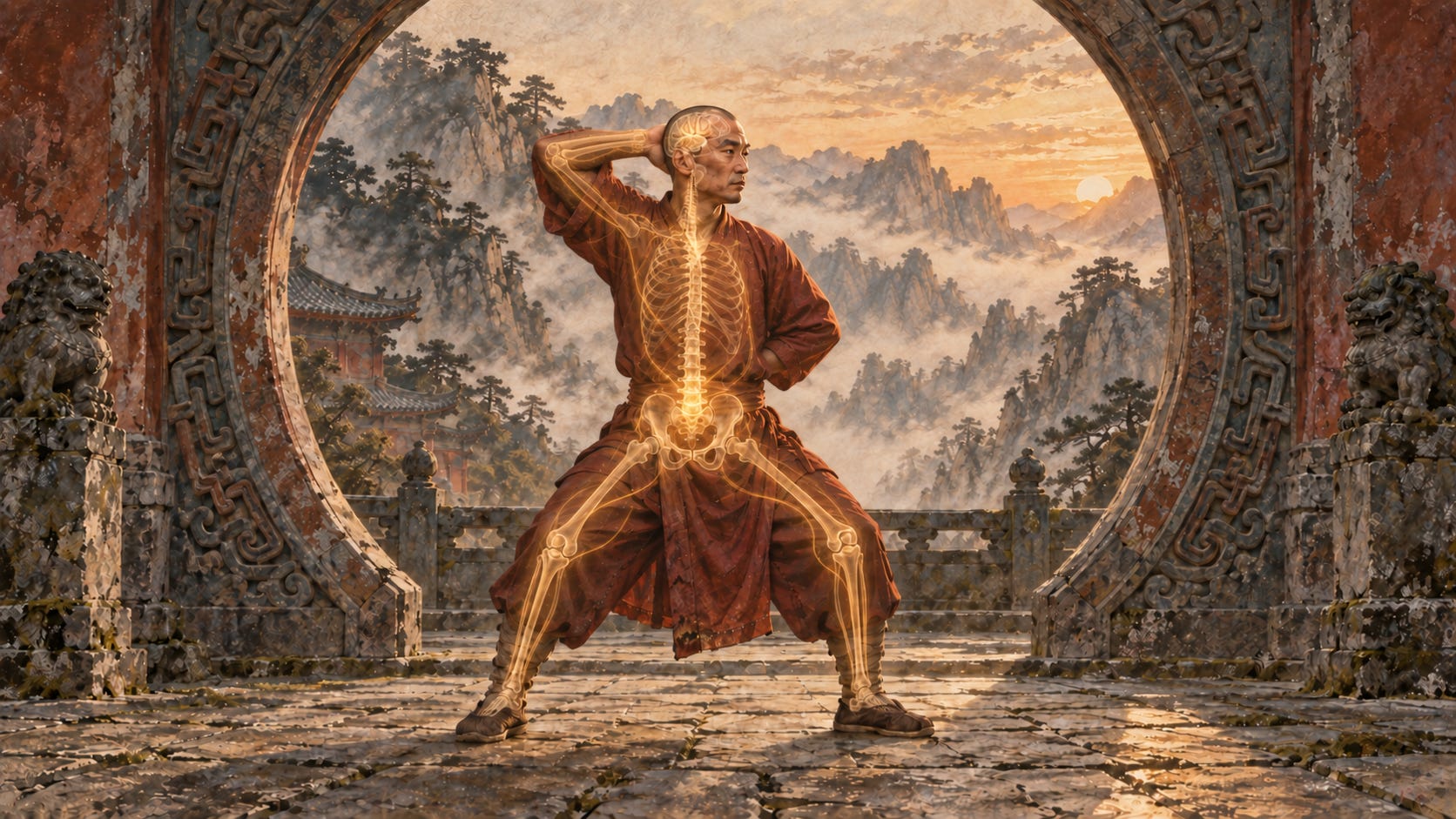
Applying controlled pressure to the shinbone helped animals recover from brain injury. In a study published in Nature Neuroscience on September 21, 2026, Zhiqing Cai and colleagues tested repeated tibial compression in mice after traumatic brain injury or stroke, and in pigs after traumatic brain injury. They reported improved survival and recovery of movement and cognitive function, together with reduced neuronal loss and chronic inflammation. Cai and colleagues
The finding gives us a new reason to pay attention to the skeleton during Qigong practice. As muscles contract and tendons transmit their pull, bone experiences changing mechanical forces. The cells within that bone respond. Understanding their response may help explain how physical training influences parts of the body far from the muscles performing the movement.
For Yi Jin Jing and its traditional association with Xi Sui Jing, this is a particularly interesting development. The language of transforming the sinews and washing the marrow directs attention toward changes within the body. Modern bone biology offers a way to investigate how that training produces physiological change.
How Bone Responds to Force
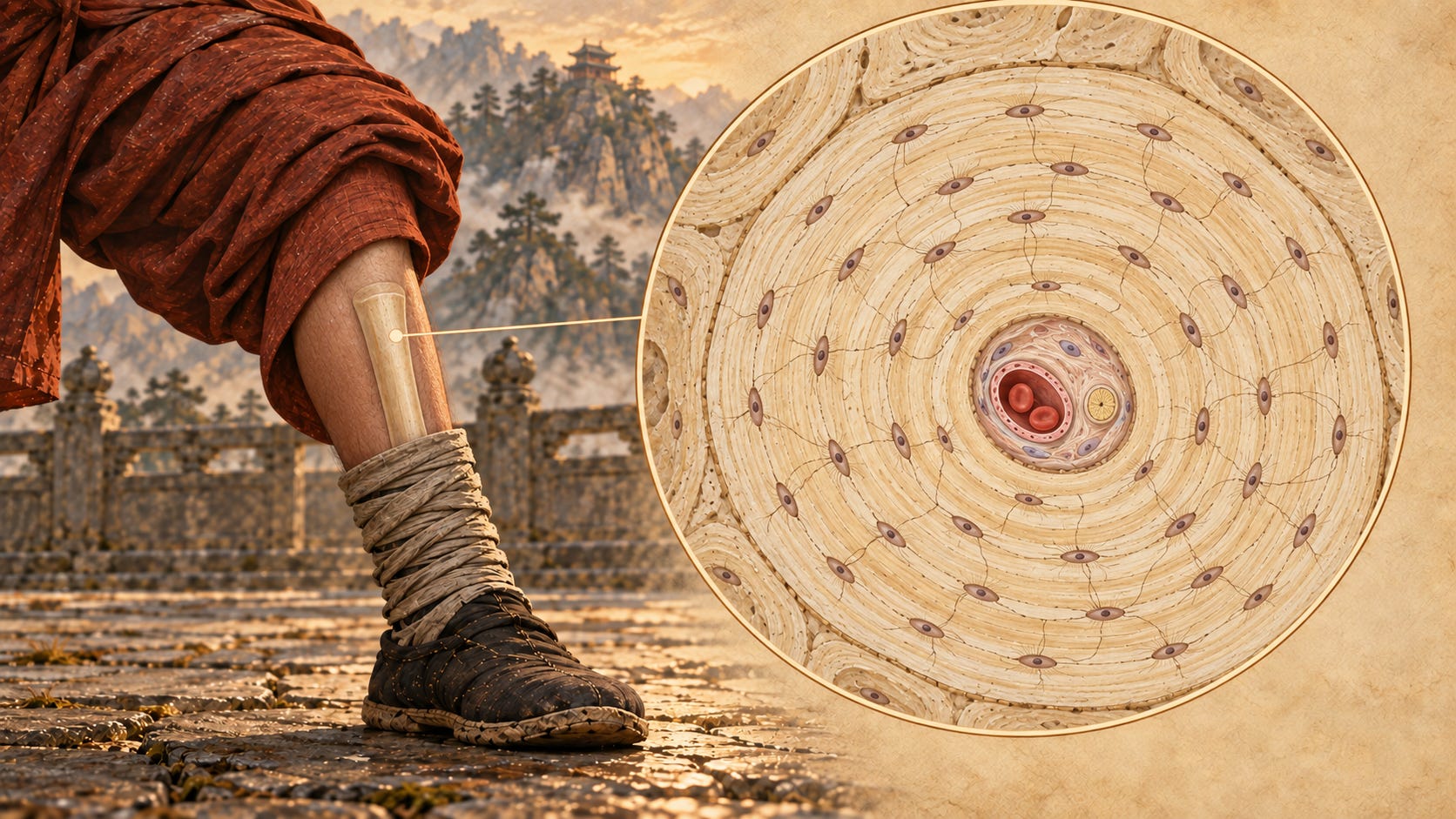
Living bone is continually renewed through remodeling, the removal of old tissue and formation of new tissue. Osteocytes, cells embedded within the mineralized bone, help regulate this activity. They detect changes in mechanical loading and communicate with other cells involved in maintaining the skeleton. Their work continues even when the body appears still. Research on osteocyte mechanosensing
One of the proteins involved is PIEZO1, an ion channel in the cell membrane. Mechanical forces can open the channel, allowing charged particles, including calcium ions, to enter the cell and trigger a response. Researchers call this conversion of physical force into cellular activity mechanotransduction. Through mechanisms like this, the loads placed on the skeleton can influence bone formation. Sun and colleagues
In Cai’s study, the benefits of loading depended on PIEZO1 in osteocytes. Removing the gene for this channel reversed the benefits. The researchers also transferred blood serum from treated mice to mice with brain injuries and reproduced protective effects. They identified proteins released directly by osteocytes, alongside indirect increases in other circulating factors. Together, these experiments traced a route from mechanical stimulation of bone to signals in the blood that supported recovery in the brain. Cai and colleagues
This provides a physiological basis for investigating effects of skeletal loading throughout the body. A muscle contracts, its force reaches bone, and bone cells respond through changes in their activity and signaling. The consequences of loading can extend beyond the tissue receiving the force.
How Yi Jin Jing Loads the Skeleton
Yi Jin Jing 易筋經, often translated as the Sinew-Transforming Classic, includes methods that stretch and load the body through sustained postures and coordinated effort. The traditional term jin 筋, usually translated as sinews, emphasizes tissues through which force passes. Different versions of the practice develop that emphasis through different movements and methods of training. Hsu and Lim’s study of Yi Jin Jing
Muscles pull on bones through their tendons. Supporting body weight adds further loading, while changes in posture alter where those forces act. A slow movement can require considerable muscular effort, and holding a position can maintain force through the limbs and trunk. The visible speed of a movement tells us little by itself about the work occurring inside the body. Muscle-generated forces and weight bearing both contribute to the mechanical environment that bone cells experience. Mechanical loading and bone formation
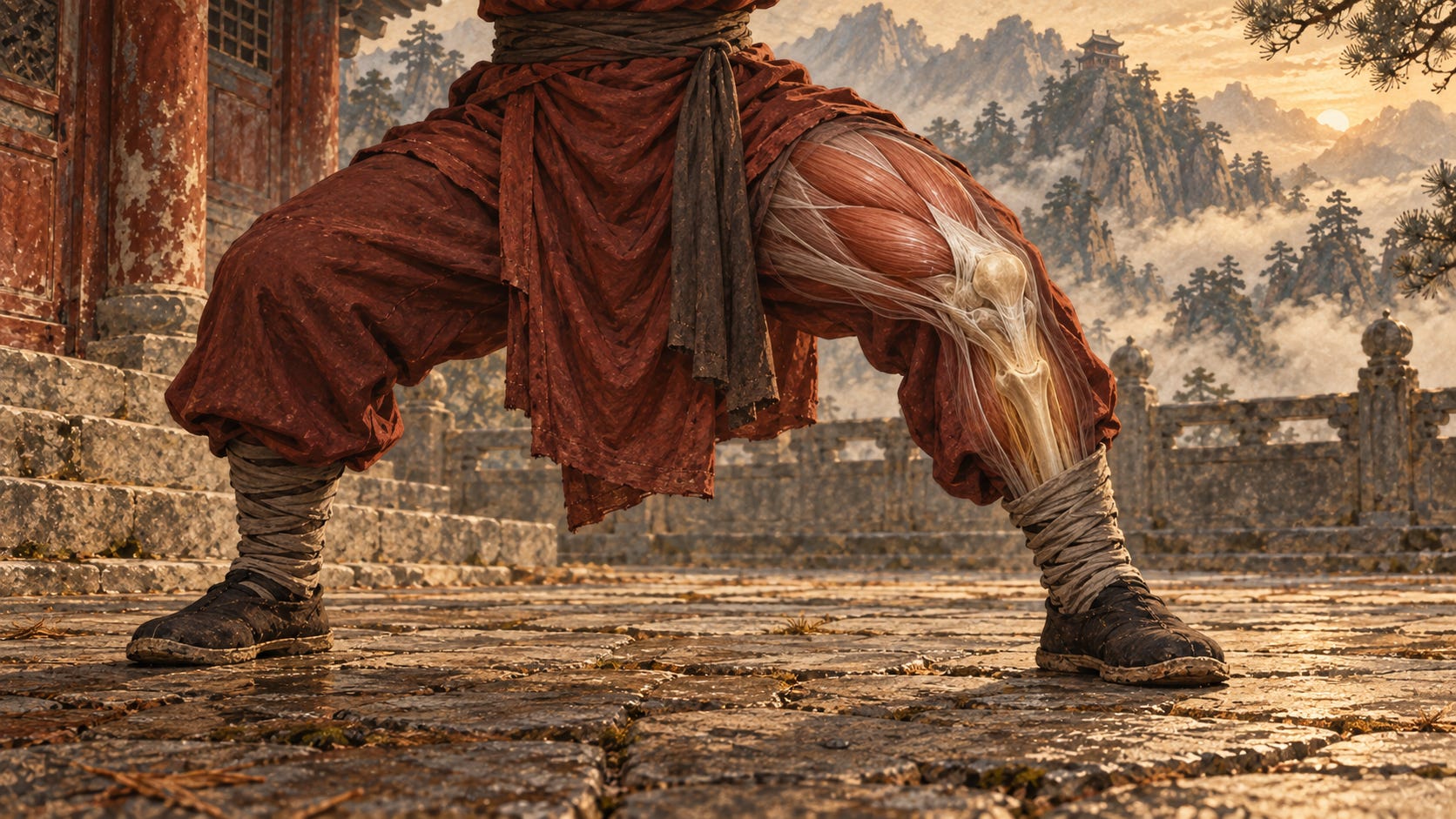
Consider a standing posture with the knees bent and the arms extended. The legs support the body while muscles around the hips and knees maintain the position. Muscles around the shoulders keep the arms raised against gravity. Changing the depth of the stance or the position of the arms changes the demands on the muscles and the forces transmitted through the skeleton. These are concrete features of practice that researchers can measure.
The new bone research suggests a specific hypothesis: some effects of Yi Jin Jing may arise through the signals generated when practice loads the skeleton. Investigating that possibility means examining the forces produced by particular movements, how long they are maintained, and how the body responds over repeated sessions.
What the Human Studies Show
Human studies already show that Yi Jin Jing can influence bone density and metabolism. In a 2025 randomized trial, 84 older women entered resistance-training, Yi Jin Jing, Baduanjin, or control groups. The exercise programs lasted 24 weeks, with three hour-long sessions each week. All groups received calcium and vitamin D supplementation. Yang and Liu
At the end of the program, the exercise groups had higher bone mineral density in the lumbar spine, or lower back, than the control group. They also showed an increase in PINP, a marker of bone formation, and a decrease in beta-CTX, a marker of bone breakdown. All three exercise programs produced this pattern of improvement. The 2025 trial
Along with the increase in lumbar bone density, the blood markers showed a shift in the processes through which bone renews itself. These changes followed regular practice sustained over several months.
A separate randomized trial assigned 40 postmenopausal women to usual activity or a program combining Yi Jin Jing with elastic-band resistance exercise. After six months, the combined exercise group showed improvements in bone density at several sites. Li and colleagues
A 2026 analysis of 31 randomized trials involving 2,457 participants also reported favorable lumbar-spine findings for Yi Jin Jing among traditional Chinese exercises. The pattern of benefit varied across skeletal sites and exercise forms. That variation suggests a useful question for further study: how do the forces generated by different movements relate to the changes observed in particular bones? Hou and colleagues
Sinew Transformation and Marrow Washing
Xi Sui Jing 洗髓經, usually translated as the Marrow-Washing Classic, extends the traditional discussion inward. Paired with sinew transformation, marrow washing describes a deeper process of cultivation. Sui 髓 means marrow, while the teaching uses that term within a broader account of internal refinement and human development. Tom Bisio’s discussion of the traditional pairing
The pairing encourages us to consider how training the structures that transmit force might influence internal function. Modern anatomy gives us distinct tissues to examine: osteocytes occupy the mineralized bone itself, while marrow occupies spaces within bones. The new research focuses on the response of osteocytes to mechanical loading, providing one specific avenue for investigating the internal effects of physical training.
The methods also have a history of development and variation. Scholarship places the Yi Jin Jing text of 1624 within the religious and martial culture of the late Ming period. Elisabeth Hsu and Chee Han Lim’s historical and ethnographic study describes differences between transmitted forms, including the use of sustained postures and flowing movements. Those differences offer useful material for research because each method places its own demands on the practitioner. Hsu and Lim
I find the traditional emphasis on internal transformation especially interesting alongside this new research. We can now investigate how the forces generated through practice affect living bone, and follow the signals that bone releases in response. The sinews and skeleton become active parts of an explanation for effects that may reach throughout the body.

Following the Signals Generated by Practice
A useful next study would measure the skeletal loading produced by a clearly defined Yi Jin Jing method and examine changes in relevant circulating signals. Comparing sustained postures with flowing movements could help identify which features of practice produce particular responses. Research could then examine whether those responses involve PIEZO1 and how they relate to changes in brain function.
Yi Jin Jing’s effects on bone density give this investigation a practical starting point. The bone-brain research adds a mechanism worth exploring. Together, they direct attention toward a feature of training that is easy to overlook: every posture and movement places forces through living tissue, and the cells within that tissue can respond in ways that influence the rest of the body.
Like what you read? Keep exploring …
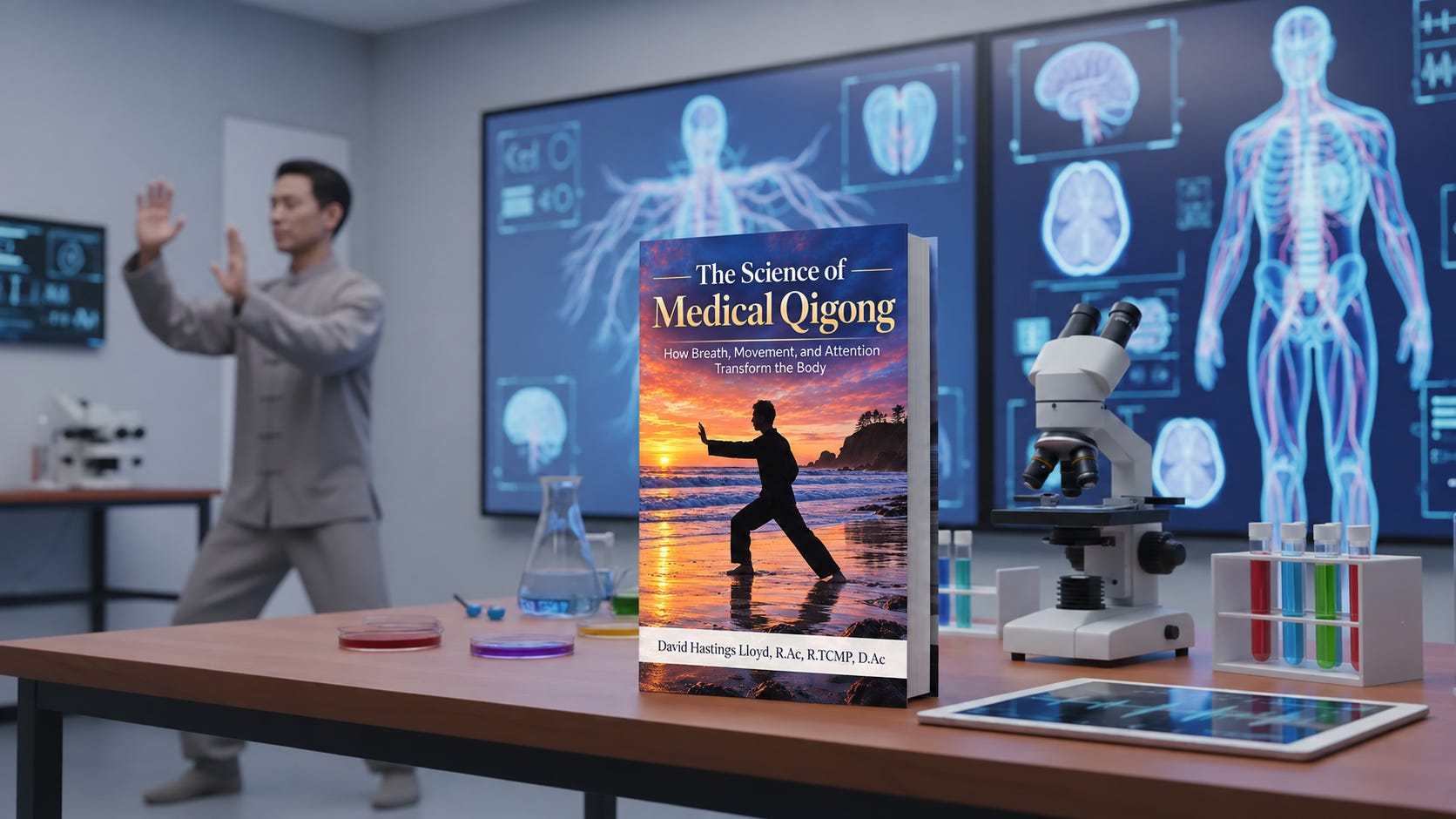
If this post resonated with you, you may enjoy my new book:
The Science of Medical Qigong: How Breath, Movement, and Attention Transform the Body
This book examines the growing body of scientific research exploring how Qigong practice influences human physiology. Drawing from clinical trials and experimental studies, it explains how coordinated breathing, posture, movement, and focused attention interact with the body’s regulatory systems.
The book explores research on:
• autonomic nervous system regulation
• cardiovascular function and blood pressure
• respiratory mechanics and lung capacity
• sleep quality and recovery
• inflammatory and immune signaling
• brain function and neural plasticity
• cognitive performance and mental health
Rather than presenting Qigong through mystical language, The Science of Medical Qigong approaches the subject through physiology, neuroscience, and clinical research, offering a clear explanation of how regular practice can influence the coordination and harmony of the body’s systems.
Available now in print and Kindle formats.