


When you sit quietly and stop trying to improve every breath, you may notice how much effort you have been adding. Your shoulders settle. The abdomen moves more freely. Breathing continues without needing your attention at every moment. You can remain aware of it while doing very little to direct it.
Embryonic breathing, traditionally called taixi (胎息), is a meditation practice that coordinates breathing with sustained inward attention. Its traditional purpose is to gather mind and vitality, often with attention centred in the lower abdomen. The name evokes life in the womb and the Daoist image of returning to an original state of unity.
Embryonic breathing belongs to a much larger tradition than the name of a breathing exercise might suggest. It involves how you settle your mind, where you direct your attention, and how practice gradually becomes less dependent on deliberate control. In internal alchemy, it also serves a spiritual purpose: cultivating an inner life understood through the image of a developing embryo.
Before birth, a developing baby receives oxygen through the placenta and umbilical circulation. The lungs are not yet exchanging gases with outside air. Daoist authors drew on life in the womb to describe an inwardly sustained condition in which vitality and mind remain closely united. An adult continues to depend on the lungs for gas exchange; the prenatal image should never become an instruction to suppress breathing or try to breathe through the navel.
The word “breath” also needs some explanation. In traditional Chinese texts, qi (氣) can refer to breath, vitality, and the processes through which life expresses itself. Translating qi simply as air misses much of what the authors are discussing. When a text describes gathering or preserving qi, its subject extends beyond the volume of air entering the lungs.
This broader meaning becomes apparent in The Primordial Breath, Volume I, translated by Jane Huang & Michael Wurmbrand. Its collected Daoist treatises connect breathing with mental tranquillity, nourishment, and the preservation of life. Its language reflects a traditional view of the body in which breath and spiritual cultivation are closely related. The collection also contains different techniques, including breath retention. It is a historical source to study in context, rather than a single beginner’s routine to reproduce from beginning to end.
The historical background is wider still. In Chinese Healing Exercises: The Tradition of Daoyin, Livia Kohn traces the development of practices involving bodily movement, stretching, and guiding qi. Breathing developed within this larger culture of self-cultivation. That context helps explain why traditional teaching gives so much attention to posture and the condition of the mind. Breathing was part of how a person practiced and lived.
The Breath and the Lower Dan Tian
For many modern practitioners, the most familiar starting point is the lower Dan Tian (丹田), usually translated as the lower “elixir field.” It refers broadly to an interior region of the lower abdomen. Different systems describe its location and function with different degrees of precision. You can begin by understanding it as an important center of attention and cultivation in the traditional account of the body.
Directing attention there gives you something concrete to work with. You can feel abdominal movement, notice whether you are tightening the belly, and recognize when you are trying to manufacture a special sensation. These observations are accessible even before the traditional terminology becomes familiar. The instruction to attend to the lower abdomen does not require you to imagine an anatomical organ called the Dan Tian.
Shen (神) is commonly translated as “spirit.” Here, “mind” is a useful rendering, provided we remember that the traditional term includes dimensions of consciousness and spiritual life beyond ordinary thinking. The teaching concerns the quality and stability of your attention as well as the movement of your breath.
In Qigong Meditation: Embryonic Breathing, Yang Jwing-Ming places this practice within an extensive training process. He distinguishes ordinary abdominal breathing from reverse abdominal breathing and describes coordinating attention with the lower Dan Tian and the upper Dan Tian in the head. In his account, bringing shen and qi together at the lower Dan Tian becomes central to embryonic breathing.
The difference between these breathing patterns is straightforward. In ordinary abdominal breathing, the abdomen expands during inhalation and contracts during exhalation. Reverse abdominal breathing reverses that coordination: the abdomen draws inward as you inhale and moves outward as you exhale. These methods coordinate breathing and movement differently. Embryonic breathing refers to a larger meditative process that also involves sustained attention and the traditional cultivation of qi. For your first exploration, ordinary comfortable breathing gives you enough to observe without introducing another coordination task.
In Embryonic Breathing: The Taoist Method of Opening the Dan Tian, Stuart Alve Olson likewise emphasizes the joining of mind and qi in the lower elixir field. His commentary presents the spiritual embryo as part of a path toward spiritual immortality. Olson describes an ambitious spiritual goal, but the breathing itself should remain gentle and unforced.
These teachers share a focus on inward concentration, but each teaches it within a particular system of practice. A direction taken from one teacher may serve a particular stage of training. Combining it with another teacher’s abdominal mechanics or breath timing can change the method. If you pursue the complete practice, learn a coherent system with a teacher who can explain its progression and correct your technique.

The Spiritual Purpose of the Practice
Internal alchemy, or neidan (內丹), gives embryonic breathing deeper context. In The Way of the Golden Elixir, Fabrizio Pregadio explains that the internal elixir concerns the recovery of an original state of being. The imagery of conception, gestation, and birth describes spiritual realization: a transformation in how practitioners understand their own nature and their relationship to the Dao, or Way. The embryo represents this spiritual development.
For your own practice, the image offers a useful way to think about patience. An embryo develops through nourishment and time. Approaching meditation with that image can help you reconsider the urge to obtain an immediate result. Regular practice gives you time to become familiar with experiences that might initially escape your attention.
In Foundations of Internal Alchemy, Wang Mu describes an initial stage of laying the foundations before the later stages of refinement. The traditional work concerns the Three Treasures: jing, usually rendered as essence; qi, as breath or vitality; and shen, as spirit or mind. Preparation belongs to the practice itself. Advanced descriptions make more sense when you understand the foundations on which they depend.
Breathwork has been associated with reductions in self-reported stress. A 2023 meta-analysis of randomized trials found lower stress in breathwork groups than in control groups, with benefits also reported for anxiety and depressive symptoms. The studies examined a range of breathing interventions. Their practical relevance here is the breathing component of training, rather than the full traditional practice of embryonic breathing.
A systematic review of slow breathing also found changes in breathing and heart rate coordination, along with reports of greater relaxation and comfort. Heart rate normally varies through the breathing cycle, and slower breathing can make those variations more pronounced. Breathing is therefore one way you can influence bodily processes that usually operate without conscious direction.
These findings help explain why working with breathing can be useful when you feel tense or mentally preoccupied. The scientific studies address physiological and psychological effects; the Daoist texts also address spiritual cultivation. You can appreciate both purposes while keeping their explanations distinct.

Beginning with Breath and Attention
For an introductory experience, sit comfortably and breathe normally. The following exploration develops familiarity with the breath and lower abdomen. This is preparation for further study, not the complete method of embryonic breathing described in traditional sources.
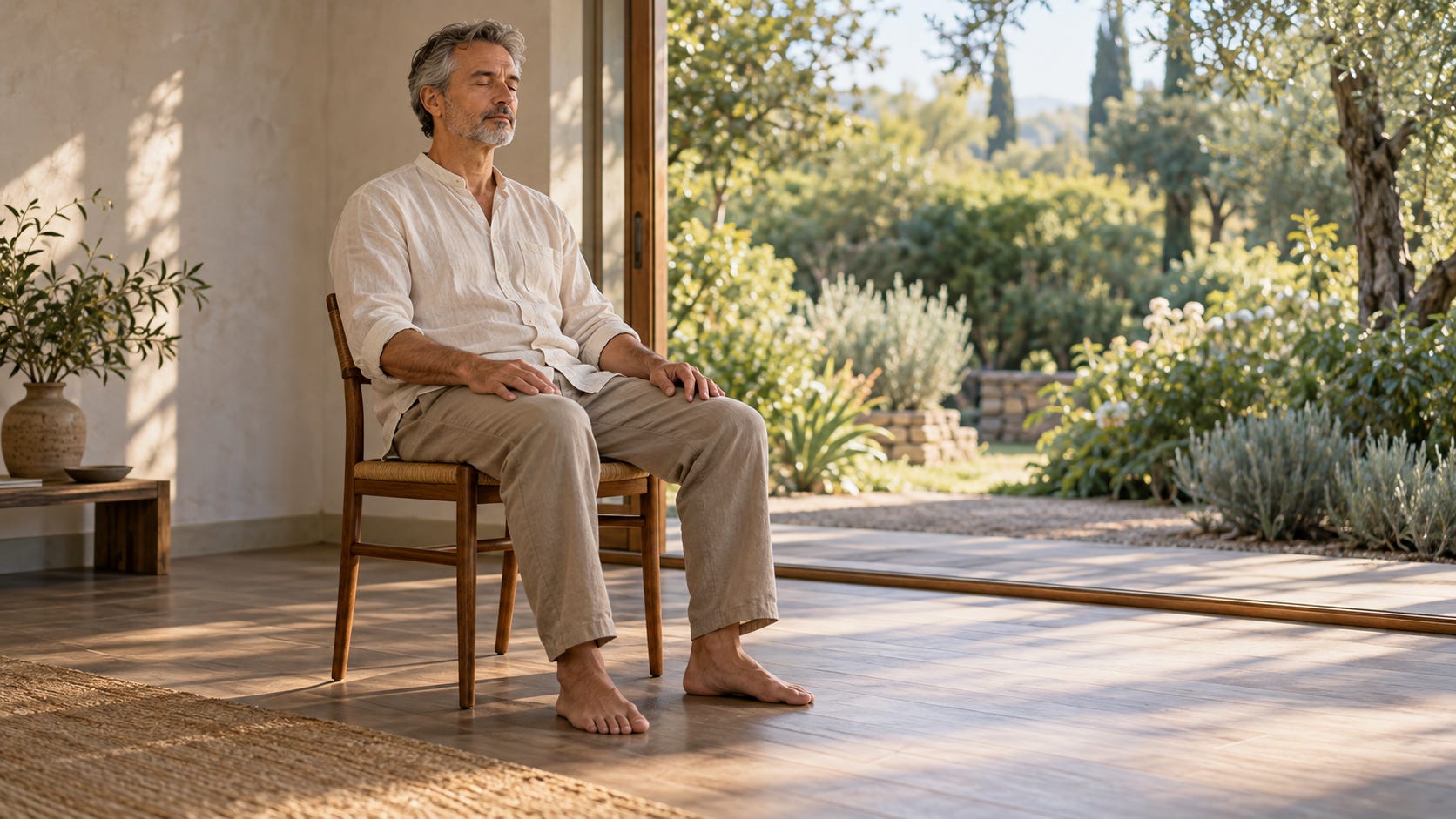
Choose a chair that lets you rest both feet on the floor. Sit upright without stiffening your back, and use the chair’s support if it helps you stay comfortable. Rest your hands on your thighs. Relax your jaw and shoulders, and keep your eyes softly open or close them if you prefer. Give yourself a few minutes in which there is nothing else you need to accomplish.
First, notice your breathing as it is. Breathe through your nose if that is comfortable. Feel the movement of your lower ribs and abdomen without deliberately increasing it. If you find yourself taking unusually large breaths, stop trying to deepen them and resume your usual breathing. Air enters your lungs. The movement you feel in your abdomen accompanies the action of your diaphragm, the broad breathing muscle beneath the lungs.
Next, place one hand lightly on your lower abdomen. Feel whatever movement is present beneath it. In ordinary relaxed abdominal breathing, the abdomen generally moves outward during inhalation and inward during exhalation. You do not need to push it outward or pull it back. Your hand provides a point of contact that makes the movement easier to notice.
Rest your attention on that area for several comfortable breaths. When thoughts carry you elsewhere, recognize that you have become distracted and bring your attention back to the sensation beneath your hand. You don’t need to argue with the thought or finish it before continuing. Repeating this simple redirection is part of learning to remain attentive.
Let the breathing keep its comfortable pace. Avoid holding your breath, tensing your muscles, or trying to make your breathing almost disappear. If you feel dizzy, short of breath, or uncomfortable, stop the exercise and breathe normally. After a few minutes, lower your hand, look around, and notice how you feel before standing.
The most useful observations may be quite ordinary. Perhaps you discovered that concentrating made you tighten your forehead. Perhaps the abdomen moved more easily once you stopped pushing it. You may have spent most of the time distracted. Each observation tells you something specific about how you are practicing and what you can adjust next time.
If you felt little in the lower abdomen, keep your hand resting lightly there and notice whatever movement you can detect. There is no need to imagine a sensation. Familiarity develops through repeated observation, including sessions that seem uneventful. A clear account of what you experienced gives you something useful to discuss with a teacher.
With repetition, try reducing the effort needed to maintain attention. Keep enough interest to remain awake and aware, while checking that you have not begun to supervise every breath. Yang Jwing Ming describes a progression toward “regulating without regulating,” in which coordination becomes familiar enough to require less deliberate management. You can explore that principle at a basic level whenever you notice unnecessary effort and ease it.
For now, take a few minutes to sit comfortably and observe your breath. Learn what changes when you relax your abdomen, breathe at a comfortable depth, and bring your attention back without impatience. You can examine those experiences for yourself. They also give you a more informed starting point when you return to the traditional texts and their demanding, sometimes beautiful descriptions of the inner life.
Like what you read? Keep exploring…

If this post resonated with you, you may enjoy my new book:
The Science of Medical Qigong: How Breath, Movement, and Attention Transform the Body
This book examines scientific research on how Qigong practice influences human physiology. Drawing from clinical trials and experimental studies, it explains how coordinated breathing, posture, movement, and focused attention interact with the body’s regulatory systems.
The book explores research on:
• autonomic nervous system regulation
• cardiovascular function and blood pressure
• respiratory mechanics and lung capacity
• sleep quality and recovery
• inflammatory and immune signaling
• brain function and neural plasticity
• cognitive performance and mental health
The Science of Medical Qigong draws on physiology, neuroscience, and clinical research to explain how regular practice affects the body.
Available now in print and Kindle formats.