


Embryonic breathing, or Tai Xi (胎息), brings together two central concerns of Daoist cultivation: nourishing life and settling the mind. The practitioner learns to breathe with less unnecessary effort while gathering attention within the body, especially in the lower abdomen. As practice develops, breathing may become remarkably quiet, and maintaining attention may feel easier.
The name evokes life in the womb, when nourishment arrives through a connection that requires no conscious effort. This image also introduces a practical lesson: refinement depends on reducing strain. Trying to manufacture an extraordinary breathing experience can interfere with the very ease the practitioner is learning to develop.
The Meaning of the Original Breath
Daoist teachings distinguish the prenatal condition, Xian Tian (先天), from the acquired or postnatal condition, Hou Tian(後天). In internal cultivation, returning to the prenatal means recovering an original unity beneath the habits and distractions of ordinary life. These ideas belong to a traditional account of human nature, vitality, and spiritual development.
Before birth, oxygen crosses the placenta and reaches the fetus through blood carried in the umbilical cord. The fetus does not draw oxygen through the navel by contracting its abdomen. For adult practice, the image of breathing through the navel directs attention toward the lower abdomen; air continues to enter the lungs through the respiratory passages.
Tai Xi has carried several meanings across Daoist traditions. Some methods emphasize abdominal coordination and visualization. Others describe an increasingly refined breath accompanying deep meditative absorption. Historical practices also include breath retention. Each approach has its own instructions and progression. Learn the sequence within the method you are studying, including how it coordinates breathing and attention.

The Lower Dantian and Internal Alchemy
The lower Dantian (丹田), often translated as the lower elixir field, provides a principal focus for this work. Teachers generally locate it within the lower abdomen, below and behind the navel, although precise descriptions vary. Practically, this gives attention somewhere definite to rest. Traditionally, it is a place where Qi gathers and where the practitioner develops the foundation for further internal cultivation.
Daoist internal alchemy, or Neidan (內丹), describes this cultivation through the Three Treasures: Jing (精), essence; Qi (氣), vital energy; and Shen (神), spirit. These terms carry meanings that extend beyond their brief English translations. Jing concerns the resources underlying life and development. Qi describes the dynamic activity that animates life, while Shen includes consciousness and spiritual awareness. Their relationships explain the purposes and stages of internal cultivation in the language of the tradition. Equating them directly with hormones, oxygen, or electrical activity loses much of that meaning, though doing so helps modern people understand their place in health/longevity practices.
In this traditional context, embryonic breathing helps bring Shen and Qi together. The practitioner learns to sustain attention in the lower Dantian as distracting thoughts gradually settle. Some alchemical teachings describe the resulting development as conceiving and nourishing a spiritual embryo. This language expresses the religious aim of inner transformation and spiritual maturation, beyond the immediate experience of relaxation.
A contemporary student can begin with the practical relationship between attention and breathing. When you become preoccupied, you may notice yourself tightening the abdomen or interrupting a breath. When you settle again, breathing often becomes easier. Learning to recognize these changes gives the traditional instruction to harmonize mind and breath a direct, observable starting point.

Tai Xi, Reverse Breathing, and Subtle Breath
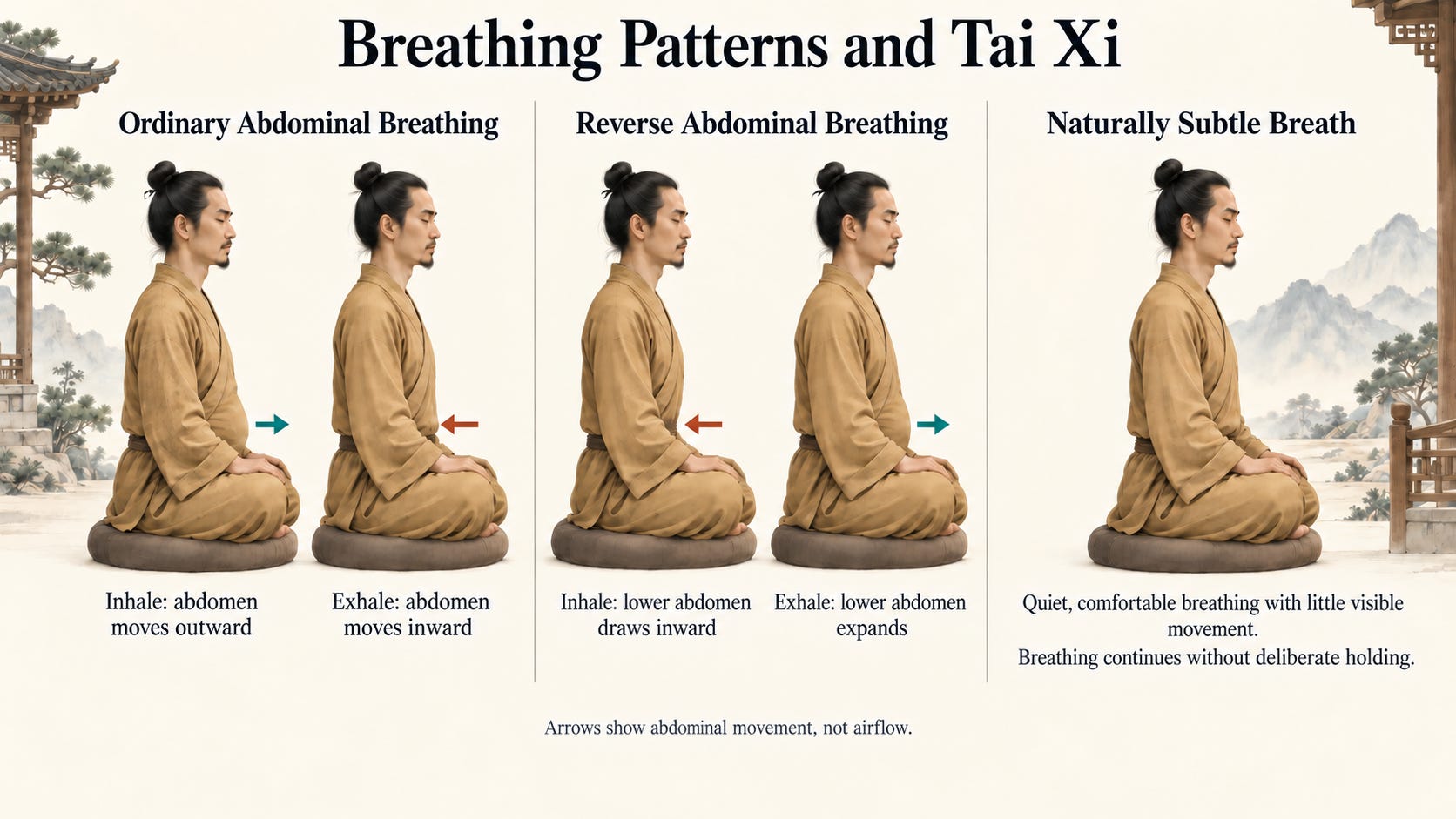
In ordinary abdominal breathing, the abdomen usually moves outward during inhalation and inward during exhalation. Reverse abdominal breathing deliberately changes that coordination: the lower abdomen draws inward during inhalation and expands during exhalation. Some teaching traditions call this embryonic breathing; others use it as preparation within a larger training process.
Reverse breathing therefore identifies a particular movement pattern. Tai Xi refers to a broader traditional practice or attainment whose meaning depends on the lineage. Naturally subtle breathing describes another feature: the breath becomes quiet and less noticeable without deliberate suppression. Learning reverse breathing or noticing a very quiet breath does not, by itself, mean you have attained Tai Xi. A person can perform reverse breathing with considerable tension, or breathe very quietly without practicing Daoist internal alchemy.
During meditation, breathing sometimes seems almost to disappear. The sensation of barely breathing is different from intentionally holding the breath. Breathing can continue with small movements that attract little attention. For a beginner, breathing should remain comfortable, without deliberately making the breaths smaller or prolonging the pauses between them. Reverse breathing and deliberate retention are best learned through instruction specific to the method being practiced.
A Foundation for Practice
Begin with five to ten minutes in a quiet place. Sit on a chair with both feet supported, or on a cushion high enough to keep the lower back comfortable. Keep the trunk upright without lifting the chest or stiffening the spine. Rest your hands on your thighs, relax your jaw, and lower your shoulders. Use back support if maintaining the posture requires persistent effort.
Breathe through your nose if that is comfortable. For the first minute or two, observe the breath without changing its pace. Feel the movement around the lower ribs and abdomen. If you are pulling the belly inward or holding the chest rigid, ease that tension and observe the next breath. There is no need to fill the lungs completely or push the abdomen outward.
Then rest your attention in the lower abdomen, below the navel. Begin with the sensations you can actually feel, such as the movement of the abdominal wall. You do not need to visualize a precise point deep inside the body. When thoughts carry you away, bring attention back without interrupting the breath or criticizing the distraction. Keep enough awareness of your posture to recognize unnecessary tension.
Continue with ordinary abdominal breathing at a comfortable depth and pace. The breath may grow quieter on its own; you do not need to make it smaller or slower. Avoid squeezing the abdomen, tightening the pelvic floor, or extending the intervals between breaths to create a particular sensation. This is preparatory practice in regulating body, breath, and mind, giving you a foundation for more specific Tai Xi instruction.
To finish, broaden your attention to the room, move your hands and feet, and stand when you feel ready. If you experience dizziness, tingling, a feeling that you cannot get enough air, or distress, stop controlling the breath and resume ordinary breathing. Comfort during practice and a clear, settled state afterward are more useful guides than unusual sensations.

What Respiratory Physiology Adds
Slow breathing can change the interaction between respiration and cardiovascular regulation. In an experiment involving 15 healthy people, breathing at six breaths per minute increased measured baroreflex sensitivity compared with spontaneous breathing or breathing at 15 breaths per minute. The baroreflex helps adjust heart rate in response to changes in blood pressure. Breathing rhythm can therefore influence an automatic reflex involved in circulation. The experiment examined paced breathing, a related practice with different instructions from Tai Xi.
If you would like to explore paced breathing with guidance, try the Resonance Breathing practice in my Inner Resonance app. Set aside a few minutes to practice, keeping each breath comfortable and unforced. It is a practical way to bring regular breathing practice into your day.
Breathing also involves coordinated muscular movement. During an ordinary inhalation, the diaphragm contracts and descends, increasing space within the chest; the lower ribs and abdominal wall accommodate that movement. Air enters the lungs, while the movement felt in the abdomen comes from the diaphragm and displacement of abdominal contents. Attending to the lower abdomen can make this movement easier to perceive. The diaphragm remains the principal breathing muscle, regardless of where we direct attention.
Both breathing rate and depth affect ventilation. Taking excessively large breaths can remove more carbon dioxide than the body is producing, even when the breaths are relatively slow. Falling carbon dioxide can produce lightheadedness and tingling, sensations that can be mistaken for progress in an unfamiliar practice. These are recognized effects of overbreathing. Breathe comfortably, without repeatedly taking oversized breaths.
Regular practice helps you recognize when concentration becomes strain. As you learn to sustain attention while breathing comfortably, you build a foundation for studying more specific Tai Xi methods with an experienced teacher.
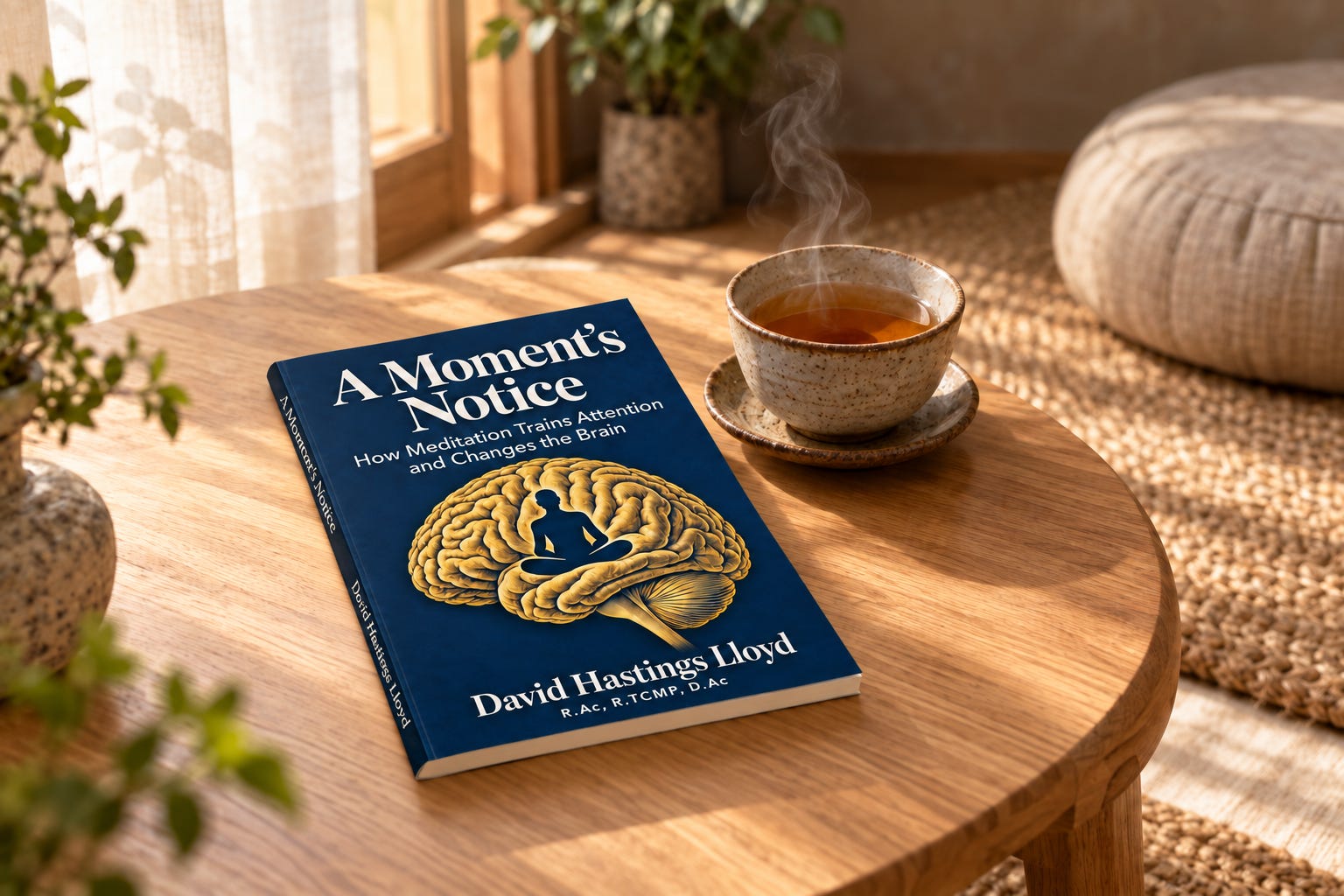
A Moment’s Notice: How Meditation Trains Attention and Changes the Brain
You sit down to follow your breathing, then discover that you are planning tomorrow or replaying a conversation. Recognizing that distraction and redirecting your attention are central to meditation practice.
In A Moment’s Notice, I explain what happens in the mind and brain as these skills develop. Drawing on neuroscience and clinical experience, I explore why attention wanders, how an urge can override an intention, and how practice helps you recognize familiar reactions before you act.
The book explores:
How meditation trains attention.
Why thoughts and emotional reactions become habitual.
How to work with persistent thoughts, strong emotions, and discomfort.
Why a difficult meditation session can still represent progress.
How to apply these skills in relationships, work, and everyday decisions.
The final chapter brings the ideas into a guided fifteen-minute practice, with practical instruction on posture, breathing, and working with distraction.
Whether you are beginning meditation or developing an established practice, the book helps you understand what you are training and how to practice with greater confidence.
Works Referenced
Bernardi, L., Gabutti, A., Porta, C., & Spicuzza, L. (2001). Slow breathing reduces chemoreflex response to hypoxia and hypercapnia, and increases baroreflex sensitivity. Journal of Hypertension, 19(12), 2221–2229. https://doi.org/10.1097/00004872-200112000-00016
Eunice Kennedy Shriver National Institute of Child Health and Human Development. (2017, December 30). Infographic: The placenta (text alternative). National Institutes of Health.
National Heart, Lung, and Blood Institute. (2022, March 24). How the lungs work: How your body controls breathing.National Institutes of Health.
Olson, S. A. (2019). Embryonic breathing: The Taoist method of opening the Dan Tian. Valley Spirit Arts.
The primordial breath: An ancient Chinese way of prolonging life through breath control (J. Huang & M. Wurmbrand, Trans.; Vol. 1). (1987). Original Books.
University Hospital Southampton NHS Foundation Trust. (2023, February). Breathing pattern disorders (Version 3).
Yang, J.-M. (2022). Qigong meditation: Embryonic breathing: The foundation of internal elixir cultivation (2nd ed.). YMAA Publication Center.