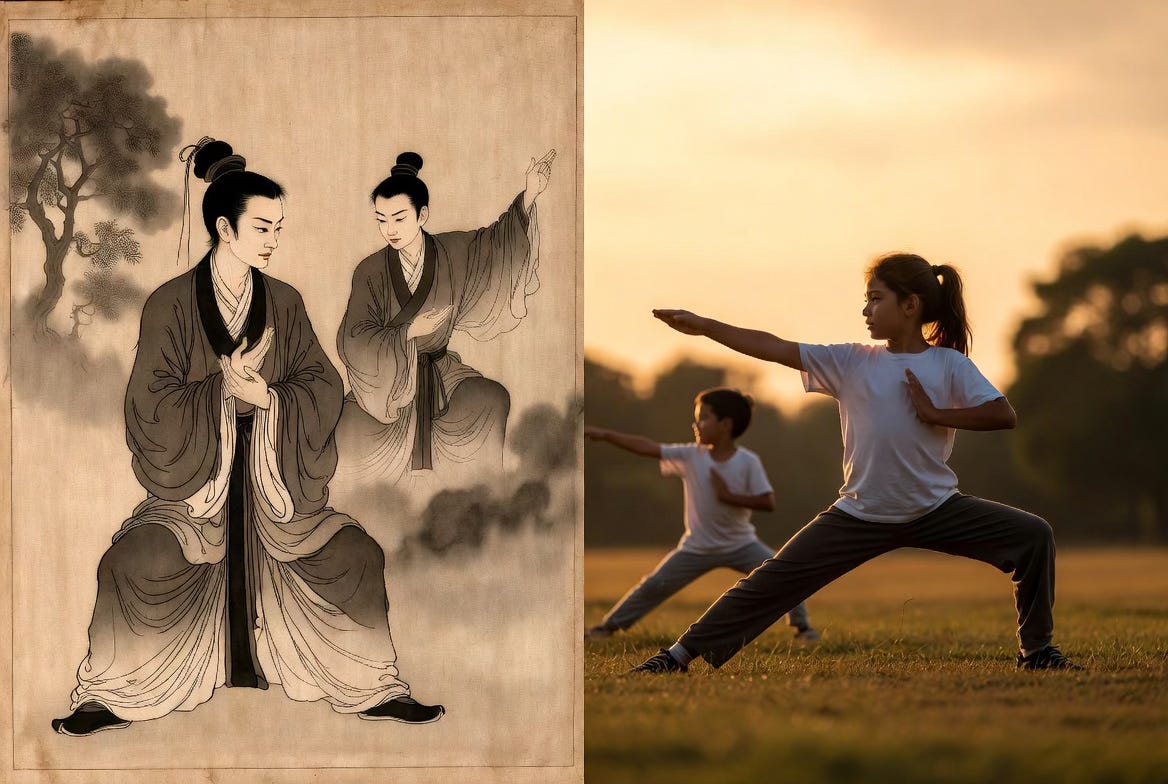
Can Tai Chi, Baduanjin, and Yijinjing Help Children with Learning Difficulties?
New Research Offers an Intriguing Answer
Learning difficulties run deeper than poor grades. Children who struggle in school often deal with frustration, bruised confidence, rising anxiety, and the painful feeling that they are always falling behind. Families and teachers typically turn to tutoring, extra supports, or behavior plans. Those are valuable tools, yet they still miss part of the picture.
Learning depends on more than raw intelligence. It relies on attention, memory, emotional regulation, and the ability to stay focused when things get tough. In short, it is as much about self-regulation as it is about smarts.
A 2025 study asked whether traditional Chinese mind-body practices such as Tai Chi, Baduanjin, and Yijinjing could strengthen these deeper foundations in children with learning difficulties. The results were more promising than many expected.
What Researchers Studied
Published in Behavioral Sciences, the study involved 72 children aged 9 to 11 identified with learning difficulties through academic performance and screening. Researchers randomly assigned them to four groups: Tai Chi, Baduanjin, Yijinjing, or a control group that continued regular physical education such as rope skipping, throwing games, and similar activities.
The three intervention groups practiced 45 minutes per session, three times a week, for 12 weeks. Researchers measured changes in academic rankings, teacher-rated learning behaviors, executive function (especially inhibition and working memory), and brain connectivity via functional near-infrared spectroscopy. This safe, non-invasive technique tracks blood flow changes in the brain.
This multi-layered approach made the study stand out. It went beyond self-reports to include observable behavior, school performance, and measurable brain changes.
Main Findings
All three mind-body groups outperformed the control group in key areas tied to learning. Children practicing Tai Chi, Baduanjin, or Yijinjing earned better teacher ratings and higher academic rankings than those doing standard PE. That alone suggests these structured practices offer something extra beyond ordinary movement.
Tai Chi showed particular strength. Its group improved most in inhibitory control: the ability to resist distractions, pause impulses, and stay on task. These children also displayed stronger gains in prefrontal brain connectivity. Those are the networks involved in planning, attention, decision-making, and self-control.
The Numbers
Teacher-rated learning behavior scores (Pupil Rating Scale) reached a median of 76 for Tai Chi, 71 for Baduanjin, 73.5 for Yijinjing, and just 65 for the control group. Academic performance rankings were also higher across all three intervention groups (medians of 15.5, 16, and 17 respectively) compared with 11 in the control group.
On inhibitory control, lower scores meant better performance. The Tai Chi group achieved a median of 7, compared with 11 for both Baduanjin and control groups. This is a meaningful gap in a skill that directly affects classroom focus.
Brain connectivity improved notably in the Tai Chi group. Connections from the left dorsolateral prefrontal cortex to BA8 rose from 0.011 to 0.058, with similar gains on the right side. These technical shifts point to better communication in the brain’s control networks.
How It May Work
These traditional practices blend elements rarely found together in typical school exercise: coordinated movement, sustained attention, slow deliberate pacing, and natural breath regulation.
Movement boosts circulation and nervous system health. Remembering sequences and maintaining posture demands focus. The unhurried pace can calm mental chaos. Coordinated breathing helps balance the nervous system and lower stress. Together, they train both body and brain in ways regular PE often does not.
Why Tai Chi Stood Out
Tai Chi places continuous demands on balance, sequencing, spatial awareness, and smooth transitions between postures. Children are not just moving. They are actively organizing their movement. This extra layer of cognitive challenge appears to give the prefrontal cortex a more targeted workout. It helps explain the stronger results in self-control and brain connectivity. Baduanjin and Yijinjing still delivered solid academic benefits, but Tai Chi led in executive function measures.
Practical Meaning
The takeaway is clear. Not all movement is equal. For children facing attention issues, impulsivity, or academic persistence challenges, practices that combine coordination with self-regulation may offer unique benefits.
These low-cost, low-risk programs could complement, not replace, tutoring and educational supports. Schools might consider adding short Tai Chi or Qigong sessions a few times weekly. Families could also explore age-appropriate home practice with proper guidance.
Important Limitations
With 72 participants, this is a modest study: promising but not definitive. The 12-week period leaves questions about long-term effects. Results may not apply to every child or every school setting. Some measures relied on rating scales that carry inherent subjectivity. One unexpected finding (no clear Tai Chi advantage in working memory) reminds us that these effects are complex.
Still, this research marks a valuable early step.
Final Thoughts
Modern schooling often treats body and mind as separate. Kids sit to learn, then move on the playground. This study hints at a wiser approach. Certain movements can directly nurture the mental skills learning requires.
Tai Chi, Baduanjin, and Yijinjing are ancient practices. Yet the question they address feels thoroughly modern. Can thoughtful movement reshape attention, self-control, and brain function for children who need it most?
Early evidence suggests the answer may be yes. And if that holds, some of tomorrow’s most effective educational tools might look surprisingly old.
APA Reference
Wang, X., & Li, H. (2025). Effects of different traditional Chinese mind-body exercises on learning abilities, executive functions, and brain connectivity in children with learning difficulties. Behavioral Sciences, 15(3), 303.
Like what you read? Keep exploring…
If this post resonated with you, you may enjoy my new book:
The Science of Medical Qigong: How Breath, Movement, and Attention Transform the Body
This book examines the growing body of scientific research exploring how Qigong practice influences human physiology. Drawing from clinical trials and experimental studies, it explains how coordinated breathing, posture, movement, and focused attention interact with the body’s regulatory systems.
The book explores research on:
• autonomic nervous system regulation
• cardiovascular function and blood pressure
• respiratory mechanics and lung capacity
• sleep quality and recovery
• inflammatory and immune signaling
• brain function and neural plasticity
• cognitive performance and mental health
Rather than presenting Qigong through mystical language, The Science of Medical Qigong approaches the subject through physiology, neuroscience, and clinical research, offering a clear explanation of how regular practice can influence the coordination and harmony of the body’s systems.
Available now in print and Kindle formats.


